As the food-as-medicine movement reshapes the grocery aisle, the food and beverage industry is experiencing a shift in how nutrition drives commercial strategy. For decades, better-for-you products were defined by exclusion such as the removal of sugar, calories, artificial ingredients or ultraprocessed inputs. Today, propelled by rising healthcare costs, chronic disease management and shifting eating behaviors linked to GLP-1 medications, consumers are demanding foods that proactively deliver measurable health outcomes.
According to a recent report from CoBank’s Knowledge Exchange, the global food-as-medicine market — valued at roughly $26.5 billion in 2025 — is projected to grow at a 12.2% compound annual rate through 2033, reaching $66.4 billion. While packaged food brands race to formulate functional products, the push for clean, additive-free nutrition puts fresh produce and dietary fiber squarely in the spotlight.
Fresh Trends Data Reveals Strong Health Intent, Though Price Remains a Hurdle
That macro market momentum is already playing out at the checkout counter. Consumer behavior data from The Packer’s Fresh Trends 2026 report suggests the food-as-medicine trend is no longer a niche concept; it has become a mainstream driver of fresh produce purchasing. Among the 71% of U.S. grocery shoppers who say they are eating more fresh produce today than they were five years ago, an overwhelming 82% cite health reasons and getting more nutrients as their primary motivation — and nearly 1 in 4 (25%) say their doctor specifically suggested they eat more produce.
The health imperative is so strong that it now rivals cost as a purchase driver: 77% of all shoppers surveyed for Fresh Trends 2026 say health is a priority when buying produce, either unconditionally (25%) or whenever a good deal is available (53%). Perhaps most telling for retailers and growers building organic programs around health positioning: 61% of shoppers who buy organic cite nutrient content and health as a core reason, and 55% of all shoppers say they would purchase more organic produce if price were not an obstacle — a figure that points directly to the gap between health-driven intent and everyday budget reality.
The Clean-Label Advantage of Fresh Produce
As manufacturers experiment with bioactive compounds and functional additives, many consumers still prioritize whole, minimally processed foods to avoid artificial ingredients altogether. Fresh fruits and vegetables hold a built-in competitive edge in this landscape.
“An essential aspect of the food-as-medicine movement will be finding options that are as healthy as possible, whether it is fresh produce or functional foods; the key to many consumers being the avoidance of additives,” says Billy Roberts, senior food and beverage economist for CoBank. “That would be where fresh produce can really stand out among consumers, who have historically regarded ‘fresh’ and ‘natural’ options as healthier.”
Grocery retailers are actively capitalizing on this connection by linking fresh produce directly to preventive healthcare and customer loyalty. Hy-Vee’s Nourishing Change initiative and Smart Benefits pilot program, for example, provide shoppers with monthly stipends specifically for fruits and vegetables — incentivizing fresh produce purchases through health screenings and dietitian guidance. Similarly, industry leaders note that truly holistic nutrition requires stronger regional and state-by-state collaboration that keeps agricultural growers directly connected to retailers, manufacturers and dietitians.
Fiber Steps Out from Protein’s Shadow
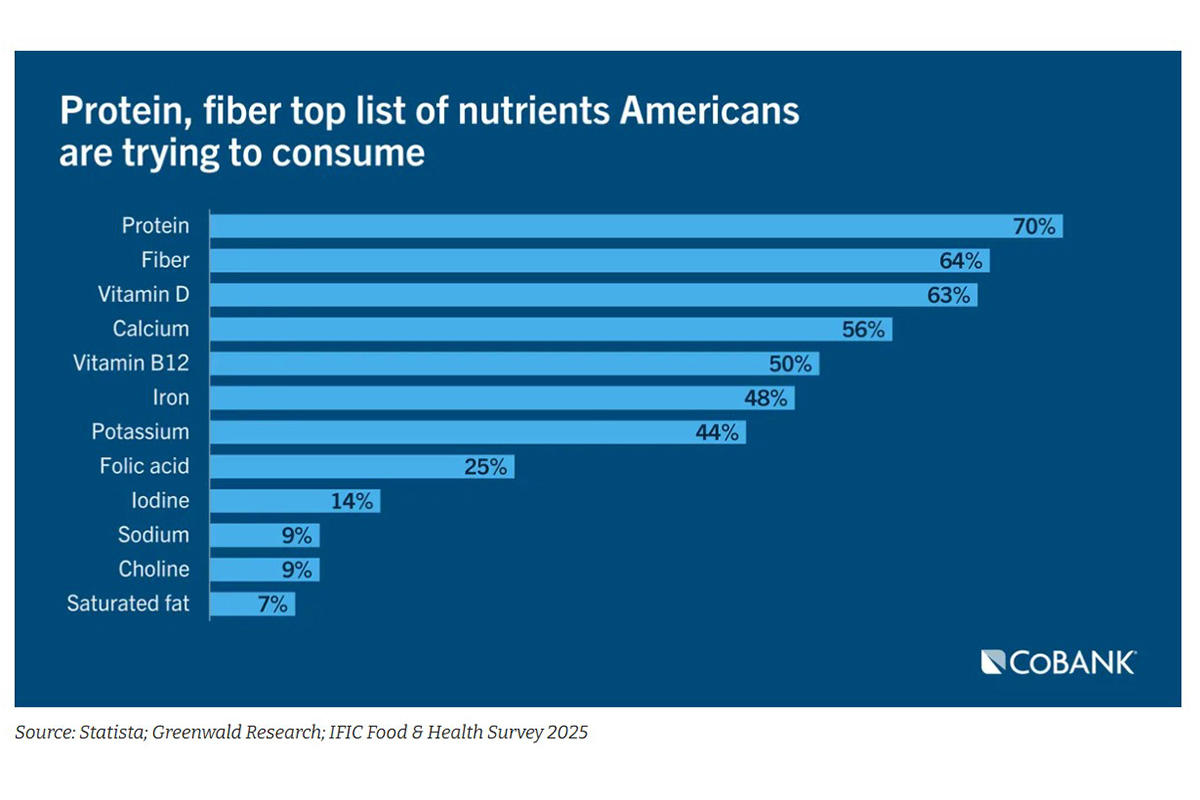
While protein remains the dominant macronutrient priority for shoppers seeking muscle support and sustained energy, fiber has rapidly emerged as the next major growth frontier. Nearly two-thirds of consumers (64%) report actively trying to increase their fiber intake to support digestive wellness, blood glucose management, satiety and gut health.
In the packaged goods space, demand for fiber is already translating into strong retail performance: SPINS data shows that snacks with 6 to 9 grams of fiber saw a 7% jump in dollar sales over the past year, while repeat purchases for fiber-forward granola bars and crackers surged 116% and 26%, respectively. However, packaged food manufacturers often face formulation hurdles, as adding high levels of functional fiber can compromise taste, texture, moisture and shelf stability.
Fresh produce bypasses those formulation challenges entirely, offering an untapped opportunity to close a persistent national nutrition gap.
“Certainly, protein remains top of mind for consumers in terms of the macronutrient they seek in foods, but fiber’s role in a healthy diet cannot be denied, whether in terms of satiety, supporting gut and heart health, etc.,” Roberts says. “Consumers are increasingly aware of not only the benefits of fiber, but of the benefits of the most naturally fiber-rich foods, an area where fresh produce can resonate. Considering only about 7% of American adults consume their daily recommended intake of fiber, according to the American Society of Nutrition, there is definitely an opportunity for fiber-rich fruits and vegetables to support food as medicine efforts and healthier lifestyles, overall.”
Scaling the Fresh Supply Chain
Meeting this rising demand for fiber-rich, whole foods will require strategic investment across the agricultural supply chain. As CoBank’s report notes, expanding the consumption of fruits, vegetables and minimally processed foods places increased demands on agricultural production, cold-chain infrastructure and distribution networks.
Ultimately, the strongest commercial opportunities in the food-as-medicine era will emerge where medical relevance, affordability and consumer trust intersect. By championing naturally fiber-rich fresh produce alongside innovative, science-backed functional foods, growers, brands and retailers can make proactive, everyday nutrition accessible across the entire grocery store.