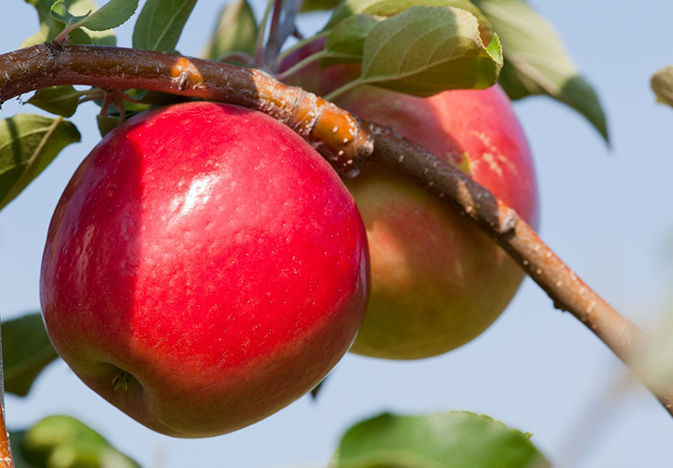
Apple breeding is quite a long game, says Matt Clark, associate professor in the University of Minnesota’s Department of Horticultural Science and director of research at the Minnesota Landscape Arboretum. The university’s renowned fruit breeding program has created household names such as Honeycrisp and SweeTango as well as Rave, Zestar and countless others.
Clark says he and his university colleague, David Bedford, senior research fellow and apple breeder, have varieties in different stages of development that will likely be released by their successors.
“The work we’re doing in 2025 — the breeding decisions we’re making now are for 2050 and beyond,” Clark says. “We try to be thinking about the future and setting up the next Matt Clark and David Bedford team in 25 years. I keep saying, the crosses I’m making now, I hope to be retired by the time they’re released.”
Clark says Bedford, known for his pivotal role in developing Honeycrisp, also calls variety development a numbers game. Clark says his research team moved forward with 11 selections this year and discarded more than 4,000 crosses. The 11 that advanced still need to go through vigorous assessments to continue in variety development.
High Stakes of Variety Selection
Honeycrisp’s ascent from pick-your-own darling to consumer favorite is nothing that any fruit breeder could have predicted, but it set in motion the current path of both variety management and variety development.
While managed varieties offer growers the chance to grow something exclusive and brands to control the final product, Clark says what’s missing is the direct-to-consumer aspect of a licensing model in many cases.
The University of Minnesota recently launched Superior Fruit Innovations, a grower-focused license model that opens its catalog of varieties to growers of different scales. While a few organizations have opened varieties to pick-your-own and direct-to-consumer markets, the university felt it was important to offer something with its own noteworthy IP, Clark says.
“It’s strategic for us to be thinking about getting varieties — that we’ve invested a lot of time and energy into — producing exceptional eating-quality apples that they can grow and direct-market to their customer, who they know,” he says. “At the same time, they don’t necessarily compete with wholesale growers who are producing for a year-round market.”
New Model for Flavor
Clark says, in many ways, some of the varieties developed for the direct-to-consumer market won’t be successful wholesale or commercial apples.
They might have thinner skin and bruise easily, but the flavor might be out of this world. Instead of scrapping a variety because it can’t be successful from grower to packer, this licensing model helps set the varieties up to a place where they’ll shine: in a farm market where a grower or a retail staff member can help consumers find flavors tailored to their tastes and expectations.
“Growers know their customers because they see them and they come back every week and buy these products,” he says.
Superior Fruit Innovations has just released Big Flirt and Super Snap. Clark says Rave, also known as First Kiss, is also a part of this licensing agreement.
Clark says Super Snap is “ultracrisp.” While the University of Minnesota classifies Honeycrisp as crisp, there are two other categories the breeding program classifies as crisp.
“It’s elevated, and it’s possible that the only way you’re going to get that is going to these direct marketers, because who knows what it’s like after three months, five months; we don’t have enough data, what the production scale is like,” he says. “But for us, we’re like, ‘Wow, that is something that consumers are going to remember.’ It’s crispier and juicier than Honeycrisp.”
Clark says there are more releases planned, including more in the direct-to-consumer marketplace.
“We have more of this pipeline because we have some that we know would never make it through a packinghouse,” he says. “They have this tender, crisp, super juicy, almost meltinglike texture. The only way to have that experience really is to pick it yourself and eat it.”
Cultivating the Future of Fresh
Clark says success as a fruit breeder is an interesting notion, as many may see wide adoption as a success, though he also sees sustainability as part of success. This means disease resistance, varieties that are easier for growers to grow and more.
“I came into this field thinking success as farmers is making money and growing things that people want, trying new things and diversifying their farms,” he says. “Success also looks like making sure I can pay for my staff and take care of the orchard and continue the innovation.”
And Clark says this licensing model will help growers access more varieties.
“We think that this model is useful,” he says. “We’ve basically set up our own in-house club, and it’s not an exclusive club, but it’s a way of saying, ‘We want you to be successful; we want you to try these varieties,’ and mirroring in some ways what the Midwest Apple Improvement Association is doing but not being exclusive like what we’ve done on some of these other varieties.”
While Honeycrisp and SweeTango put the University of Minnesota on the map for apple breeding, Clark notes the program’s reach extends to table grapes, blueberries, strawberries and raspberries. Having spent the last decade focused on the university’s table grape breeding, Clark is now seeing those efforts come to fruition. Several new cold-hardy varieties, including the LumiGlo grape, are being released through the Superior Fruit Innovations model.
“They have the most fantastic flavor,” he says. “If you’ve never tasted a grape that tastes something like pineapple and strawberry and guava together, we’ve got that. Does it have the best texture? No. Does it have a little bit of a seed trace that you might notice? Yeah, but the flavor is awesome. And why sit on that? Let’s try to get growers to produce this.”
Clark says he hopes the licensing model will help support the continued effort of land-grant university breeding programs, though the goal is also to continue to push the envelope of flavor to draw more consumers to fresh produce.
“It’s a win to get really tasty varieties into the mouths of consumers who should be eating more fruits and vegetables,” he says. “And then I think they’re going to have an eating experience that they’re going to enjoy.”
As for the crosses he’s making today, Clark says he just hopes his successor will agree with the direction the program moves toward.
“We’re already thinking about who [is] your successor and how are they going to use this information and hope that they agree with our decisions that we’re making,” he says. “We’re hoping that we’re doing the right thing and making good decisions.”