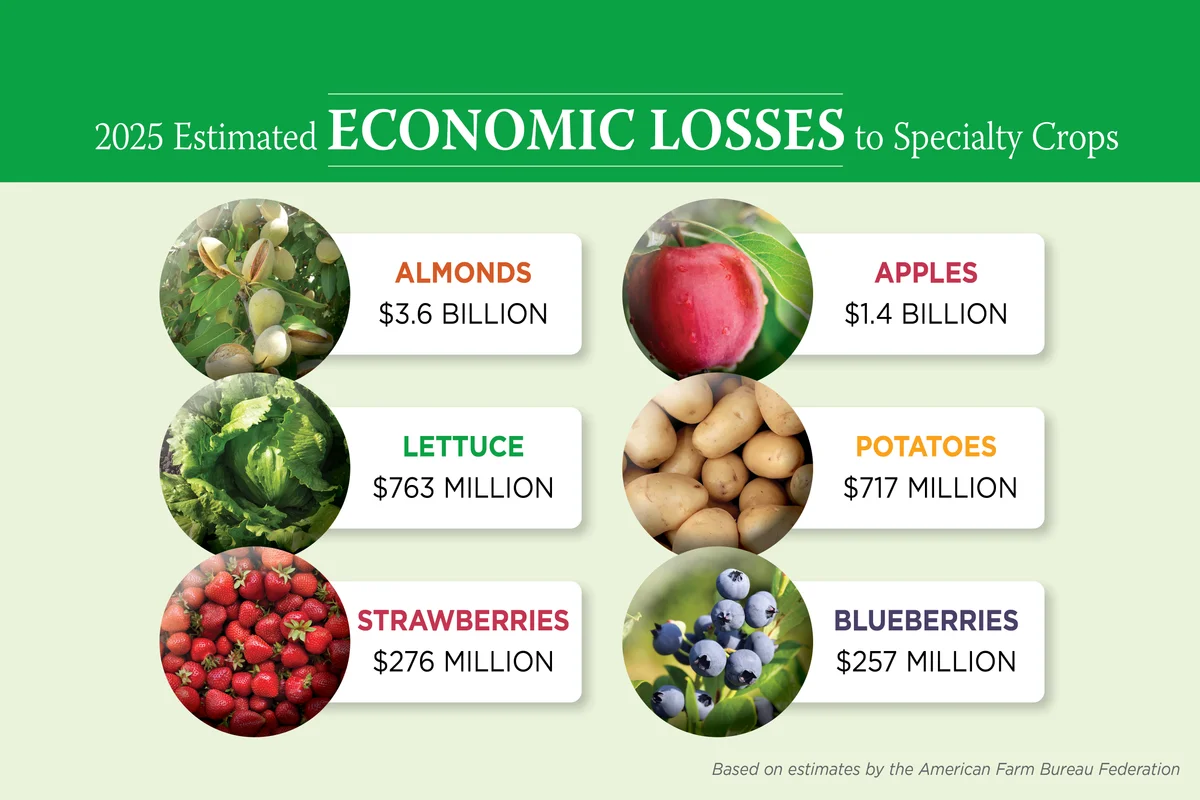
Economic losses to specialty crops last year were on a level that can put farming operations out of business.
The American Farm Bureau Federation estimates $3.6 billion in economic losses for almonds, $1.4 billion for apples, $763 million for lettuce, and $717 million for potatoes alone.
Specialty crop leaders this week renewed their calls for urgent economic support for U.S. growers and shared their disappointment after the U.S. House released final spending bills Jan. 20 that did not include aid for American specialty crop producers.
While the Specialty Crops Farm Bill Alliance (SCFBA) says specialty crops, including fruits, vegetables, tree nuts, nursery, greenhouse and floriculture products, generate more than $75 billion annually in U.S. agricultural cash receipts, account for more than one-third of all U.S. crop sales and support rural economies nationwide, under the current USDA Farmer Bridge Assistance program, $11 billion is allocated to row crops, and only $1 billion is reserved for specialty crops and other commodities, with key details on eligibility, payment and timing still unresolved.
“It’s a challenge with specialty crops to come up with aggregated data across all the more than 300 different commodities, but the American Farm Bureau Federation has done good analysis related to specialty crops,” says Kam Quarles, CEO of the National Potato Council and SCFBA co-chair.
“Effectively Farm Bureau is saying that if you’re going to have a relief plan rollout, specialty crops should be about a third of whatever Congress spits out,” he says.
Word on Capitol Hill is Congress is contemplating a total of $15 billion in assistance, SCFBA says.
“We agree with the one-third of whatever Congress comes up with, but also the package has to be large enough to make a material impact,” Quarles says. “The specialty crop industry has told Congress that we need no less than $5 billion in economic relief for specialty crops in order to positively move the needle for growers.
With food affordability still a top focus for many consumers, what happens to the cost of fruits, vegetables and other grocery staples if specialty crops don’t receive the aid they desperately need?
“We’re facing an unprecedented economic crisis in the U.S. right now for agriculture, and it’s not just specialty crops, it’s broader than that,” Quarles says. “If you have growers that are going out of business due to this economic crisis, that’s going to further impact supplies of commodities. It’s going to impact prices, and it will add to the affordability issue.”
Last week SCFBA joined American Farm Bureau Federation and ag organizations across the U.S. in penning a letter to Congress highlighting record-high input costs, labor shortages, weather challenges and historically low market prices that have caused farmers to face negative margins and nearly $100 billion in losses nationwide.
Reasons for Optimism
Quarles says feedback from both the House and Senate appropriations committees on the specialty crop crisis has been encouraging.
“They absolutely understand where we’re coming from,” he says. “The other thing to remember is that there have been fundamental changes in tax policy that were put into law last summer, and they’ve already started to come online. And when some of the trade agreements that have been discussed are finalized, they also could create a more competitive environment, along with the tax policy.”
But could this be a case of too little, too late?
“These policy recommendations could create a much better environment in the future, but if you’re out of business before you ever get to that better environment, it just doesn’t matter,” Quarles says. “So that’s the imperative of this economic relief; we need a short-term safety net or a bridge, whatever you want to call it, to get producers from this crisis into an area where they can start to take advantage of some of these changes.”
Another bright spot, he says, is how effectively the industry, along with he and his SCFBA co-chairs, including Cathy Burns, CEO of the International Fresh Produce Association; Mike Joyner, president of the Florida Fruit and Vegetable Association; and Dave Puglia, president and CEO of Western Growers, are working together.
“The industry has really rallied together under the umbrella of the Specialty Crop Farm Bill Alliance,” Quarles says. “Twenty years ago, this was not the way the industry worked, but the alliance has created a kind of muscle memory, where we know how to all get around the table. We know how to look at a particular situation, develop a strategy, and then everybody disperses out to where they have strengths across the United States.”
“It has really been the best of the fresh produce industry rallying together to try to get some relief for our grower members,” he continues. “I’m very hopeful that we’re going to get something positive done here.”