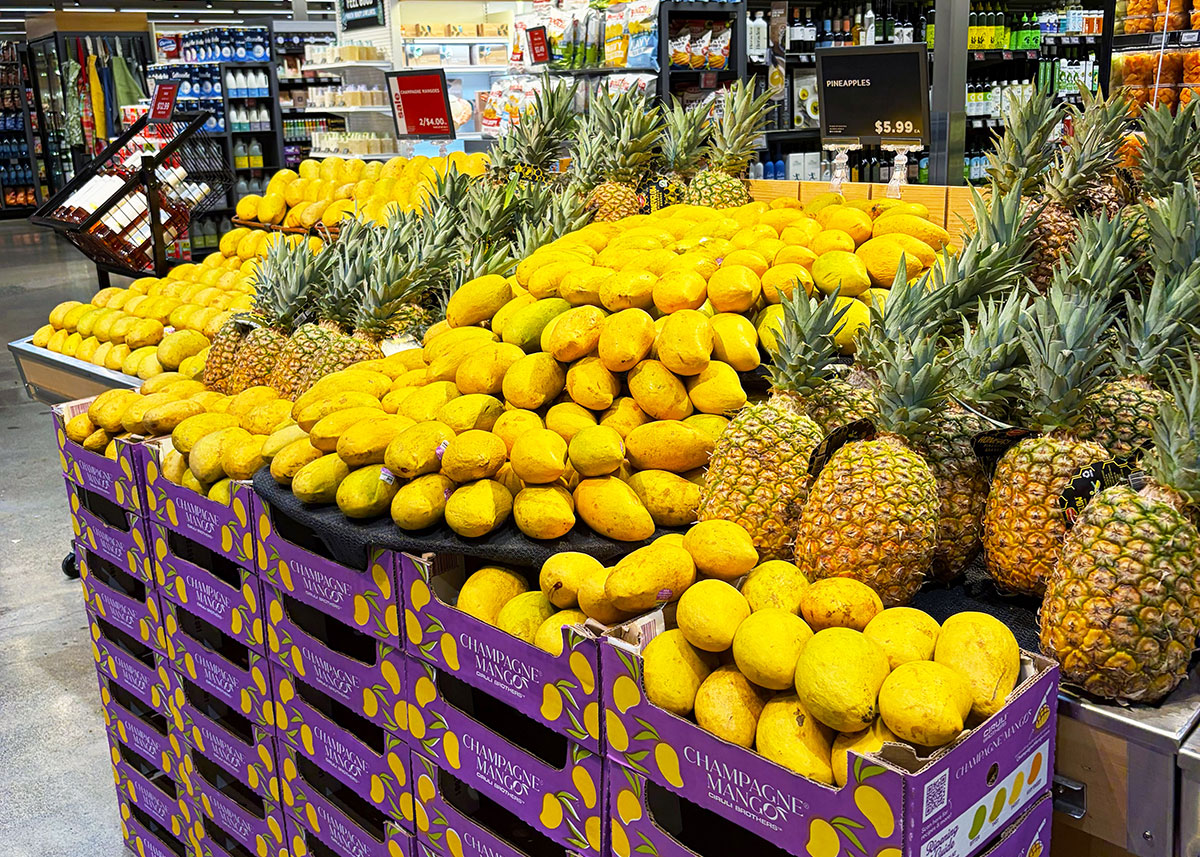
Merchandising tactics like creating huge displays and focusing on core volume drivers might help retailers move more mangoes, distributors say.
“We have always contended that when you get really, really large displays out there, you move more fruit,” says Chris Ciruli, partner at Rio Rico, Ariz.-based Ciruli Bros.
“We’re talking about trying to convince retailers to go to 8- to 16-foot displays — something very impressive and eye-catching when you walk in the store that gives you that impulse buy,” he says.
Ciruli says he’s seen that technique work firsthand and adds that the National Mango Board plans to conduct research to back up that claim.
During the late winter and early spring, when weather issues might still exist in parts of the country, selling mangoes can be a challenge, he says, even though volume is picking up.
“But when you see these large displays of ripened fruit on display, it gives that impulse buy, and we do see fruit move better,” Ciruli says.
Display size has everything to do with boosting mango sales, agrees JoJo Shiba, West Coast director for GM Produce Sales LLC, Hidalgo, Texas, especially if those displays appear at the right time.
For example, honey mangoes will be peaking through the third week of April, she says. So, now is the time to go in on honey mango displays.
Sebastian Sanchez Jr., director of sales and procurement for Santis Produce LLC, Pharr, Texas, recommends focusing on core volume drivers — tommy atkins, kent and keitt varieties — along with honey (ataulfo) mangoes.
“Keeping the set simple but effective helps drive movement and avoids overwhelming the customer,” he says.
He adds that it’s a good idea to display a mix of bulk and packaged product.
“Bulk drives impulse purchases and strong volume, while consumer packs provide convenience and consistency, helping build customer confidence and repeat purchases,” Sanchez says.
When it comes to consumer packs, Ciruli suggests cardboard packs or clamshell containers rather than plastic bags.
“We still see a lot of retailers using plastic bags with mangoes,” he says. “Mangoes don’t ship well in bags; they don’t breathe well in bags.”
Ciruli Bros. offers a 5-pound cardboard consumer pack as well as clamshell containers.
In ethnic communities, retailers may be able to sell mangoes by stacking boxes outside the entrance to the store or just inside the door, he says.
“It really helps push volume to have large displays with boxes involved,” Ciruli says.
Cross-merchandising is another way retailers might sell more mangoes, distributors say.
“Mangoes pair extremely well with other tropical items like pineapples, which we also supply under our label,” Sanchez says.
Retailers can cross-merchandise mangoes with limes and chili-lime seasonings to enhance the overall tropical display and drive additional sales, Sanchez adds.
Ciruli also suggests cross-merchandising mangoes with complementary fruit items like avocados, Hispanic-style foods or Hispanic food flavorings.
“There are definitely a lot of cross-merchandising ideas we’re trying to push to get mangoes in more places than just the produce section,” he says.
Shiba suggests merchandising all or some mangoes with citrus items because of their high vitamin C content.
Some retailers started that during the COVID-19 pandemic and saw sales spike, she says.
Displaying both red and yellow mangoes is another good merchandising tip, she says, and ideally, more than one size.
No matter the mango variety, Lavanya Setia, director of marketing for the National Mango Board, Orlando, Fla., says it’s best to avoid storing whole mangoes in freezers or refrigerators, and she suggests using mangoes to complement produce items such as berries (for smoothies) or avocados.
And don’t overlook opportunities with organic mangoes.
“Offering organic mangoes gives customers the ability to choose and expands your reach to health-conscious shoppers,” Sanchez says. “Having that option available is increasingly important in today’s retail environment.”











.png)