In the heart of California's Central Valley, the stakes for the agricultural community have transitioned from simple harvest cycles to the complexities of global economic survival.
For Robert Verloop, CEO and executive director of the California Walnut Board and Commission, the role has evolved beyond moving a commodity; it is now about managing a global health brand in an era of unprecedented volatility. As part of The Packer's executive series, the narrative of the industry recently shifted from the sunny optimism of California's groves to the gritty reality of international trade and a rapidly changing consumer landscape.

The Vision: A Corner Turned — and a Pause
Early in 2026, Verloop commented that the industry was “turning a corner.” A massive, high-quality crop was hitting the market, and trade barriers were falling. But as Verloop now says, the global stage had other plans.
“I have to be honest with you,” Verloop says, reflecting on his previous optimism. “Today, with the war in Iran, I think I would put a pause on that statement. We had an extremely large crop, which was phenomenal in quality, but it was so good that we had too much of it. We produced 400 million pounds more walnuts than we did in 2024.”
The disruption isn't just a matter of logistics, he says; it's a direct hit to the bottom line.
“Unfortunately, when you have a large crop like we always see in agriculture, supply and demand do play a big role in pricing structure, because we've got to move through the crop. And this year, we started out with acceptable prices, but it slipped a little bit. And then the war certainly has added to that,” Verloop says. “And the disruption … we had a lot of diverted loads that were not able to be delivered as had been scheduled. We estimate that the problem was a cost to the industry in excess of $15 million, including fees and transfer costs and lost value, and it disrupted the market flow.”
#WalnutsAreProduceToo: Changing the Retail Map
Despite the geopolitical headwinds, Verloop is relentless about repositioning the walnut in the mind of the shopper. He wants to drag the walnut out of the “pantry staple” shadows and into the vibrant light of the produce department.
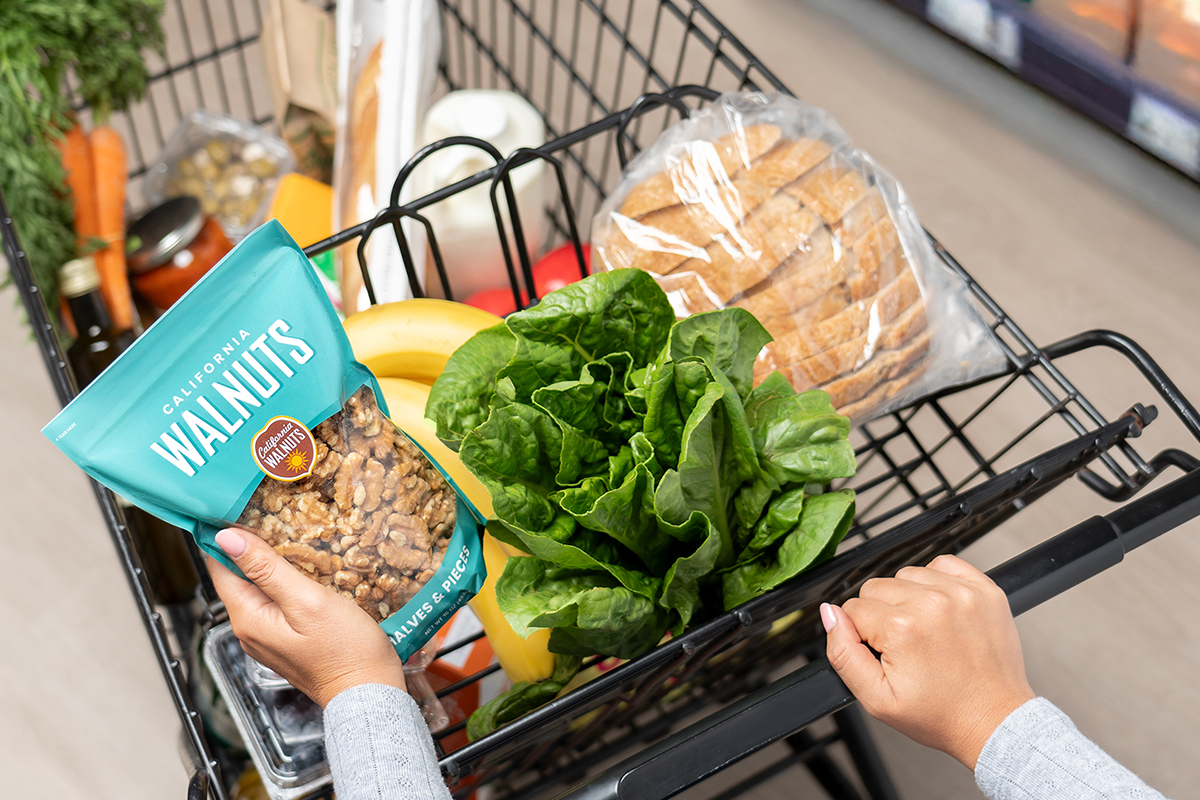
“My business card says, #WalnutsAreProduceToo,” he says. “They grow on trees. In many parts of the world, they consider walnuts a dried fruit. We started three and a half years ago on a journey to move walnuts out of the preferred position of being in the baking aisle.”
Verloop says the strategy is backed by hard data that proves walnuts are a powerhouse for retailer profitability:
- Research shows 76% of shoppers are more likely to buy walnuts when they are displayed with produce.
- When walnuts are present, the average market basket value jumps to $55 — a 132% increase over the average cart.
- Fresh produce comprises eight of the top 20 items purchased alongside walnuts, with bananas, berries, tomatoes and apples leading the list.
- Most fresh produce items show a “strong affinity” with walnuts, indexing over 200, which suggests shoppers naturally view them as complementary ingredients.
Verloop explains the logic of moving toward this Whole Food 2.0 movement as a way to meet the consumer where they already are. While snacking has become the No. 1 way shoppers use walnuts, the industry still faces an education gap regarding freshness. Currently, 79% of shoppers store walnuts in their pantry, while only 19% use the refrigerator or freezer to maintain peak flavor, he says.
“With the focus on ultra-high-processed [foods], [the produce department] is where the consumer is looking,” Verloop says. “We think it's the right place to be.”
The ‘Feel-Good' Lifestyle: Marketing to Gen Z
To reach a younger, more skeptical demographic, Verloop has pivoted away from clinical health claims toward a broader, lifestyle-driven narrative: the “Feel Good” campaign.
“We're shifting our messaging to be more reflective of the California lifestyle,” Verloop says. “We want moms to feel good about what they're doing for themselves, feel good from a bodily perspective, but then also feel good about what they do for their kids and their family in the meals they're preparing.”
This shift includes a heavy emphasis on culinary innovation.
“We actually have a chef on staff ... Robert Danhi, our chef in residence. He's at the Culinary Institute of America this week helping that inner cooperation between healthy cooking and introducing walnuts,” Verloop says.
Beyond the kitchen, Verloop is tapping into the social nature of the younger generation.
“The younger generation is really into sharing food and food discovery. I think about the growth of charcuterie plates ... walnuts play a really good role in that,” he says. “We feel that's part of the ‘Feel Good' attitude — bringing people together, sharing our differences, but also our similarities. Food does that.”
The Legacy: Fighting for the Grower
Verloop returns the conversation to the men and women in the Central Valley who are feeling the squeeze of $9 diesel and 1,300% increases in regulatory costs, according to a study conducted by California Polytechnic State University, San Luis Obispo, for the wine industry.
Verloop's vision for his legacy is one of survival and eventual prosperity.
“Walnuts are actually, for the consumer, they seem to be a high-priced item, yet for the growers, they're losing money,” he says. “We've got to find ways to streamline the distribution networks to make sure that consumers see value, but the growers are able to sustain their business practices.”
His goal is simple, yet impactful: “Our job is to get more consumers to buy more walnuts more often ... and hopefully for a better price.”