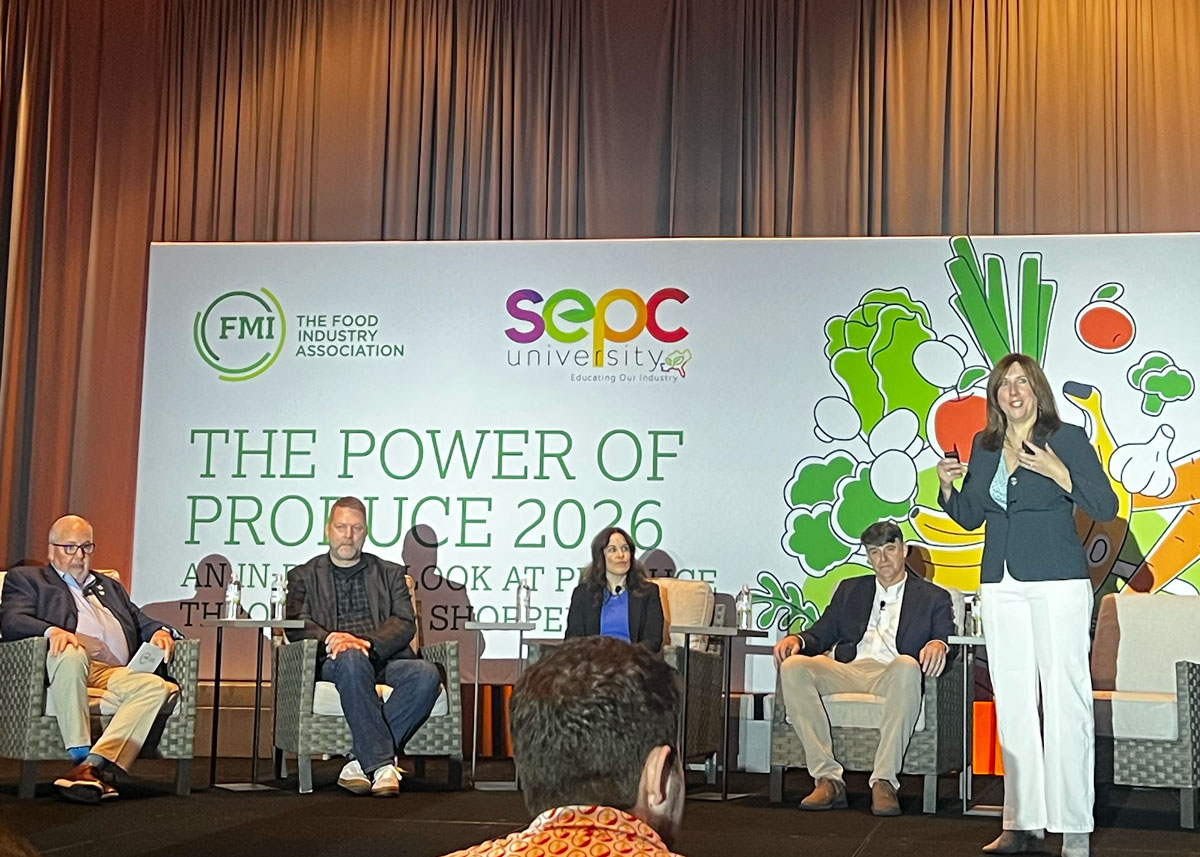
ORLANDO, Fla. — A central theme of this year’s “Power of Produce” presentation at the Southeast Produce Council’s Southern Exposure is the tension between consumer perception and food costs.
The presentation, which was part data, part conversation, began with 210 Analytics President Anne-Marie Roerink highlighting the trends in data and Rick Stein, vice president of fresh for the Food Industry Association, leading an in-depth discussion with Shanan Cox, senior director of produce for Sam’s Club; Andy Hamilton, CEO of Markon Cooperative; and Chris Keetch, director of produce and floral for The Giant Co.
Roerink delved into the tension by showing how the price of food and beverage items has increased more than 40% since 2019 and consumers are now shifting dollars from foodservice to retail.
“In the produce department, we’re up in dollars, up in units, up in volume,” she says. “That is a really, really good accomplishment, really only outdone by the meat department, and that is because Gen Z and millennials at the moment are moving into that meat department very aggressively.”
Grocery trips are also up, she says, noting that 93% of consumers have made changes in the way they shop for groceries. However, Roerink points out a cautionary trend: While produce trip frequency has grown 2.7% (with consumers buying one or two times a week), it is lagging behind the total store’s growth of more than 5%.
“What consumers are doing is to really try to buy as little as they need, buy exactly what they need, skip non-essentials, and that has led to buying fewer units per trip,” she says. “They are looking to make sure that every dollar they buy is a dollar they consume. So, they’re buying fresh even differently from the rest of the store.”
Hamilton says he’s seen the impact on consumer spending in foodservice, though the end of 2025 was much stronger for foodservice.
“With foodservice ... it’s highly correlated to how the economy is going in general, because going out to eat at a restaurant is the most disposable or discretionary thing almost that you can do out of a household’s budget,” he says. “If you’re feeling good about your job, feeling good about your economic situation, you know, that is perfect for foodservice.”
Fighting Friction With Everyday Value and Kitchen Education
Roerink says consumers have also shifted purchasing to more everyday value stores, including supercenters and club stores as well as online retail, which is driven by younger consumers.
Roerink says price, freshness and taste help determine what consumers purchase, and the more pressure on income, the higher the importance of price. But she says there’s an opportunity to drive home freshness and taste as well as convenience.
“The last thing consumers want in the current environment is to buy something that then is either going to waste before they consume it or didn’t taste great,” Roerink says. “The more we can focus on that in retail and foodservice as well, the better off we are in terms of dollars.”
Keetch says that creating everyday value is a key part of how retailers can capitalize on shoppers’ more frequent trips but smaller basket sizes.
“It’s really a balance of how we handle promotions and our everyday low prices at the base and create value for our customers every single day,” he says. “Working around the seasons, working with our supplier partners to create that value proposition from top to bottom.”
Closing the Prep Gap to Boost Vegetable Volume
Roerink notes that she and Stein dissected the growing divide between dollars spent on fruit versus vegetables at SEPC’s Southern Innovations, which is also a generational divide.
“Boomers were always more engaged with vegetables, but millennials and Gen Z are highly focused on fruit,” she says.
Roerink says the top 10 items that grew in sales from 2024 to 2025 were fruit. While consumers tend to eat more fruit for breakfast and snacking, these are opportunities for vegetables to make inroads, she adds.
Cox says it’s important for retailers to tailor strategies for each segment of the produce category, as fruit is often about immediacy. She says consumers often choose fruit for its convenience and taste, while vegetables often require preplanning to be properly used in a meal.
“With fruit, we’re looking at consistency and taste as the strategy,” she says. “Whereas with vegetables, you’re looking at how do we remove friction? How do we make it easier? I think retail and club models that really look at it from that standpoint and tailor strategy specifically to each segment will win when we look at growth in the future.”
Keetch noted that, unlike frozen or value-added options, fresh bulk vegetables such as broccoli lack cooking directions, which can create a barrier to purchase.
“The newer generations are scared of buying bulk fresh,” he says. “They’re grabbing a bag that has the directions on the back. [Fresh] broccoli doesn’t have those directions, but in frozen they do. In the salads, they do. So, how do we bridge that gap and teach our customers how to cook at home?”
Digital Influence and the Rise of Social Media Trends
It’s no secret that social media and digital media are playing a greater role in meal planning. Younger generations flock to YouTube, recipe websites and more. While boomers might make more consistent, routine purchases, Gen Z and millennials make more whimsical purchases. Roerink says this is due to the influence of Instagram, TikTok and YouTube.
She says 46% of Gen Z shoppers discovered new recipe ideas through social media, versus only 7% of boomers. She points to the rise in cucumber sales and dragon fruit, driven by social media. Dragon fruit is the No. 3 item that made gains in trip frequency.
Consumers have flocked to social media for just about everything, she says, including snacking ideas, meal planning, recipes, produce on a budget, storage and more. Roerink says this is an opportunity for retail to use activations to capitalize on social media trends or point to new flavors or textures. She adds this is where eye-catching displays, freshness and seasonality can help drive consumers to make those impulse purchases.
“The more we can intrigue somebody with trying something new, the better,” she says.
Winning the High Protein and Fiber Partnership
Roerink says that while Gen Z and millennials have really put an emphasis on protein, it’s a good opportunity for fresh produce to lean into fiber as a complementary item for protein.
She says 58% of consumers say a top priority of their shopping budget is meat and poultry, followed by vegetables and carbs.
“This is a big clue for us to say, ‘Can we further align with that department to make sure that the two are always purchased hand in hand?’” she says.
Roerink highlights beef bucking the trend of cost as beef prices continue to go up, pointing to ground beef being the No. 1 growth item in retail.
“That to me is probably one of the best lessons for us as a produce industry,” she says. “Beef was always in the bull’s-eye as too bad for the environment. Is it good for my health? Because of turning that conversation around to protein, beef has gone from villain to vital, and with it, the dollars are moving.”
Roerink says tacos, burgers and more dishes using ground beef are fantastic opportunities to bring produce into the conversation.
“The more we can tie into what people still consider the center of plate, I think the better we are,” she says.
Health, though, is a big driver for fresh produce consumption, Roerink says, and the industry needs to continue to highlight the benefits of produce consumption.
“The more we can align produce and specific nutritional benefits with consumption, the more it is prioritized,” she says.
Health Narrative Shift
Roerink told The Packer that for years, shoppers attributed healthful eating to almost exclusively mean fruits and vegetables. Today, that definition has undergone a fundamental shift.
“Now, at least half of consumers bring up protein,” Roerink says. “Sometimes they bring it up in addition to their first fruit and vegetable reaction, but protein has become so important. We don’t have many fruits or vegetables that contain protein or contain levels to where we’re allowed to call that out, according to the USDA, but I would argue that fiber is important and protein in addition to fiber is important.”
This shift is why Roerink thinks the produce industry must stop viewing itself as a separate category and start acting like a strategic partner to the meat department.
“The whole idea of constantly aligning ourselves with beef, chicken, pork and what have you is so important,” she says. “And that’s really where the recipes come in, cross-merchandising comes in, and I would say the snacking occasions as well.”