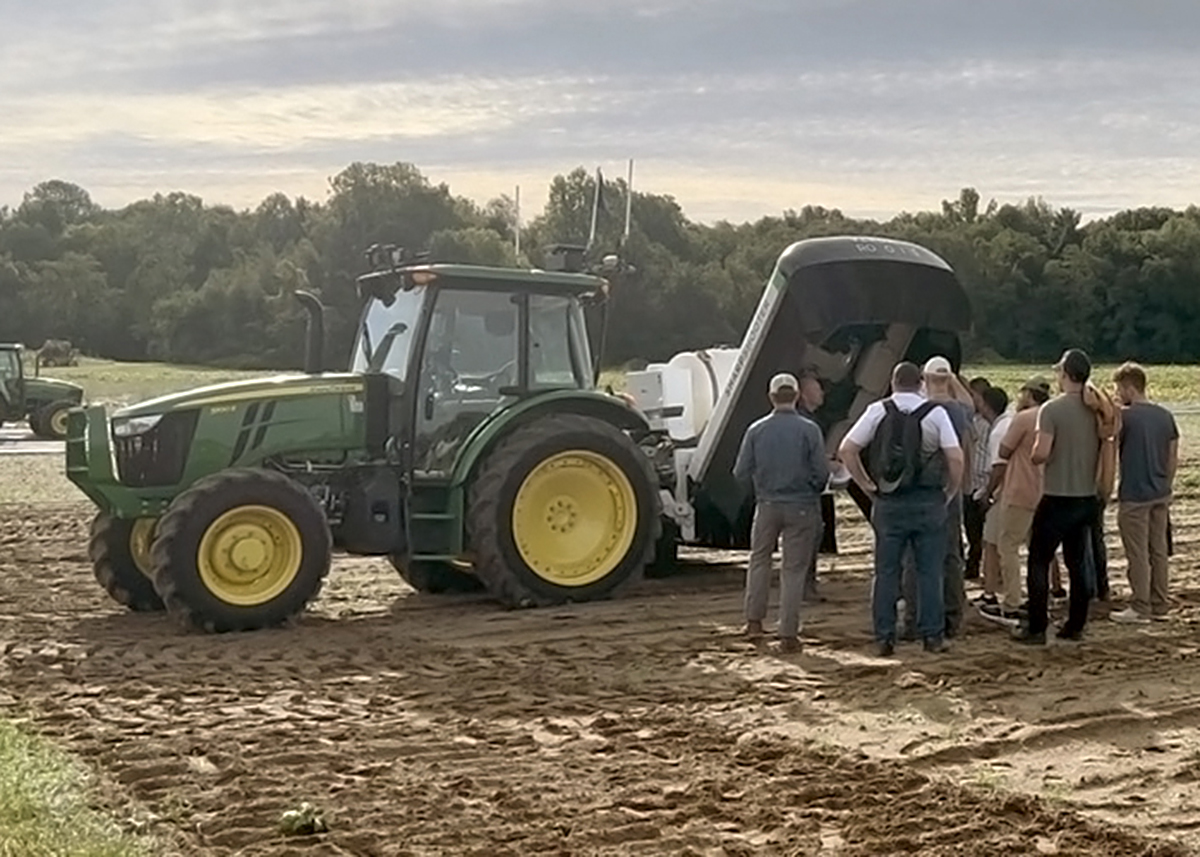
Editor's Note: This is the latest report in a series that explores the shifting economic landscape of the specialty crop industry.
As specialty crop growers face tightening margins and rising labor costs, ag-tech offers potential relief. However, growers face a Catch-22: Reduced margins leave them without the capital to invest in the technology that could solve their operational woes.
Chuck Baresich, president of Haggerty AgRobotics, says innovators often assume farmers will buy technology immediately. But every investment requires deep operational alignment.
“You don't just wake up one day on a whim and just buy it,” Baresich says.
Tim Bucher, CEO and co-founder of the agricultural technology company Agtonomy, says it takes far more labor per acre, and more equipment, to farm specialty crops.
“This segment carries enormous economic weight on the thinnest labor foundation in agriculture, and that's exactly why the technology has to land here first — not as a nice-to-have but as a labor force you can actually count on,” he says.
Growers facing challenging on-farm economics may decide to add automation and technology to help return to profitability, says Jon DeVaney, president of the Washington State Tree Fruit Association.
“These current constrained conditions create an environment where there is a path out of it, but it requires having access to the resources to make the investments necessary to retool your operations for new technology,” he says.
Calculating Real Ag-Tech Costs and Field Logistics Beyond Purchase Price
Beyond purchase price, growers face complex field logistics. Tor Tolhurst, assistant professor at Michigan State University, notes growers primarily seek tools for straightforward tasks like spraying and mechanical weeding.
“It's primarily those easier to mechanize tasks that they're looking at right now,” he says.
Baresich says growers come to his business looking for a solution to a specific problem. They usually focus on speed, acreage coverage and upfront price — but he insists that logistics account for half the real equation.
“How is it going to get to the field? How are you going to charge it? Who is going to monitor it? What about if it rains?” Baresich says. “Maintenance, remote monitoring — all that kind of fits in that logistics package.”
He works at a granular level to ensure a robotic implement will succeed, noting, “If the farmer can't answer those questions, then we will usually start to back away because there are some operations, actually a lot of operations, where all of this information is just in the farmer's head, and that is really hard to translate that into a robotic system.”
As cost becomes part of the conversation, Baresich says he tries to help growers really see the opportunity cost and the true cost of farming when adding a piece of ag-tech. This includes the labor cost, chemical cost, improved yield benefits and opportunity cost improvements.
“The part that farmers hate the most, which is the documentation of what they're doing, ... can really help them in understanding the ROI or the returns on a robot,” he says.
Ben Palone, senior commercialization director for Western Growers, echoes Baresich, saying growers must know their exact operational figures before buying.
“You, as a grower, need to understand your numbers through and through and through,” he says. “It's not just that a grower may think a weeding bill is a certain figure, but [it's] really knowing the exact cost. And unfortunately, some growers aren't tracking cost.”
Growers, he says, must be able to track and understand actual line items and what those figures are monthly, quarterly or, at the least, annually. This way when a grower looks at the number and sees weeding costs roughly $800 an acre and that it has increased in the last two or three years, it helps the grower understand what the operations' biggest cost centers are and the opportunities for ag-tech to reduce those costs.
The Compounding Costs of Delaying Automation and On-Farm Data Collection
For growers, it's often not just a question of “Am I ready to innovate?” — but rather it's “Can I afford not to innovate?”
“Here's what waiting actually costs: Labor rates keep climbing while availability keeps falling, so the same mowing pass costs more every season and gets harder to schedule,” Bucher says. “When you can't get the pass done in the right window, you don't just lose the labor line — you lose yield and quality, and in specialty crops, quality is the whole margin.”
He says every year a grower puts off automation, “the fleet you'd be modernizing is worth less and costs more to keep running.”
Baresich adds that technology costs are unlikely to decrease over time.
“It's way cheaper to do it today or at least to start down that process today,” he says.
Both say the largest hidden penalty of waiting is lost operational data.
“The grower who starts in 2029 is at zero, on rented time, while his neighbor is optimizing,” Bucher says. “You can buy a machine overnight. You cannot buy three seasons of your own ground truth.”
Baresich agrees that implementation grows harder as time passes.
“The sooner that you can start collecting that contextualized data that's specific to your farm to put into these machines, the faster you're going to be able to adopt and the faster you're going to be able to benefit from it,” he says. “If you wait 10 years to get started, not only is the cost going to go up, but the amount of change you're going to have to do is just going to increase.”
Bucher emphasizes that equipment available today is field-ready.
“The labor math is not going to improve, and the acquisition costs of these operations aren't waiting on anybody,” Bucher says. “Every season you sit out is a season of compounding data and cost advantage you hand to somebody else, and you don't get it back by writing a bigger check later.”
While some growers delay investments during downturns, others adopt technology early. Many growers prefer not to take on bleeding-edge risk, choosing to adopt after seeing success nearby.
“You get a chance to learn from other people's mistakes, see what catches on and what doesn't,” DeVaney says. “It's a lot easier to pick a winner closer to the finish line than when the starting bid was off.”
Tolhurst's research confirms this mindset: “The most trusted source of information for growers is other growers,” who help de-risk decisions during challenging economic cycles.
Still, financial skepticism remains high. Tolhurst found that “less than 30% of growers strongly agreed that the technologies would pay for themselves.”
DeVaney notes growers can rarely afford to wait out labor trends: “That couple of seasons of sustained losses could be the difference between the farm surviving or not.
“It's not as though they were looking at technology to solve a one-year problem next year,” he says. “They're still saying, ‘I can't afford this labor bill,' or ‘I can't find people,' or ‘I just have to find something that will change things, because the numbers are still not adding up.'”
Alternative Financing Models Transforming Ag-Tech Equipment Adoption
Most growers responding to Tolhurst's survey plan to use a combination of cash and debt to afford ag-tech.
“What that tells me is that growers are being forced to consider a very risky financial decision in what's already a very risky business,” Tolhurst says.
Traditionally, growers bought machinery outright to maintain in-house. Connected hardware changes the model.
“When you talk about some of the more high-tech equipment, the idea that you're just buying it and will maintain it yourself becomes increasingly difficult, because that stuff is valuable because it's a whole data management system,” DeVaney says.
Baresich notes growers care more about utility rather than just upfront price alone.
“They're not worried about writing a check for $300,000,” he says. “What they're worried about is that they buy that piece of equipment, it doesn't do what they want it to do, and it ends up sitting in the row of shame at the back of their property.”
Renting provides an effective risk-mitigation strategy.
“In our business, we've been probably like 50/50; half of the farmers who rent it one year will continue on and the other half just say, ‘You know what? This is too big of a leap for me. And you know, thank God I just rented it,'” he says.
Baresich says he's had to work with lenders to explain the technology because when a farmer goes to a bank or lender to finance it, with many of these innovations being so new, there is no history of a resale value to help the lenders appraise the technology.
These rental options, Bucher says, help growers see how the technology works on their farm before committing to anything long-term.
“A million-dollar big-ag machine was never designed for a hundred-acre orchard, and asking a grower to write that check to test an unproven technology is a nonstarter. High upfront cost is the No. 1 barrier to adoption.”
While capital expenditures require committing credit lines to projections, operating models use funds already allocated to seasonal tasks.
“You're not financing a depreciating asset through a bad crop year,” Bucher says. “And if it doesn't pencil for your operation, you hand it back.”
Many banks and lenders have become more attuned to investing in ag-tech to improve operations, Palone says. These institutions have started to offer more favorable loans and lines of credit for the investment. Creative deployment models are also taking hold, with some growers acting as ag-tech service providers to offset capital costs. Meanwhile, competitive pressures are pushing startups to adapt.
“We're seeing this market competition actually change the business models of the startups,” Palone says. “And that's a place that we have to get to in order to make it competitive for growers.”
How Farm Scale and Operational Consistency Drive Future Automation ROI
Tolhurst says that as technology field-tested out West comes east for use in Midwest and Eastern farms, the size of those farms will likely change how the ROI pencils out.
“If you're buying a very big technology, a very expensive technology, it's going to be easier to pay for that over a large amount of acreage,” he says.
The other thing Palone wants to stress is that growers move beyond the mindset of a “game changer” innovation and look more toward the long game.
“It's more a consistency factor, and it makes your operation more consistent and sustainable, and you know exactly what the numbers are every single year,” he says. “People have always said it's revolutionizing agriculture and it's making everybody so much more profitable, and I think ... the bullet point there is it makes it more sustainable and consistent — not necessarily like a game-changing thing.”
But margins continue to tighten as do continued operating costs.
“Growers have to continue to get creative, and they have to continue to grow with and do more with less in order to make enough money to farm again next year,” he says.
Palone points to how Harold McClarty, owner and CEO of HMC Farms — a grower, packer and shipper of stone fruit in California's Central Valley — leverages technology to keep farming.
“His only reason for justifying how he stays relevant is through the use of technology and [to] continue to be innovative,” he says.
McClarty uses deep learning, machine learning and robotics. Palone says that has come at a heavy capital cost, but the benefit is a consistent operation and economics. And this is the case with many major specialty crop farming operations.
“There's a reason why they're at the scale and the size they are,” he says. “Whether or not you could say directly innovation is tied to that, they believe that innovation will always help them along that way. And if the economics did not work out, they wouldn't be doing it.”