“We think everybody knows about the law,” Emerald Packaging CEO Kevin Kelly says about extended producer responsibility (EPR) laws, specifically California's SB 54. But he explains that's not actually the case, as many produce businesses remain unaware of the law and its potential implications.
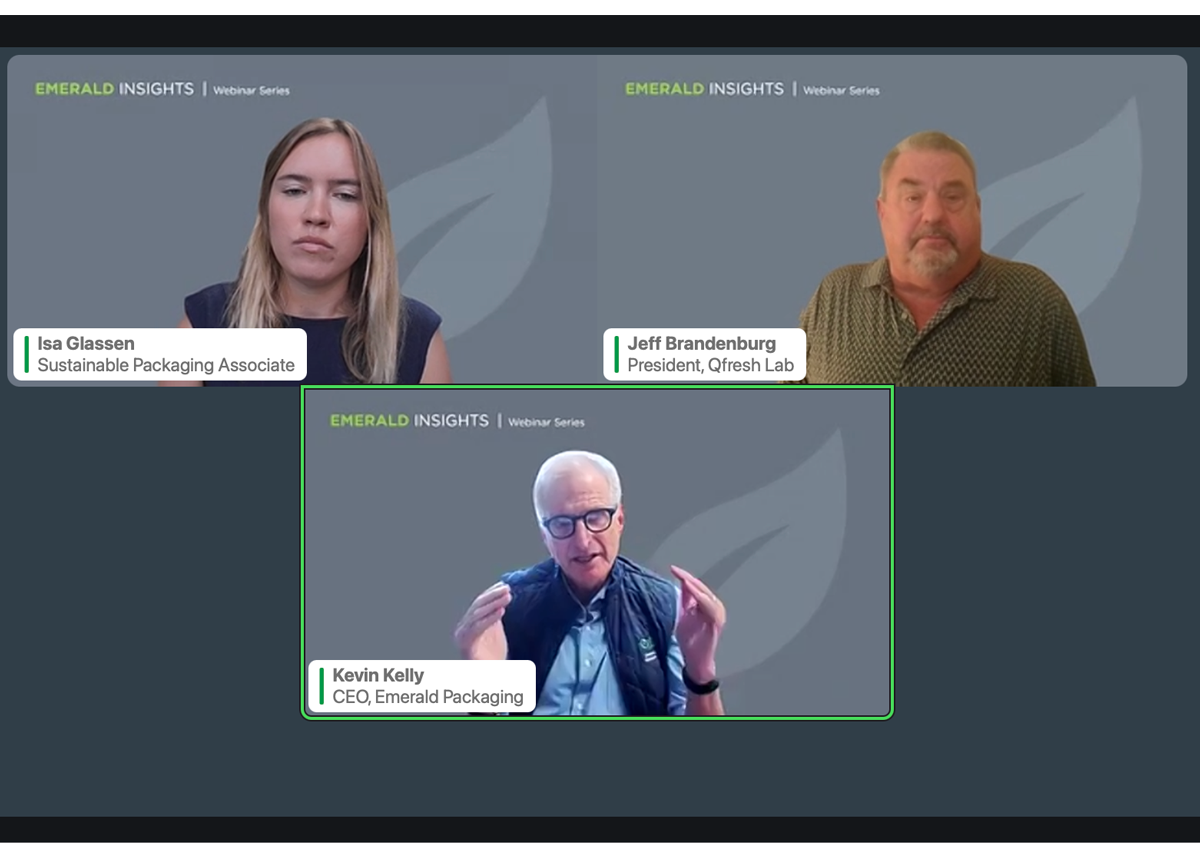
Kelly discussed SB 54 during a recent webinar hosted by Emerald Packaging, with speakers Isa Glassen, sustainable packaging associate for the company, and Jeff Brandenburg, president of QFresh Lab.
Another challenge, Kelly says, is that many businesses also struggle to understand what a “producer” is and therefore who would be liable for fees and reporting. It seems straightforward as a brand owner or a brand licensee, but it's far more complicated.
“The rules and regulations are difficult to understand,” Kelly says.
While the regulation might be difficult to understand, Brandenburg says “that doesn't mean, though, that you can just decide to ignore it.”
Kelly says the fresh produce industry is in a particularly difficult space, as packaging helps protect items that could be easily damaged and there isn't a ready replacement for plastic packaging.
Balancing Food Safety and Material Functionality
Brandenburg cautions businesses looking to identify packaging that complies with SB 54 to keep functionality in focus, as there's a lot of research around biopolymers, compostability, increasing post-consumer recycled materials and fiber. Still, there isn't one solution for the fresh produce industry.
Produce businesses can increase PCR or compostability, but each option has advantages and disadvantages. He says it's more important to start looking at alternatives.
“It doesn't mean you don't do anything,” he says.
Brandenburg suggests producers review the physical properties set out in SB 54 to match the bill's functionality requirements. There is a cost difference between adding PCR and virgin plastics, and each has a different physical property. For example, 30% PCR in a polyethylene film will act and behave differently than no PCR, and conversely, 50% will act and behave differently, too.
“There is an impact to the physical properties of that film which may manifest itself during the supply chain that you need to understand,” he says. “You can make changes. You should make changes and you should research these changes. Make sure that you're not trading one set of problems for a different set of problems.”
Brandenburg says it's important for produce businesses to understand “there's not going to be a one-size-fits-all.” Instead, produce businesses need to understand where a particular packaging, such as fiberboard, may fit one distribution channel versus another. Or downgauging might fit another channel.
“It's not going to be carte blanche,” he says. “That technology just doesn't exist. You're going to have to pick and choose. The best place to start is to understand what you currently do. … Then you can start to look at what I can change and what I can do.”
He notes that food safety laws mandate protections to keep consumers safe; while those regulations don't explicitly mandate plastic, Kelly says packaging is currently the only practical way to meet those standards.
“FDA does not state what kind of packaging you should or should not use,” Brandenburg adds. “What they do state is whatever packaging you choose to use, make sure that it has the functionality to keep the food safe and does not impart anything into the food or allow the food to become unsafe.”
Taking First Steps: Registration and Packaging Audits
Brandenburg says companies that have not registered with CalRecycle should register and begin inventorying the packaging used.
“You should start looking at your packaging. Can you downgauge certain things? Probably yes. Can you change the size of the package? Possibly. Can you look at a compostable film? Yes, you certainly can,” he says.
Companies can also look at biopolymers, but he says compostable films and biopolymers are still considered plastics at this stage. Companies can also look at fiber, too, as well as hot-fill using multi-layer and mono-polymer.
Navigating Regulatory Conflicts: SB 54 vs. AB 1201
Kelly says California's AB 1201 may threaten the compostable option, as it directly conflicts with SB 54. AB 1201 says packaging cannot be labeled as “compostable” unless it meets strict technical standards.
However, SB 54 encourages companies to transition away from conventional packaging only to face strict regulatory requirements of AB 1201. As of now, AB 1201 takes effect in June 2027. Kelly says attendees should call state Assembly members and the governor to ask for an extended timeline, as AB 1201 would limit the development of compostable materials.
“A potato bag, for instance, has clearly downgraded to the point there's nothing left to downgrade,” Kelly says. “With salad packaging, there are opportunities. We're using 80-gauge polyethylene, [which could be] switched to 70-gauge. We're using 1.25 mil low density as a sealant. You could switch to 115 [gauge].”
Supply Chain Realities and Global Distribution
Kelly acknowledges that while regulators may understand the realities of shipping fresh produce globally, EPR laws like SB 54 still push for targets the market cannot yet meet.
“There's only one way to do it, and that's with plastic,” he says. “There's no technology on the horizon that could handle the volume that is shipped in this sector.”
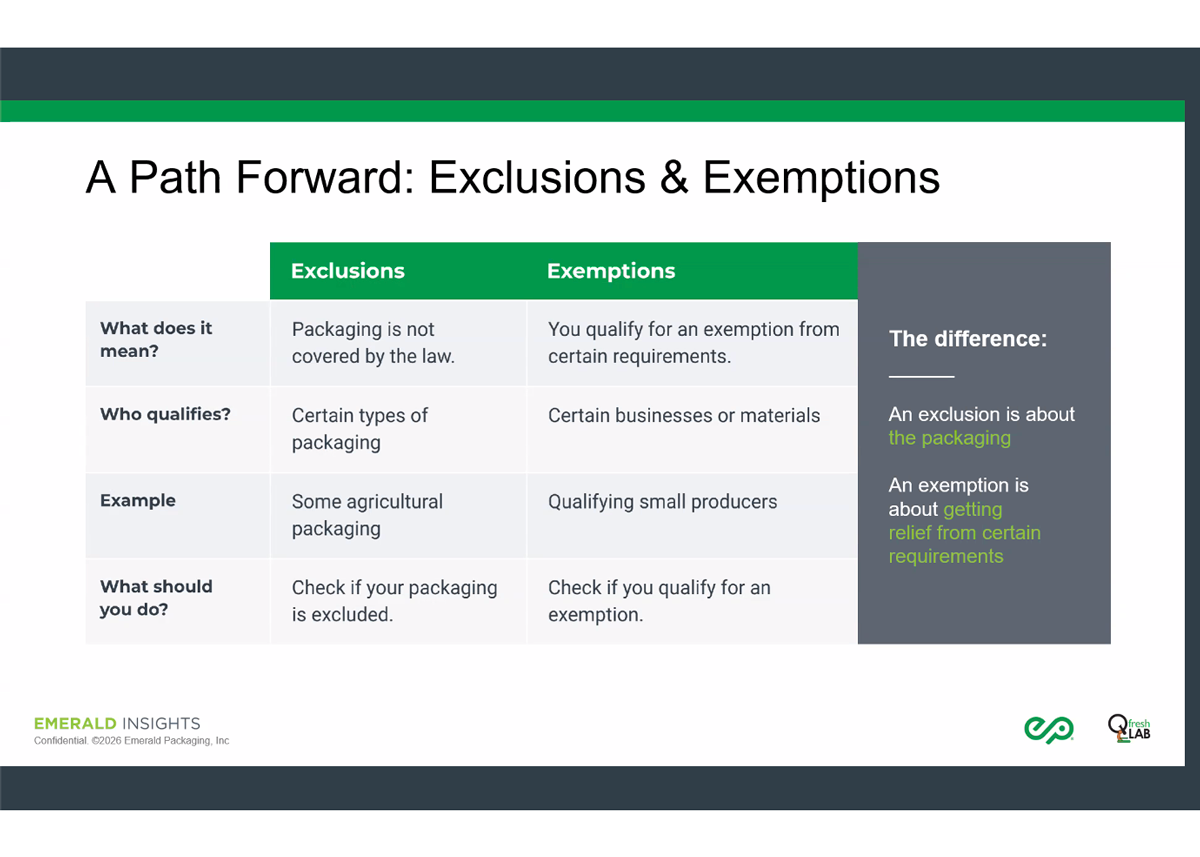
Kelly and Brandenburg also break down “exceptions” versus “exclusions.” Kelly says that while produce businesses have an exclusion for field-packed produce, “it's not subject to the law or to any fees.”
Exemptions, though, mean a company is covered by the law and the rates, just not the compliance dates.
Another challenge is that if field-packed produce is excluded, does that include the boxes, pallet wrap, the pallets? Kelly says that there isn't a clear answer.
“There's a thousand questions that the real world introduces into this situation,” he says. “There's no clear answer yet, and it's going to take a long time to work out. I think we're just going to have to be patient.”
Unrealistic Timelines and Infrastructure Gaps
Kelly says the dates prescribed by SB 54 present a real challenge to the industry. This includes the 10% reduction in plastic packaging by Jan. 1, 2027. Kelly says the dates outlined in SB 54 have caused widespread panic in the industry.
“People who are absolutely complying with the law have just submitted their plans for source reduction, and nobody has approved or objected to them,” Kelly says. “A 30% recycling rate by 2028 ain't going to happen for flexible packaging or thermoforms. There's no system in place right now to actually recycle those products.”
He says a lot of the guidance coming from CalRecycle is that companies are making progress toward compliance, not perfection.
Looking Beyond California and Preparing for EPR Expansion
Kelly says another thing to keep in mind is that while SB 54 has a major impact on the entire fresh produce industry, it is far from the only EPR law on the books. Most of these laws have different reporting requirements.
“There is a world beyond California,” he says. “There are seven other laws out there right now in the states that have seven other EPR laws. There's a flood more coming, and they're all different.”
Kelly points out that while it may seem like he's opposed to plastics recycling, that is not the case at all. He says he was on the forefront of advocating for plastic packaging recycling nearly 20-plus years ago.
“We believe in EPR, but we need realistic dates, and we need rates that are not going to put midsize and smaller companies out of business,” he says.
Kelly briefly addressed several lawsuits challenging EPRs right now, but he says that even if one of the lawsuits wins, the legislature will likely reconfigure SB 54 as a tax.
“It's not going to go away,” he says.
His take-home advice for produce businesses is to register as a producer, but don't panic if a noncompliance letter comes from California or any other state with an EPR law; “Don't lose focus,” he says. Then, gather reporting information on the types of packaging used and start working on a source reduction plan.
Brandenburg also says it's important to stay up to date on any possible legislative reform and learn about possible substitutes for packaging. Kelly agrees.
“Get involved,” Kelly says. “You've got to be at the table. You've got to understand the law, and you have to be willing to deal.”