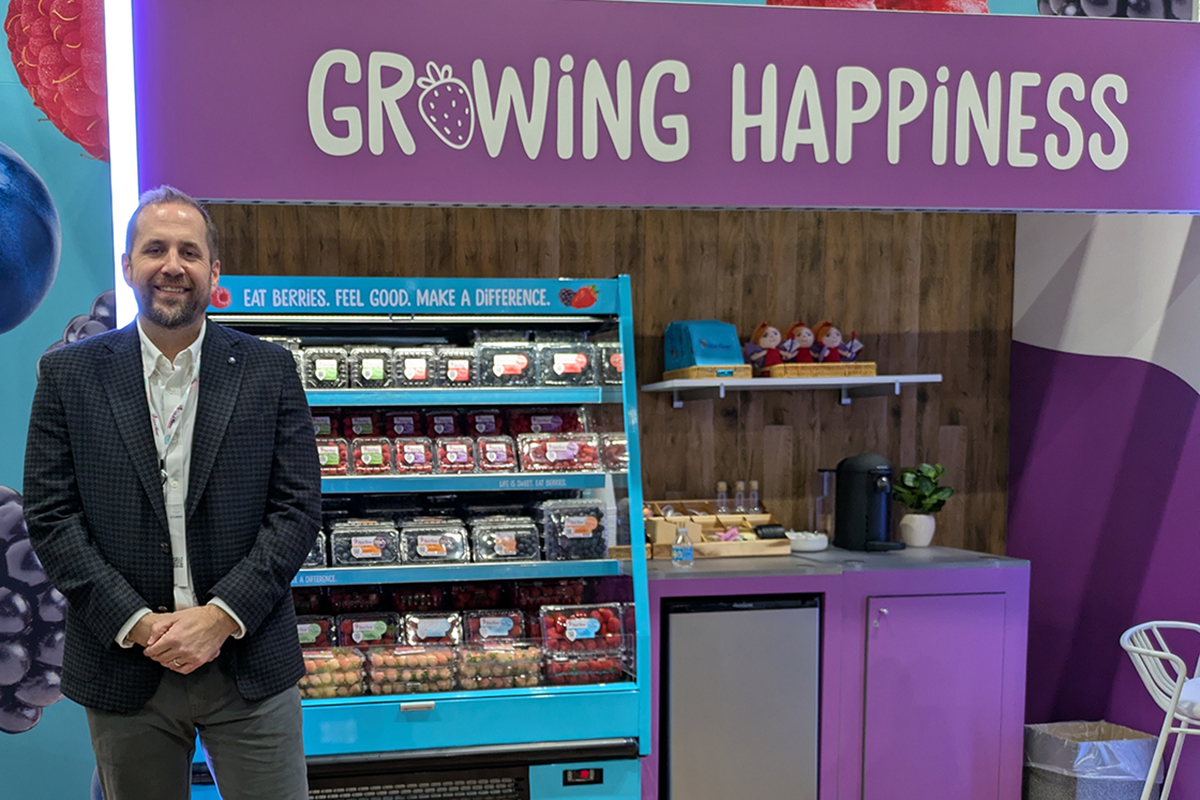
ORLANDO, Fla. — In an exclusive interview with The Packer during the International Fresh Produce Association’s Global Produce and Floral Show on Oct. 15, newly appointed Wish Farms CEO James Peterson outlined his vision for navigating structural margin pressures, elevating food safety standard operating procedures and leveraging advanced analytics and genetics to lead the berry category into its next era of growth.
Peterson, who officially assumed the chief executive role on June 1 following a tenure as chief operating officer and vice president of sales and marketing, steps into leadership at a pivotal moment as the Plant City, Fla.–based grower-shipper honors its 100-year history while adapting to modern supply chain economics.
Aligning Supply and Sustainable Pricing Amid Rising Input Costs
A central challenge facing the berry industry is the cumulative impact of cost inflation. Peterson notes that elevated post-pandemic production expenses have raised the cost floor across all berry commodities.
“It’s become increasingly harder to grow sustainably as our input and harvest costs have risen,” Peterson says. “We’re being very intentional about how our supply and programs are built so that, for both our company farms and outside growers, we can pair supply and demand together to ensure sustainable pricing and profitability.”
Persistent price pressures across daily farm operations have made careful supply planning essential. Key farm inputs like tractor diesel fuel and plastic clamshell packaging climbed significantly during the pandemic and have shown no signs of easing in the short term. At the same time, policy changes have reshaped the agricultural labor market. Following Florida’s passage of strict E-Verify legislation, Wish Farms shifted its entire farming operations to bring in guest workers through the federal H-2A visa program.
While the guest worker program secures a reliable labor supply, it comes at a higher operational cost than the domestic workforce the industry previously relied on. Peterson says that even when harvest yields and farm acreage remain identical year over year, the higher wages and administrative fees associated with H-2A labor add several dollars in expense to every flat of berries picked.
By matching acreage and harvest yields strictly to consumer demand, Wish Farms aims to shield both its company-owned land and external partner growers from late-season market collapses, offering a path to sustainable, profitable grower returns.
Restoring Consumer Confidence Through Food Safety Rigor
Addressing recent broader industry challenges, including indirect demand dips tied to summer cyclospora outbreaks elsewhere in the produce section, Peterson emphasizes the fragility of consumer trust.
Wish Farms operates under 33 foundational core principles, Peterson says, led by its top directive: “Never compromise on food safety.”
“I think we saw with cyclospora how fragile that confidence is,” Peterson says. “When that confidence is broken between supply and the consumer, you can see what that does to affect demand. So internally, it allowed us to evaluate processes and make sure we have all — not only all the checks and balances in place — but frankly, more checks and balances than we probably need to ensure that we’re not part of any next outbreak.”
The Shift to Genetics, Flavor and Quality Assurance Real-Time Tech
Despite supply challenges, berry consumption continues to outpace many produce categories, growing by approximately $700 million over the trailing 52-week period. Peterson attributes this category growth to a fundamental shift in retail expectations — moving away from basic year-round availability toward a standard for premium flavor and quality.
To keep pace with consumer demand, Wish Farms has accelerated its proprietary breeding program, recruiting top breeding talent formerly with Driscoll’s to develop next-generation blackberry and raspberry varieties. These new varieties, on the cusp of commercial availability, are designed to set a new benchmark for flavor and eating experience.
At the same time, Wish Farms is leveraging real-time technology through a partnership with Clarifresh to inspect and monitor quality instantly across its distribution channels. Advanced data analytics allow field and QA teams to evaluate fruit condition, sugar levels and disease resistance in real time, ensuring that superior genetics translate directly to a better product on grocery store shelves.
“As technology has improved, it’s allowed us to evaluate quality in real time, far faster and more accurately than in the past,” Peterson says. “That technology, paired with superior breeding, is driving the category forward. For a long time, retailers just wanted berries on the shelf 52 weeks a year. Today, simply having supply isn’t enough — retailers demand 52 weeks a year of the right flavor and the right genetics.”