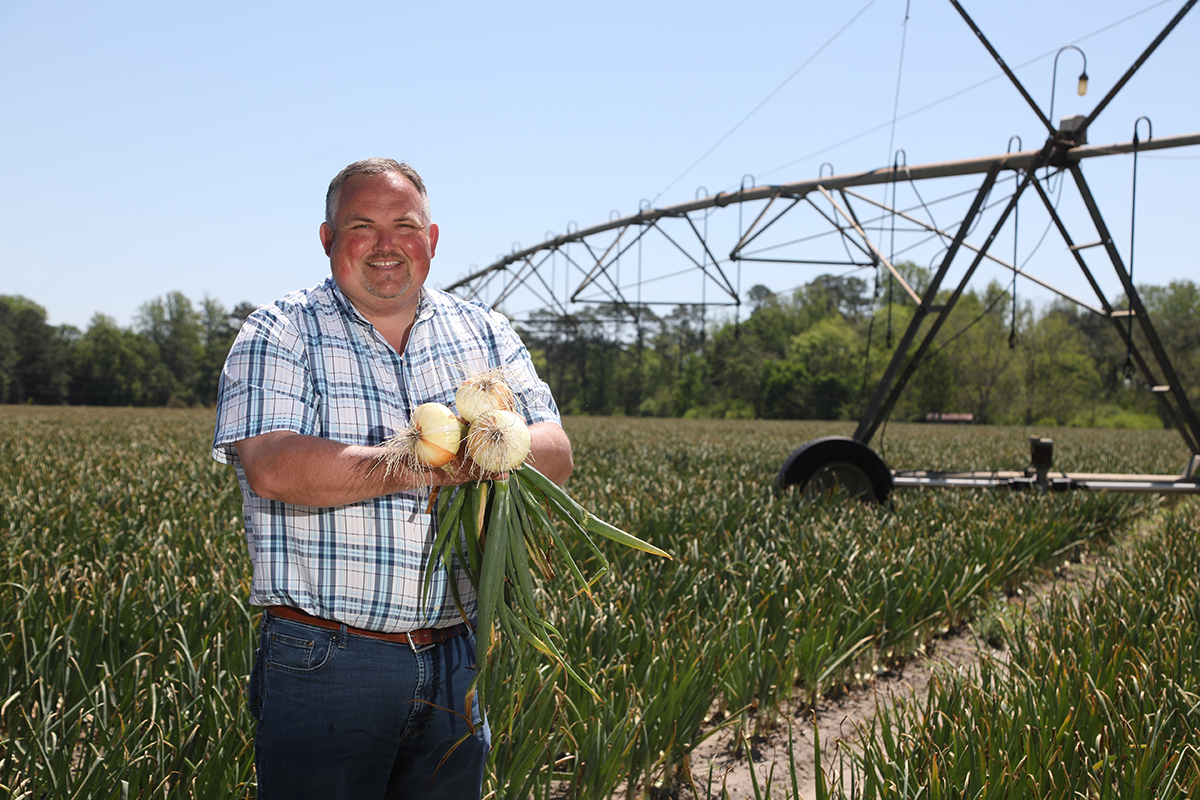
The 2026 Vidalia onion season is shaping up to be a story of resilience, as Georgia’s world-famous sweet onions overcome a volatile winter to meet their highly anticipated spring debut. Despite facing record-breaking weather swings, industry experts and growers report that the crop is not only surviving but thriving as it nears maturity.
Weathering the Storm: A Gauntlet in the Field
The journey of the 2026 crop began with significant anxiety. In mid-to-late January, temperatures across the 20-county production region plummeted into the high teens. For a crop that typically thrives in the mild Georgia winter, the triple threat of three hard freezes followed by 5 to 6 inches of snow was a shock to the system.
“Our 2026 Vidalia onion crop looks extremely good right now,” says Shane Curry, executive director of the Vidalia Onion Business Council. “We experienced some winter temperatures that dipped down into the high teens in some fields, but it didn’t cause significant damage. Once the days started getting longer and temperatures warmed up, the crop really started to change. Customers can get ready to see their favorite sweet onion on the store shelves by mid-April.”
The onion’s resilience lies in its biology and the proactive measures taken by growers. When the freezes hit, many farmers utilized their irrigation systems, keeping soil temperatures just enough above the danger zone to protect the developing bulbs.
“Overall, the Vidalia crop looks very good,” says Chris Tyson, area onion agent and coordinator for the Vidalia Onion and Vegetable Research Center. “We had some concerns about cold temperatures in January and February, but weather conditions since then have been favorable. The crop is progressing well and appears very promising. We have continued to monitor it closely and anticipate that any impact from the earlier cold weather will be minimal, if any.”
At G&R Farms, weather challenges were met with rigorous field management. Cliff Riner, vice president of agriculture production and grower relations for G&R Farms, explains the high-stakes chess match played against Mother Nature: “This season certainly brought some unusual weather challenges with the freeze and drought cycle. Thanks to expert preparation and meticulous follow-through throughout the growing season, we were able to maintain the quality of our crop. While some growers across the region didn’t fare quite as well with the weather swings, G&R Farms was well-positioned to manage through the conditions, and inventories are expected to be strong with the same sweet, mild flavor consumers expect from Vidalia onions.”
The Art of Patience: Official Pack Date
Despite the visible recovery in the fields, the Vidalia name is a federally protected trademark. Farmers cannot simply harvest when they feel ready; they must wait for the official pack date, a day determined by the Georgia Department of Agriculture and the Vidalia Onion Committee based on crop maturity and sugar testing. That date is typically in April.
“Vidalia onions are protected under a federal marketing order, which means they can only be harvested and sold from a specific region and after an official pack date determined by the Vidalia Onion Committee and USDA,” says Steven Shuman, general manager and vice president of sales for G&R Farms. “Even if fields look ready, we still have to wait for that date to ensure quality and consistency across the industry.”
For farmers, Shuman says, that can be challenging because the weather doesn’t follow regulations.
“Timing harvest perfectly while protecting bulb quality and meeting the official standards requires tight coordination between growers, inspectors and packers,” Shuman says.
This regulation is what separates a true Vidalia from any other sweet onion. The Yellow Granex variety must be grown in 20 specific south Georgia counties where the soil is uniquely low in sulfur. This low-sulfur environment prevents the onion from developing the heat or pungency associated with standard onions, resulting in a vegetable so mild it can be eaten raw like an apple.
Farming With a Mission: Shuman Farms and the Healthy Family Project
Beyond the technical side of farming, the 2026 season highlights how the Vidalia onion industry uses its platform for broader social impact. Shuman Farms is one example of this through its giving back pillar and its work with the Healthy Family Project.
The Healthy Family Project, founded by John Shuman, serves as a cause-marketing organization that brings the produce industry together to give back to those in need while promoting healthy eating for families. Since its inception in 2002, the initiative has raised $8 million for charities, including Feeding America, which works to combat food insecurity across the country. During the Vidalia onion season, these efforts are often visible through specially marked packaging that allows a portion of the proceeds to support hunger relief, ensuring that Georgia’s official state vegetable provides nourishment far beyond the dining table.
The impact of this work was celebrated just last month. In February, at the annual Healthy Family Project Thank You Reception, industry professionals gathered to celebrate raising over $348,000 in 2025 alone. These funds support Feeding America food banks, the Foundation for Fresh Produce and organizations like Our Military Kids and the Boys & Girls Clubs of America.
Empowering the Next Generation: Shuman Farms University Returns
As Shuman Farms approaches the 2026 harvest, its commitment to industrywide growth is spearheaded by the return of the Shuman Farms University platform. This spring, the program features a revamped curriculum tailored to provide produce teams with deep-dive insights into Vidalia farming, innovative merchandising strategies and essential consumer data.
A highlight of the expanded 2026 program is a new economics course that educates retail partners on the unique value proposition of the Vidalia onion; by emphasizing its versatility for both raw and cooked applications, Shuman Farms demonstrates how consumers can simplify their shopping — and maximize their kitchen’s efficiency — with a single, high-quality variety.
“People love to talk about what they know and love, and the ultimate goal of the Shuman Farms University initiative is to empower produce teams to confidently share with shoppers what makes a Vidalia onion so special,” says John Shuman, president and CEO for Shuman Farms.
Tradition Meets Technology: The Modern Harvest
The 2026 season also highlights how technology has transformed a blink-and-you-miss-it spring treat into a year-round staple. Historically, the Vidalia onion window ended by June. Today, controlled-atmosphere storage allows farmers to put the onions to “sleep” in high-nitrogen, low-oxygen environments.
“Our grandparents’ generation had a much shorter selling window — basically the fresh harvest season,” Riner says. “Today, CA technology ... lets Vidalia onions stay fresh and flavorful from mid-April to around Labor Day.”
Furthermore, innovation in seed varieties is helping farmers combat the increasingly volatile climate. New disease-tolerant varieties like Athens and Augusta have been instrumental this year in resisting Stemphylium leaf blight, which often attacks plants weakened by freeze damage.
“It doesn’t eliminate the need for crop protection entirely, but it can reduce spray pressure and help us farm more sustainably,” Riner says.
Those new varieties are an exciting development for the industry, he adds, noting that disease-tolerant onions can help improve resilience against common field challenges like leaf diseases.
“For growers, that means we can move even further toward integrated pest management practices — using genetics, crop rotation, monitoring and targeted treatments — instead of relying solely on chemical controls,” Riner says.
Celebrating the Pillars of the Industry
The culture of the Vidalia region is one of tight-knit competition and shared excellence. At the Vidalia Onion Committee’s annual celebration on Feb. 7, the industry recognized its top performers.
Bland Farms was named the 2025-26 Grower of the Year. CEO Troy Bland highlighted the deep roots of the award: “Vidalia onions will always be our No. 1 priority; it’s what we built this farm on, and what keeps us rooted in the community.”
The committee also introduced a new honor, Producer of the Year, awarded to L.G. Herndon Jr. Farms. This award recognizes the farm with the highest per-acre paid assessments, funds that are directly reinvested into the research and promotion that keep the Vidalia brand globally recognized.
“I think to be recognized as the Vidalia onion Producer of the Year further validates our commitment to excellence in producing everyone’s favorite onions year in and year out,” says Jason Herndon, CEO of L.G. Herndon Jr. Farms.
2026 Outlook: A Product of Place
As harvest crews, many of whom arrive via the H-2A visa program, begin the labor-intensive process of hand-clipping every single onion, the mood in south Georgia is one of cautious triumph. Despite the administrative red tape associated with labor and the atmospheric curveballs of the winter, the crop is ready.
“Labor has become one of the biggest challenges facing specialty crop growers. The H-2A program is essential for bringing in seasonal agricultural workers, but the paperwork, compliance requirements and timelines have grown more complex every year,” Riner says. “For farmers, harvest timing is critical. When paperwork delays or regulatory hurdles slow the process, it can create uncertainty about having enough hands in the field exactly when the onions are ready.”
The 2026 season is a reminder that the Vidalia onion is more than just a culinary ingredient; it is a symbol of Georgia’s agricultural heritage, a testament to technological advancement and, thanks to initiatives like the Healthy Family Project, a vital tool in the fight against hunger.
As Steven Shuman says, “Every Vidalia season tells a different story ... [they] are a product of place — the soil of southeast Georgia creates that unmistakable sweetness that can’t be replicated anywhere else.”
This spring, consumers will get to taste that story for themselves.