The Packer's Sustainability Insights 2026 survey results reveal escalating labor and input expenses leave permanent crop farmers unable to maintain economic sustainability between fixed retail prices and devastating losses.
Patrick Smith, a fourth-generation apple and hop grower in Washington, has watched the cost of fertilizer, crop protection, fuel and labor continue to increase. While tree fruit growers could normally absorb or navigate these bumps, Smith says the prices farmers receive for their crops haven't kept pace.
“The margins get squeezed or some years disappear entirely, and that puts a significant amount of stress on farm balance sheets,” he says.
How Escalating Operating Expenses Threaten Farm Economic Sustainability
That frustration echoes across the industry, according to the Sustainability Insights 2026 report. Most growers report being trapped in the margin squeeze, with 87% agreeing (45% strongly, 42% somewhat) that operating costs are rising much faster than crop prices. When asked to pinpoint the expenses driving this strain, growers identified a triple threat of essential inputs: labor (55%), energy and fuel (53%), and fertilizer and chemicals (51%).
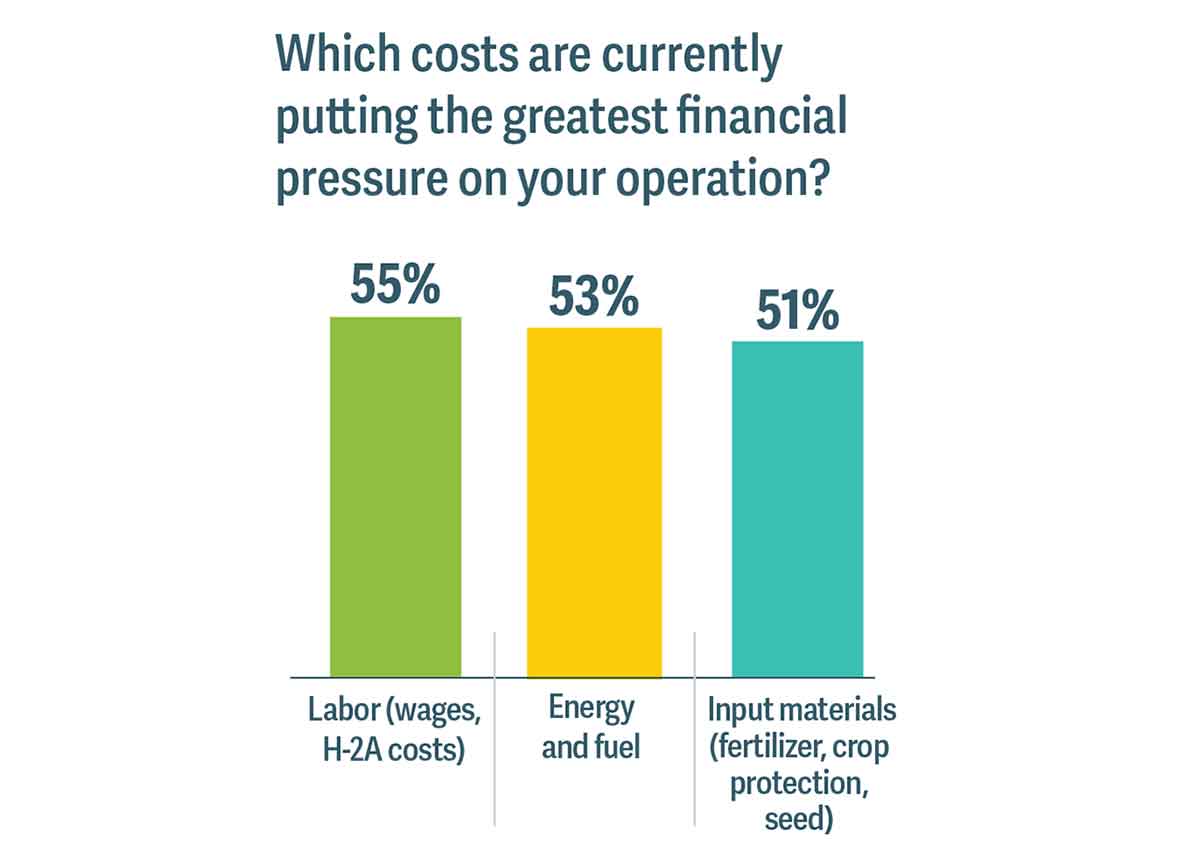
When broken down by operational size, report data shows the shifting financial drivers. Smaller operations (those with 500 acres or less) are far more likely to feel the brunt of high labor costs. For midsized growers (500 to 5,000 acres), input costs for fertilizer and chemicals are the biggest burden. Meanwhile, the largest operations (5,000 or more acres) report that rising insurance costs and compliance with extended producer responsibility, or EPR, mandates cause the greatest financial strain.
Lisa Tate, a sixth-generation citrus and avocado grower in Southern California, says regulatory and operational standards add weight to her family farm's balance sheet without bringing in additional revenue.
“Minimum wage is going up, fertilizer went up, fuel went up, workers' comp is high,” she says. “And then on top of that, we have some of the highest standards for environment, public safety, consumer safety. All that comes at a cost.”
Smith says the consistent squeeze has hit for many years, and “at some point, something's got to give,” adding that the current state of the apple industry “is the definition of an unsustainable trajectory from a business standpoint.”
“I know that this is true for a lot of the folks I've talked to,” he says. “It feels like people are working harder and harder to make less and less money, and in some cases no profit at all, on the significant amount of capital this industry has deployed over the last 15 or 20 years.”
Smith thinks that the industry must shrink to regain profitability.
“The size that it is right now will not lead to fair returns at the producer level. Period,” he says. “The dynamics are not in place for the pie to get big enough for the industry to stay the size that it is. So, the industry has to shrink.”
Higher regulatory standards add to the high cost of production, Tate says.
“We can't compete with other countries that don't have those same standards. Our standards are incredibly high. Good or bad, that's what they are, but nobody wants to pay for that,” she says. “It's ending up being paid for by the farmer, and we can't hold on anymore.”
Diversification can mitigate some of these risks in bad years when all commodities suffer. The troubling part of the crossroads tree fruit growers face, Smith says, is that growers don't really have a good alternative to plant.
“If there was something that you could do like cut an apple orchard down, replant it to whatever and expect a better outcome, you'd see that happening,” he says.
Harsh Economic Realities of Permanent Specialty Crops
According to the Sustainability Insights 2026 data, crop selection heavily dictates profitability. Producers growing berries, small fruits or tropical and exotic fruits were twice as likely to report being profitable compared with tree fruit and allium growers. Tate breaks down this math by looking at her family farm's topline.
“For lemons, we're losing 12 cents for every dollar that comes in,” Tate says. “That is not economically sustainable. You might be able to hold on for a few years. Let's say I'm bringing in a million dollars a year — that means I'm losing $120,000 a year. … Even [for] avocados, that are the best crop in our area, the profitability is so small. If you look at the net over the years, they've grown, but they haven't grown at the same rates as even inflation has.”
She says specialty crop agriculture, especially permanent crops, has a completely different economic reality than many industries — one that makes turning a profit more of a challenge.
“We're not a factory where we can just shut down production,” she says. “I grow lemons and avocados. If I shut down, what does that mean? It means I stop watering. The plants die. If we wanted to get back up and going, you're looking at a 20-year startup by the time you plant the trees, they grow and they're ready to be harvested. Millions of dollars have been lost and then reinvested, and that's not sustainable. And in the meantime, we become more and more reliant on other countries.”
Meanwhile, Smith points out that fob prices have lagged far behind production costs, meaning “the grower ends up absorbing the cost increase of the whole system.”
Skyrocketing Farm Labor Costs Force Fruit Growers to Crisis Point
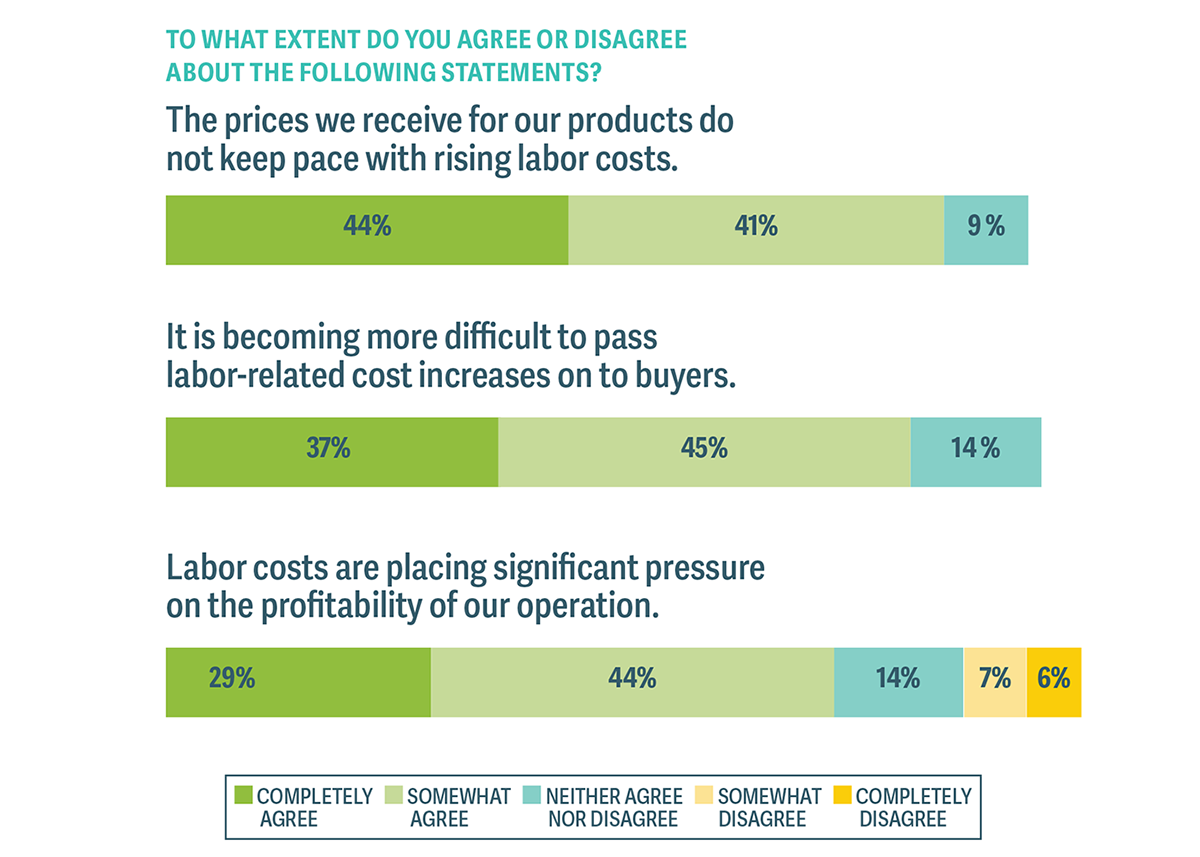
An overwhelming 85% of growers agree (44% completely agreeing and 41% somewhat agreeing) that crop prices have failed to keep pace with escalating labor expenses. Most growers, 82% (37% completely agree, 45% somewhat agree), say it has become increasingly difficult to pass labor-related cost increases along to buyers.
“As a grower, it hurts even more if the freight companies raise their rates, but ultimately the retailer doesn't pay more for the apples. Who paid the increase in shipping costs? The grower did,” Smith says. “If the packinghouse responds to higher labor costs by raising the packing charges but retailers don't pay more for a box of apples, who ended up paying for the higher packing charges? The grower ended up paying more. At the end of the day, the grower paid the vast majority of the increase in the cost of getting an apple from a tree to a consumer.”
Tate agrees: “Farmers don't have the luxury as many other businesses do of raising their prices.”
She says this eats into a farm's profitability.
“We can't raise the price of our goods because there's a few retailers in the country, and everybody's competing for them,” she says.
Because a handful of massive retail buyers dominate the market, farmers have zero pricing power.
“Everybody's in a race to just get whatever they can,” Tate says. “The retailer or restaurant gets paid, the packinghouse gets paid and whatever is left over goes to the grower. Sometimes, the grower ends up owing money at the end of it all.”
For apple growers, consumer behavior creates a double-edged sword. If retail prices drop, consumer demand doesn't automatically surge; if prices rise, consumers quickly switch to cheaper alternatives.
“You can't spur consumption growth with lower prices, and you can't actually get significantly more revenue into the industry with higher prices because there's a lot of alternatives in the produce aisle,” Smith says. “And a lot of those alternatives are significantly cheaper than an apple.”
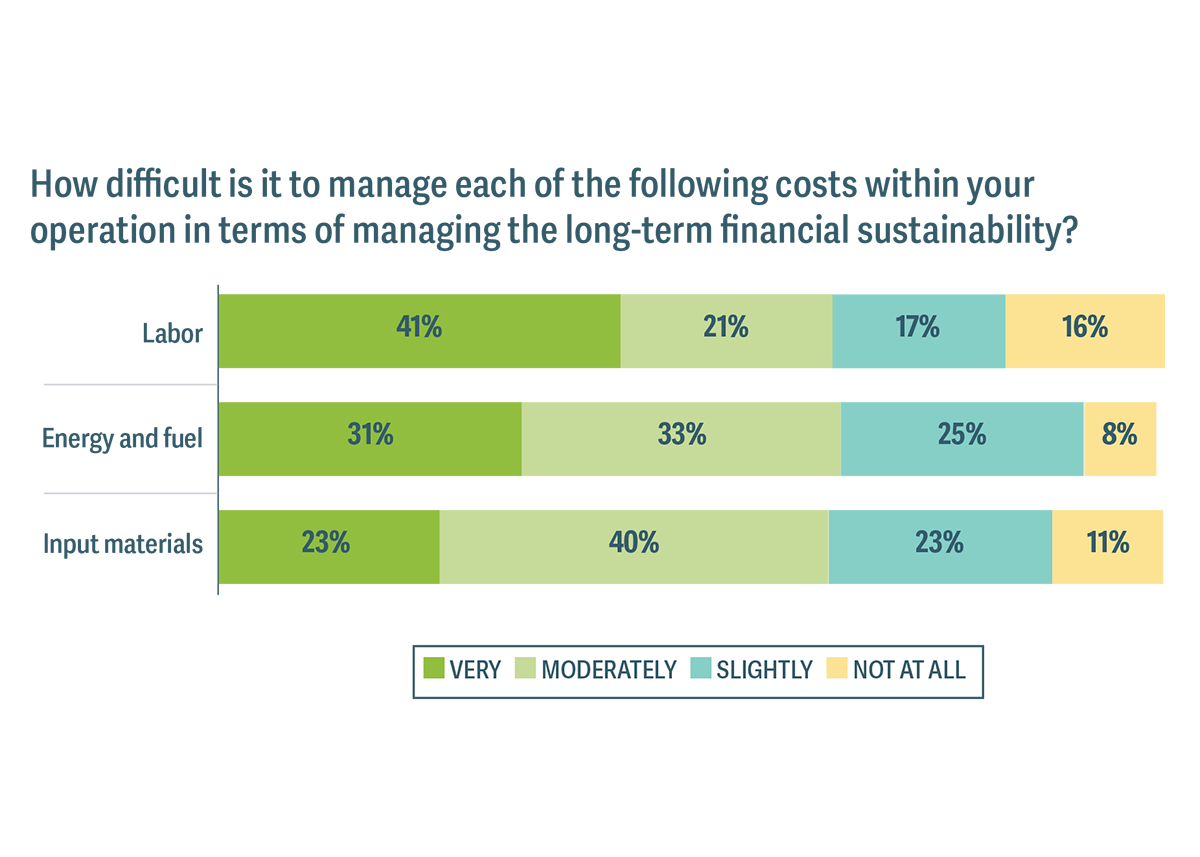
Across the industry, nearly two-thirds of growers report severe challenges managing energy and fuel (64%), material inputs (63%), and labor (62%). However, growers overwhelmingly rank labor as the single most severe structural threat, with 41% rating it as “very difficult to manage,” far outpacing energy (31%) or materials (23%).
“We can't pass the costs on, and our competition doesn't have the same costs,” Tate says.
She also highlights how high domestic wages create an uneven playing field against global imports.
“If I'm paying $17 an hour here and they're paying $17 a day somewhere else, and labor's 50% of my costs, why would anybody buy my product? It's going to be more expensive. I can't compete,” she says.
Even programs designed to assist farmers present massive hurdles. Despite recent administrative updates to the H-2A guest worker visa program, Smith says it remains fundamentally broken.
“It's very clearly a program that was designed to disincentivize its own use,” he says. “If there's that much demand for a program that was intentionally designed to make it so expensive that the only reason you would ever do it is if it was the last resort, doesn't that say a lot about the state of the supply of farm labor in the country and that there's a bigger problem at hand?”
Data from the Sustainability Insights 2026 report underscores this labor crisis: 73% of respondents state that labor expenses exert significant pressure on overall profitability (29% completely agree, 44% somewhat agree). Only 13% of growers report feeling minimal or no impact from rising labor costs.
As these economic pressures mount, Tate warns that family-owned farms will bear the brunt of the fallout, adding that this instability is going to hurt smaller farms the most.
“We want a lot of small farms. We want family farms because families think differently — they think in legacy terms,” she says. “Right now, I'm planting trees that I will never benefit financially from, but my children will, just as I'm benefiting from the plants my grandparents and parents planted. If you don't have that mentality, you're not going to make those long-term investments in permanent crops.”
Ultimately, Smith warns that without meaningful reform to solve farm labor shortages and fix the H-2A program's structural shortfalls, the industry faces a stark ultimatum: “We can import our labor or we can import our food.”
For Smith, the choice is clear.
“Importing labor is a much more preferable path to go down than importing our food,” he says. “If you begin to import your food, you've got national security problems. You've got all sorts of issues that pop up if you're now a net food importer.”
More From Sustainability Insights 2026
- Download the full Sustainability Insights 2026 report for free here.
- Sustainability Insights in retail: Retailers Driven to Pursue Sustainability for Purpose and Performance
- Inside the Paradigm Shift: How Sustainability Is Reshaping Fresh Produce Economics