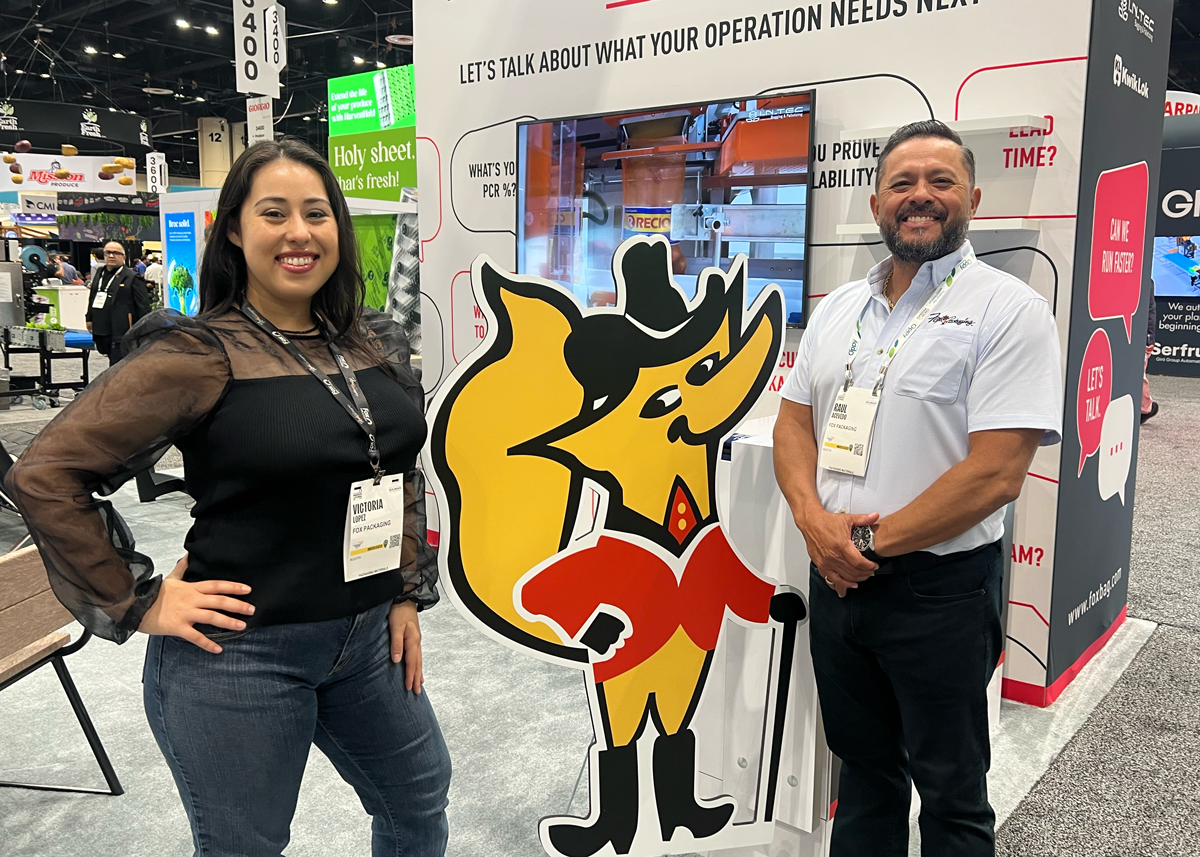
ORLANDO, Fla. — While the International Fresh Produce Association featured several education sessions around extended producer responsibility, or EPR, and innovative packaging at the Global Produce and Floral Show, Victoria Lopez, marketing and business development manager for Fox Packaging, says there’s still a general lack of awareness among produce businesses.
First, she says companies in California have approached her for data to report on plastics use.
“And I go, ‘That was due Oct. 1,’” she says.
The other question she gets from California-based produce companies is whether Fox Packaging can assist with data reporting or if these businesses need to hire specialized EPR consultants. Lopez thinks growers and shippers are paying for outside help unnecessarily even though packaging suppliers already track the required material metrics.
“I have some customers who are saying they’re paying $20,000 for an EPR consultant, and I don’t understand why, because packaging companies can provide the data. I give them everything for free,” she says.
The Destination-State Trap
Lopez suggests the actual regulatory fees generated by state compliance tools may be far lower than the broader financial impact touted across the industry, though the ultimate cost remains heavily dependent on an operation’s size and scale.
“If you look at the calculator, some people are only going to pay $300, maybe $700,” she says. “So, some of it is significant, and some of it is not.”
Lopez says there’s almost a general belief that produce businesses outside the states with EPR laws in place don’t have to provide reporting or data. She says a customer in the Northeast told her the business was not concerned about EPRs because they’re not in place in that state.
“But where are your bags going?” she says. “You need to think of the destination. If your destination is in the states in which this is active, then you qualify to be fined.”
She says the lack of awareness or understanding is frustrating as Fox Packaging and other packaging companies are trying to sound the alarm.
Balancing Material Performance and Regulations
Lopez says her company offers a 30% PCR bag as well as a compostable bag to prepare for EPR regulations, but she notes some customers don’t like the way the packaging feels and she’s concerned about how it will print and if it will smudge.
“But that is going to get you the most relief,” she says of the compostable bag.
While talk of a federal EPR policy sounds promising, Lopez says with the strict California laws set forth in SB 54, she’s unsure what will supersede what.
“It adds a layer of complication to it, though,” she says. “Because if California has laws, it still has laws. But then now you have state laws and then the federal laws. And what plays into what?”
The other challenge, she says, is that “recycling is different everywhere in every single place.”
Lopez says Fox Packaging had to pay roughly $40,000 for a test to clear the company’s mesh recyclable bag in one state. And because she had used a different lab for the test, it didn’t truly qualify for an approved APR lab, so Fox Packaging had to pay a fine.
But she says the lab indicated the bag was a highly recyclable item.
“We’re doing the work,” she says.
But a major concern with these EPR regulations and subsequent fines is that there’s likely going to be a major impact on consumers who often choose value-pack bags of produce.
“People go to that bag because they trust it,” Lopez says. “I don’t think environmental policy should infringe or impact food security policies.”