AVENTURA, Fla. — The message at this year’s East Coast Produce Expo was clear: Produce isn’t just competing for wallet share among other produce brands; it’s in a high-stakes battle with every brand in the grocery store.
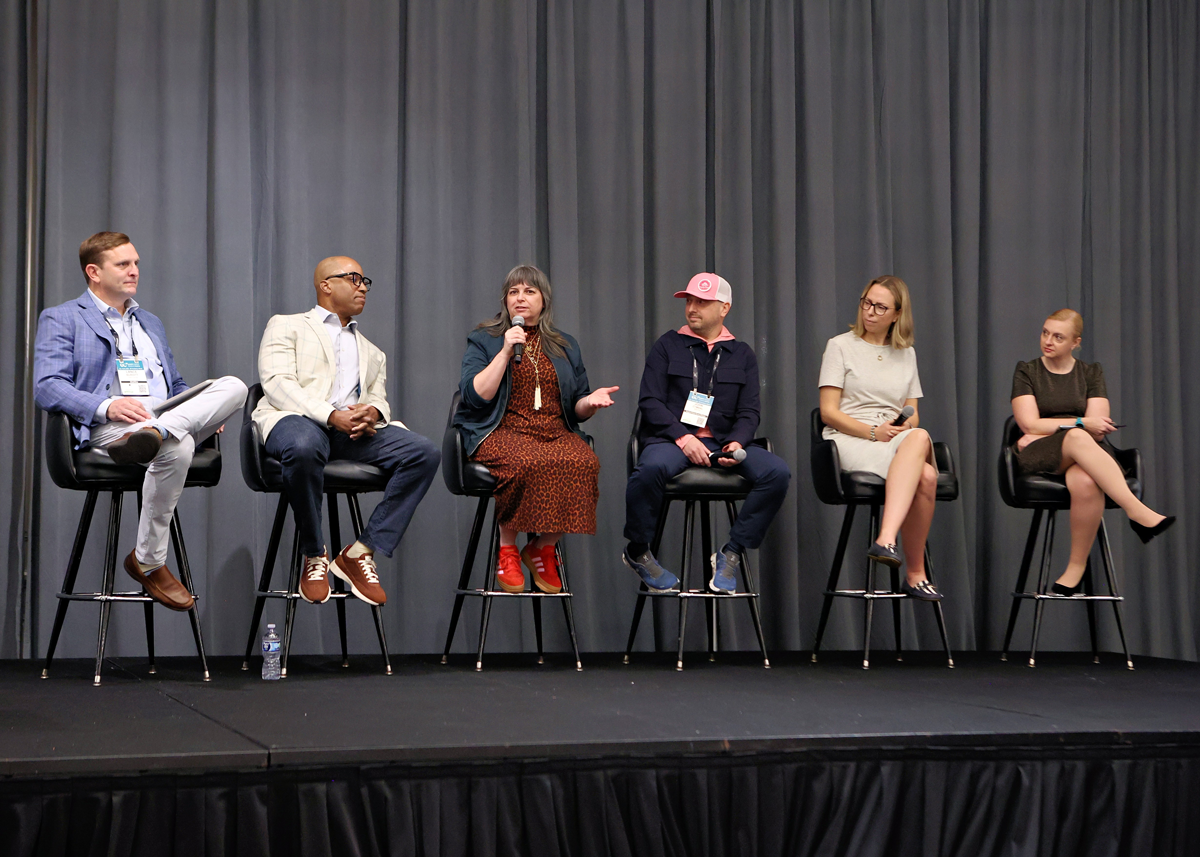
Opening a high-level marketing panel at the event, Lance Burditt, senior vice president of food and agricultural sustainability for Farm Journal, says that while CPGs spend time and money building extremely powerful brands with emotional equity tied to them, the fresh produce industry still lags in building that brand awareness.
Burditt was joined by Kevin Hamilton, vice president of global marketing communications for the U.S. Highbush Blueberry Council; Cristie Mather, vice president of marketing for the Mushroom Council; Kim Chackal, co-owner and vice president of sales and marketing for Equifruit; John Cymbal, co-founder and chief marketing officer of Molly’s Grape & Citrus Co.; and panel co-moderator Christina Herrick, produce editor for The Packer.
The Battle for Wallet Share
Hamilton set the stage by highlighting the differences between CPG and fresh produce marketing, where CPG marketing has successfully tapped into the “need versus want” discussion.
“The biggest difference that I see between what we do here in agriculture and what I’ve seen in the CPG spaces is the understanding that profitability can be driven through behavioral and emotional means, not just sort of factual, tangible pieces; the left side of the brain, the want side of the brain, can drive as much of that profitability as anything else,” he says.
Hamilton says that’s where he sees the greatest opportunity within the fresh produce marketing space: to create something that has both high need and high want to the consumer.
“You really have to connect with consumers,” Hamilton says. “You really have to find a way to garner attention. If you don’t get that, everything else after that is kind of a moot point.”
Mather points out that it’s a myth that fresh produce industry marketing is dramatically different from CPG marketing.
“The difference that we see between ourselves and CPG is actually that there is no difference. Every tool in the marketer’s toolbox is available to everyone in the produce industry,” she says. “So, we should be taking advantage of that and not saying, ‘Oh, that tactic is for them,’ or ‘Only they can do that. That’s not for us. That’s not who we are.’ It is who we are, and it’s how we’re going to be competitive.”
Breaking the Commodity Habit
Chackal, who notes that Equifruit underwent a complete overhaul on its marketing and design about five years ago, says what she’s noticed in the fresh produce space is a lack of branding.
“We can be a little bit lazy when it comes to branding, because we don’t have an enormous amount of competition,” she says. “There’s one organic banana on the shelf. There’s one conventional banana on the shelf, maybe one celery … Go to the coffee aisle, go to the cereal aisle, go to the jam aisle, the pickle aisle; these brands have to compete with each other in a big way. And ... the first thing that you see that really gets you excited is packaging.”
Chackal says Equifruit has put an emphasis on packaging to speak to younger generations in a quick, succinct and memorable way that helps them understand the unique value proposition of Equifruit: paying growers fairly for fair trade bananas.
Cymbal says he enjoys going to the grocery store and looking at shopping lists to learn more about shopper behavior.
“I saw someone’s list, and I was at a Meijer in Michigan, and it said on there, ‘Cheerios, Dr Pepper, Vlasic pickles,’ and then it said, ‘celery, onions, carrots.’ So, all these brands were front-loaded, and then the back half was just celery, onions, carrots,” he says. “There’s zero emotion, zero connection whatsoever.”
Cymbal says he’s worked with Molly Pop to develop a “pink bag promise,” which he says means everything within the pink bag or bottle has a promise to deliver an exceptional eating experience, which helps to build consumer trust.
“Once we have trust, that’s where we get the loyalty,” he says. “It feeds everything, and then once we have that loyalty, customers aren’t going to be shopping categories. They’re going to be shopping brands. That’s where we need to get into the produce area. That’s where I see the biggest opportunity.”
Storytelling as a Competitive Tool
Mather highlights the importance of storytelling, saying it’s the way that produce industry businesses can help contextualize a product for a consumer.
“When you think about your products, you’re thinking: ‘My product story has been the same this whole time. My product attributes are pretty much the same. The health attributes are the same. The way that people might cook or serve my product is the same,’” she says. “But your story can change over time. You can pull different levers to make sure that you’re keeping your story relevant to the conversations that are happening in the marketplace at any given time.”
Mather says the Mushroom Council seeks to grow its presence among those occasional mushroom shoppers and those much younger consumers.
“We can’t just go with the same playbook that we’ve always gone with by saying: ‘These are folks going to be looking at recipe prep videos and that kind of thing,’” she says. “We have to capture their attention outside of the universe that we’re used to working in.”
Mather says this includes not only highlighting the functional benefits of mushrooms to consumers but also reaching the consumer in different spaces. She says the Mushroom Council plans to work with podcasts such as “Call Her Daddy” and will appear on the livestreaming service Twitch for the first time this year.
“We are really working hard to grab the attention of the medium and light mushroom consumer,” Mather says.
Data-Driven Results and Retailer Trust
Building on the conversations around data, Hamilton says: “If you are trying to advertise and promote without insights, you’re driving a car, not knowing where you’re going.”
He says a challenge to marketing in the fresh produce space is that every commodity can claim health benefits. Hamilton calls health a foundational part of marketing and notes the challenge for the industry is to move beyond just health into the space where CPG marketing excels.
“In my first year, we ran some consumer insight studies to understand where health sort of fits in as it pertains to blueberries and consumers,” he says. “One of the most important insights that we uncovered was that eight out of 10 people tell us, ‘We know everything that we need to know regarding the health profile, nutritional benefits of blueberries.’ Those that don’t even buy blueberries say the same thing. Like seven out of 10 say, ‘I don’t buy blueberries, and I still know that they’re super healthy.’”
Chackal also says that there’s a huge fear among retailers to increase the price of bananas, even though it’s only a slight price increase.
“We’ve had retailers go up in Canada 20 cents, 30 cents, 50 cents a pound and with sometimes even zero marketing,” she says. “They see the next day that they’re able to sell the same product at a higher margin that is more profitable and has better distribution of value along the supply chain.”
Chackal says best-case scenario is that a new retailer understands Equifruit’s unique value proposition and leans in with promotion and creative displays, but the worst case is the team takes a “try and see” approach.
“It’s not easy, but sometimes we say, ‘Just give us a chance. This is what we’ve seen be successful in the past, and let’s reassess in a month. If we’re not doing well, then kick us off the shelf and go back to the other thing,’ but that hasn’t happened yet, so we feel even more confident,” she says.