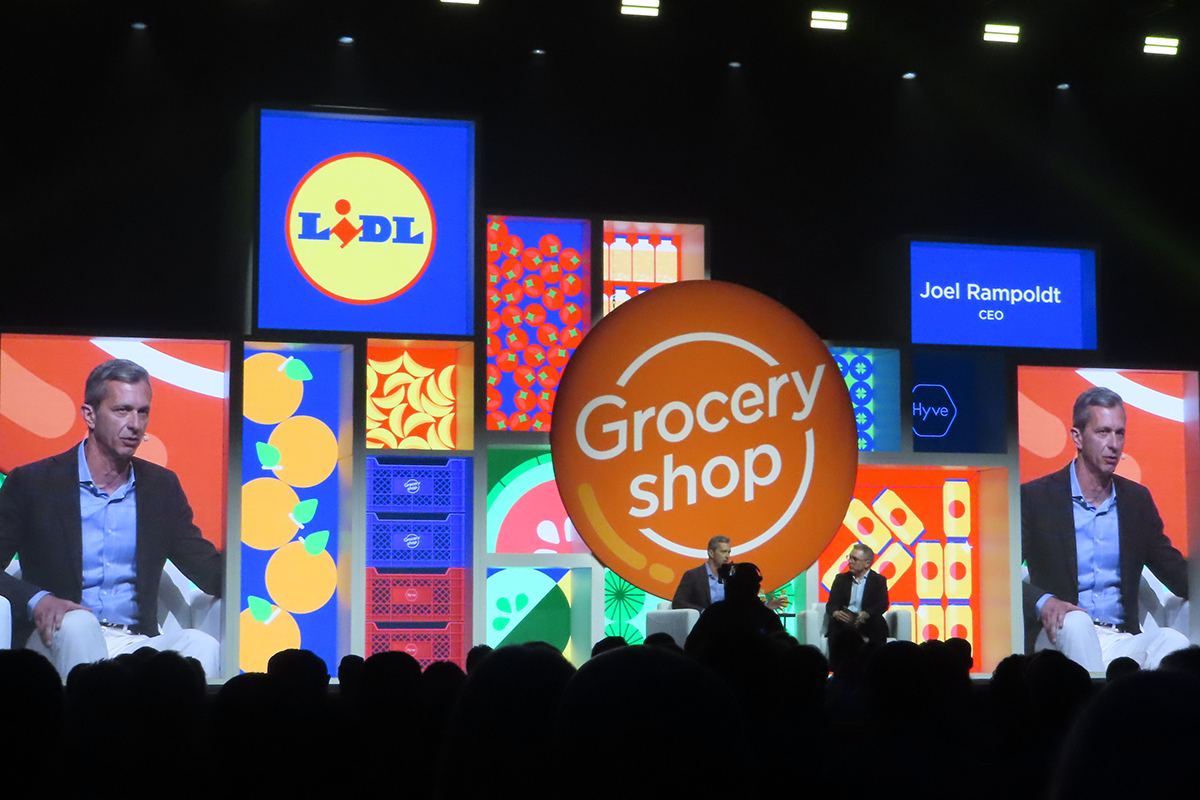
LAS VEGAS — Groceryshop 2025 captivated attendees with a keynote address from Lidl U.S. CEO Joel Rampoldt, who reflected on his first two years leading the discount grocer and laid out the company’s priorities for growth and customer engagement in the U.S. market.
“When I walked in, it was pretty clear pretty quickly that we had four main priorities we needed to work on,” Rampoldt says. “The first was our talent … making sure we had the right people in the right roles, but also we had the right career pathing and training and investments in people.”
The other three vertical priorities, he says, were commercial excellence, operational excellence and financial transformation.
“If you mean to be a price leader, you have to be a cost leader. Otherwise, it’s not going to last,” he says.
A key move was trimming Lidl’s U.S. assortment.
“When I walked in, we had about 4,500 SKUs in our core assortment … we’ve cut that down to about 3,250 in the core assortment,” Rampoldt says. “If we’re really smart about it, we can meet all of our customers’ needs with that small number of SKUs.”
Alongside assortment changes, Lidl refreshed its brand identity.
“We launched our branding of Lidl: The Super-Est Market, which has been very effective,” Rampoldt says. “And we tied that with getting behind some of what we call our Lidl legends, or our hero products, the No. 1 being our fresh-baked croissant.”
On supplier partnerships, Rampoldt acknowledged challenges in the past but emphasized a shift in approach.
“We want to be every supplier’s first choice … predictability, long-term contracts, mutual investment, are all at the heart of that,” he says.
Rampoldt describes Lidl’s guiding principle as being as global as possible, as local as necessary. That includes focusing on market density.
“We all felt that our stores were too spread out across the country. We didn’t have enough local density and scale,” he says. “Part of our strategy is to invest in the markets where we already have a good foothold, densify those markets and really get those distribution centers humming.”
Efficiency, Rampoldt says, is cultural at Lidl.
“What we do at Lidl is we make everything as simple as possible so we can do it as quickly as possible,” he says. “We’re constantly looking at the business, saying: ‘What is more complicated than it needs to be? What can we simplify? Where can we take a minute out of the process?’”
Technology is central to that effort.
“We’ve rolled out electronic shelf labels everywhere across all of our stores now, and that’s a huge labor savings,” Rampoldt says. He also highlighted investment in self-checkout. “Our customers are asking for it … when I’m in our stores where we haven’t deployed self-checkout yet, it’s always one of the first things the customers ask me.”
To enhance customer experience, Lidl zeroes in on the first 90 feet and the last 90 seconds, Rampoldt says.
“The first 90 feet in our stores is fresh when you walk in … we want those areas of the store to be in great shape,” he says. “And the last 90 seconds … leaves an impression as you’re leaving the store.”
Looking ahead, Rampoldt points to consumer trends shaping Lidl’s strategy.
“Consumers are incredibly focused on value,” he says. “And also, I think consumers are more demanding about fresh than ever … the consumers’ expectation just keeps going up and up and up.”
On loyalty, Rampoldt says Lidl’s myLidl app is already a leader within the group.
“We’re No. 1 at the percentage of our customers that use our myLidl app,” he says. “We’re going to strengthen that next year. We’re going to be rolling out a lot of improvements to it.”
As for growth, Rampoldt confirms steady expansion.
“We’re going to open four stores next month, for October,” he says. “We have a plan to continue to open stores for the next 10 years. We’re growing at what I would consider to be a modest pace for now, because we want to make sure that the business is stable and operating exactly the way we want it.”
Some key strategies Rampoldt shared during his keynote address:
Four Strategic Pillars
When Rampoldt took the helm in 2023, he says he identified four key priorities:
- Talent — building the right team, career paths and training to strengthen Lidl’s foundation.
- Commercial excellence — refining the assortment and price architecture to deliver “the right product at the right price.”
- Operational efficiency — simplifying processes to maintain Lidl’s position as a cost leader.
- Financial transformation — cleaning up the balance sheet, exiting unproductive assets and ensuring the business is fit to compete.
Supplier Relationships
Acknowledging challenges with past perceptions, Rampoldt stressed Lidl’s renewed commitment to being suppliers’ first choice. With 85% of products sourced domestically, Lidl is moving toward long-term contracts and mutual investment, similar to its European model. The company remains firmly private-label led, but branded products — about 20% of its range — play a complementary role.
Global Model, Local Adaptation
Lidl’s principle of being as global as possible, as local as necessary, in practice, means adapting U.S. operations (such as direct-to-store deliveries) while maintaining efficiencies from Lidl’s global operating system. Rampoldt highlights the need for local store density: Lidl will densify existing markets to maximize distribution center efficiency rather than spreading too thinly nationwide.
Efficiency and Technology
Efficiency is central to Lidl’s DNA. Rampoldt described a culture of simplification — removing unnecessary steps and reinvesting savings back into the business. Technology is key to this, with electronic shelf labels now rolled out chainwide, saving dozens of labor hours per store each week, and advanced self-checkout systems being piloted in the U.S. in response to strong customer demand.
Customer Experience
Lidl is focusing on the first 90 feet and the last 90 seconds of the shopping trip:
- First impressions with fresh flowers, bakery, produce and proteins at the entrance.
- Final impressions at checkout, ensuring speed and friendliness — whether via staff or self-checkout.
The non-food “middle aisle” is also evolving, Rampoldt says, moving from rotating special buys toward six core own-brand families with changing assortments within those brand umbrellas.
With 190 U.S. stores today, Rampoldt says Lidl plans to continue expanding at a measured pace, opening stores steadily over the next decade while maintaining operational stability. Rampoldt underscores that growth will come after ensuring the business model is firmly locked down with the right mix of efficiency, customer experience and commercial discipline.