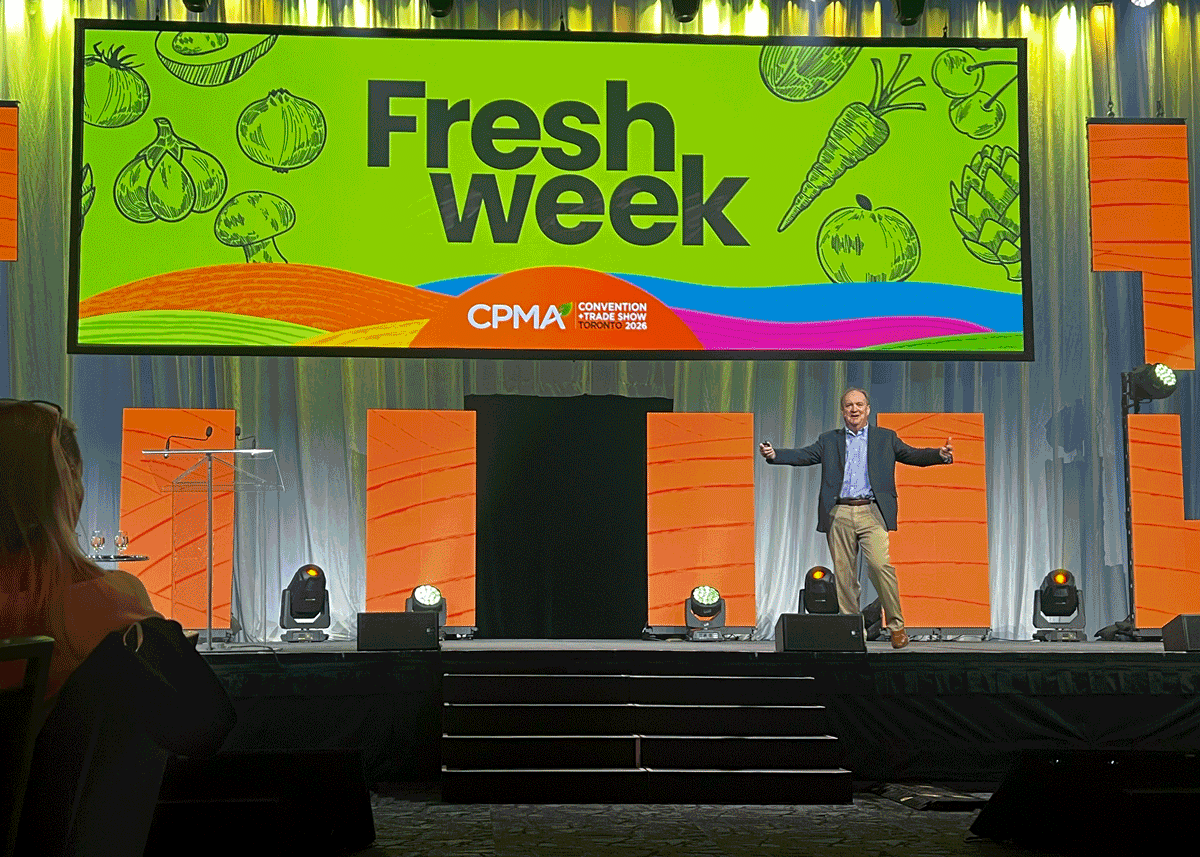
TORONTO — Futurist Jim Carroll started his keynote session at the Canadian Produce Marketing Association’s Annual Convention and Trade Show with a dose of stark reality at the rapid pace of change: “It is estimated that 65% of kids who are in preschool today will work in a job or career that does not yet exist because there’s so much new knowledge, so much new discovery, so much new science, so many new innovations.”
He asked attendees whether or not they were prepared for this reality.
“Are you putting in place strategies that are for a horse-drawn carriage era and we’re already paving the next superhighway of the future?” he says. “The future belongs to those who are fast. It’s not what you’ve done in the past that defines your success. It’s your speed. It’s your agility. It’s your ability to align to a fast-paced future that really defines where you can go.”
Carroll says what complicates not only a future view but also tracking trends is that trends can simmer for a long time before emerging hard and fast.
Farming Without a Sunset
“Take the issue of robotics,” he says. “We’ve been talking about precision farming for decades — a lot of experimentation going on with robotics, ... and all of a sudden, that trend can suddenly accelerate and mature and become very real. And it takes us into a world in which we are no longer restricted to farming when the sun is up, but we can farm 24 hours a day because robotics and artificial intelligence and advanced precision agriculture take us into a world in which we can suddenly do the inconceivable because it has become possible.”
Carroll says this also is going to happen for the fresh produce industry in production, packaging and more, where ideas that are almost inconceivable will become mainstream.
“We are now in a situation in which companies that do not yet exist will build products not yet conceived, using materials not yet invented, with methodologies not yet in existence, with ideas yet to be imagined,” he says. “Who is out there with a revolutionary idea that is going to come to the world of agriculture?”
Carroll likens this to the world of “The Jetsons” TV show, which depicted what the world would look like in 2063. However, a lot of the innovations, including smart watches, smart devices, drones and more are already in place.
“We thought the future was far away. ... It arrived 50 years early,” he says.
Carroll says it’s the pace of change that is incredibly important for the industry to think about and prepare for.
Adapting to the Impossible
Carroll says someone once said that 65% of the knowledge humans have currently will be obsolete in two years, so learning is incredibly important.
The world is going through an era of impossible realities and extreme global volatilities, he says, noting that during economic downturns or periods of uncertainty, 60% of organizations barely survive, 30% disappear but 10% become breakthrough performers.
Carroll says those organizations that double down on innovation during stormy times will become profitable, which he calls “resilience done right.”
“We can panic, we can do nothing, or we can innovate, change and adapt,” he says. “That is your secret for going forward.”
AI, of course, is a significant trend in the industry that will change everything. He says AI, coupled with machine learning and vision, will change the world. During the presentation, he showed a video of a robot that was given a prompt to pick up the extinct thing on a table of items. Within seconds, it had identified a dinosaur.
“That is the future of robotics which is going to change your world,” he says. “We take apart the world of agriculture and robotics and AI and think about the acceleration of precision farming.”
Capturing Attention Span
Consumers today have shorter attention spans, which means produce companies have limited opportunity to draw a shopper’s focus. Carroll says that while millennials might have a rather short attention span, it’s about 6.5 seconds for Gen Z and roughly 4.2 seconds for Gen Alpha.
“What are you doing with your packaging? What are you doing with your branding? What are you doing with your marketing that is trying to grab those momentary moments?” he says. “What are you going to do to continue to innovate in the context in which we no longer have no attention span whatsoever?”
Complicated packaging is out the window; it has to be easy to understand and simple.
“Simplicity is the new pathway forward,” Carroll says. “Your package has to be drop-dead simple.”
And it needs to be innovative. He points to StarKist, which transitioned from tuna in cans to pouches and saw a $200 million sales uplift in the first year.
“What’s your tin can? Where are you bringing out a package because you brought it out in that package for the last 110 years and [where] you are not taking advantage of all the new packaging opportunities that are floating around you as a huge opportunity for innovation, trying to capture the attention of that consumer who no longer has an attention span,” he says.
Prescribing the Grocery List
Carroll says fresh produce also has entered a world of programmable food consumption, where consumers track micros and macros and everything is available on their smartwatch. He says there may come a time when the smart device tells its wearer what to eat and when based on the data it’s tracking.
“This might lead to a world in which your groceries are prescribed to your exact biology,” he says.
Innovate in Uncertainty
Carroll says during a period of supply chain, tariffs and other volatility and uncertainty, the produce industry has the opportunity to see the situation differently.
“You can panic, you can do nothing, or you can innovate, change and adapt,” he says. “You need to wake up every single morning, [and] look at the world as one of opportunity, not threat.”