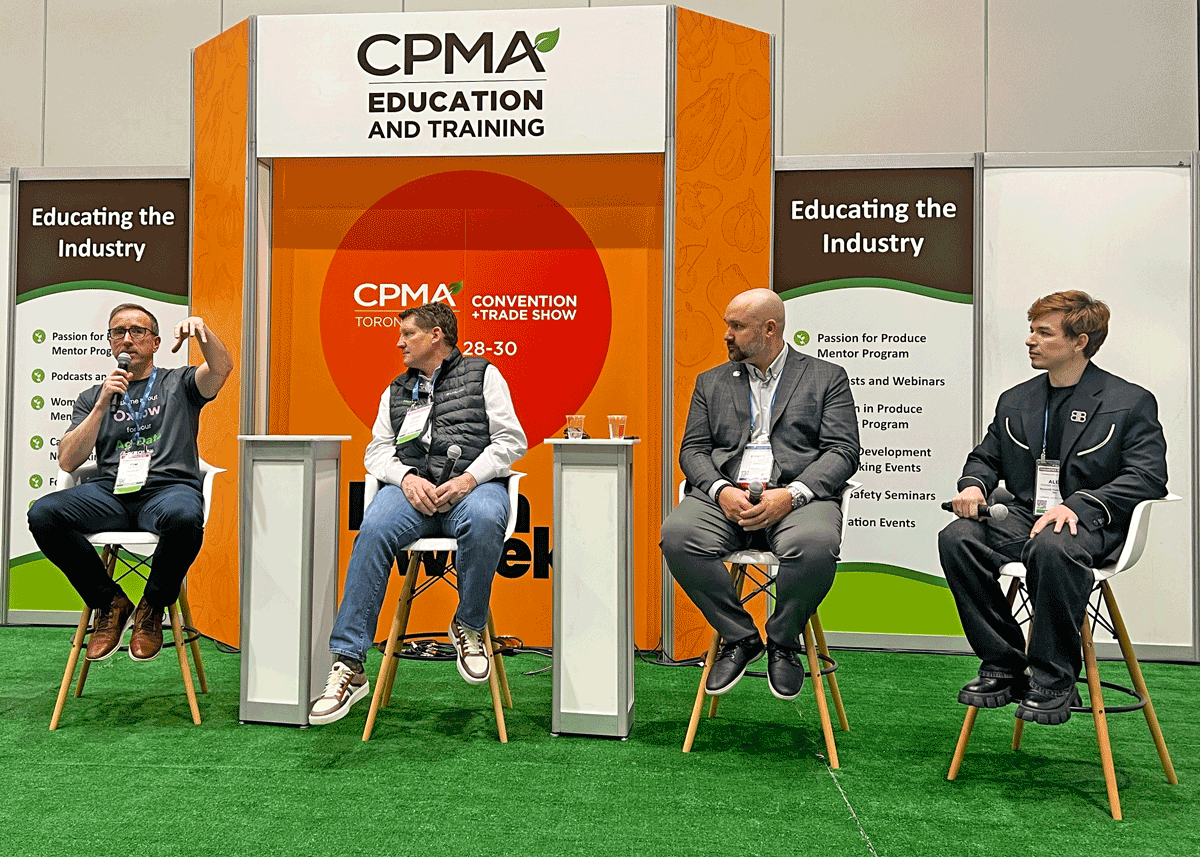
TORONTO — A panel at the Canadian Produce Marketing Association Convention and Trade Show discussed both the opportunities and the challenges of using artificial intelligence in the fresh produce industry. While moderator Steve Roosdahl, CEO and president of BC Fresh, warned that AI can hallucinate and create false information if not fed good data, the benefit to closed data sets was discussed by panelists Stewart Lapage, vice president of supply chain and logistics for The Oppenheimer Group; Mike Meinhardt, North American business development executive for Clarifresh; Tim Raiswell, CEO of Oxrow.ai; and Alex Carvalho, chief technology officer of Bloom IQ.
“AI is kind of like your smartest friend that does hallucinogenic drugs. If AI doesn’t know, it makes it up,” Roosdahl says. “But as it learns, it needs feedback, and it needs good data to make good decisions.”
Meinhardt says these closed data sets, which use only the collected information the company supplies, ensure analytics are accurate.
“That’s a very healthy place to be,” Meinhardt says. “You don’t have to worry about garbage data because it’s your data — your data only that you’ve collected.”
Carvalho says that grounding models using specific searches and algorithms ensure information users act upon is consistent and accurate.
Scaling Operational Accuracy From Packinghouse Sorters to Global Logistics
When asked about the potential benefits AI can present, Raiswell says it falls in two categories. The first is acceleration of work, which includes automating repetitive, standardized tasks like scheduling, processing invoices and compliance. The second includes the ability for organizations to perform tasks previously impossible without specific skills.
Meinhardt says that AI can help scan fruit much faster within packing operations and screen for specific defects.
“We use AI to measure size, color, color coverage, stem color and external defects,” he says. “[We use] machine learning to identify cracks versus scars versus sunburns and so forth.”
Roosdahl says AI can offer consistency that might not be possible with even the best sorter.
“You get consistency because you get a machine that — when people get tired, they miss things, but machines tend not to,” he says.
Lapage says he sees a huge potential for AI’s use in farming to boost long-term sustainability.
“I see the real benefit being actually on the farming and growing side,” he says. “There are so many farmers and growers around the world on a knife’s edge, as we like to call it, whether their businesses and their farming operations are going to be sustainable from year to year. They can use this technology to find efficiencies, save costs, improve forecasting, yield — all the different things to make the farming side of the business sustainable.”
Roosdahl points out that drones could scout for pests and water issues and machines could automatically weed.
Lapage says, though, that data security is a huge focus for Oppy as it integrates new technology. Roosdahl cautioned the audience to ensure that data protection is a huge component of the integration as new technology is brought into an operation.
While it might seem tempting to use a public AI model that’s available — such as ChatGPT, Microsoft Copilot, etc. — Roosdahl cautions against that, as that data will be shared as common knowledge.
“If you just go with public AI and you take all your policies in your company and throw them out there, now everybody has your policies,” he says.
Evolution Toward Specialized Language Models and Proprietary Data Security
Raiswell says that the future of AI is less about the technology and more about how companies will integrate it.
“If you’re wondering how AI is going to impact my workforce, that’s more to do with you and how you structure roles than it is to do with AI,” he says.
Raiswell says industry leaders will be willing to test AI against the best human experts.
“The companies that are willing to ask that question of our gala guy, our Honeycrisp guy who knows the market better than anyone — are they willing to put them up against AI and really test that hypothesis?” he says.
Lapage also says he expects the conversation around AI at CPMA’s 2027 event in Vancouver, British Columbia, will be markedly different, but he warns that produce industry businesses that are reluctant to enact AI might not recover as technology continues to evolve at a rapid pace.
“If we don’t get on board, we’re probably going to get left behind to some degree,” he says.
Meinhardt says he sees opportunities with warehouse and operations, noting that there’s a strong potential for food safety.
“Food safety documentation [is] all rolled up into AI, giving you a food safety scorecard and telling you what your risks and analysis [are] and then, you know, trying to send the alarm light before the alarm light needs to be sounded,” he says.
Carvalho says that AI will shift within the next five years from general large language models designed for broad tasks — such as ChatGPT, Claude and Microsoft Copilot — to smaller language models designed for very specific tasks.
“Each model knows one specific part of the process to help you optimize your systems, your day-to-day and how you work,” he says.
And he expects this small language model will also help improve the work-life balance of its users.
“In five years, I believe we will have a better work-life balance and also a more improved work with all this decision making,” he says.