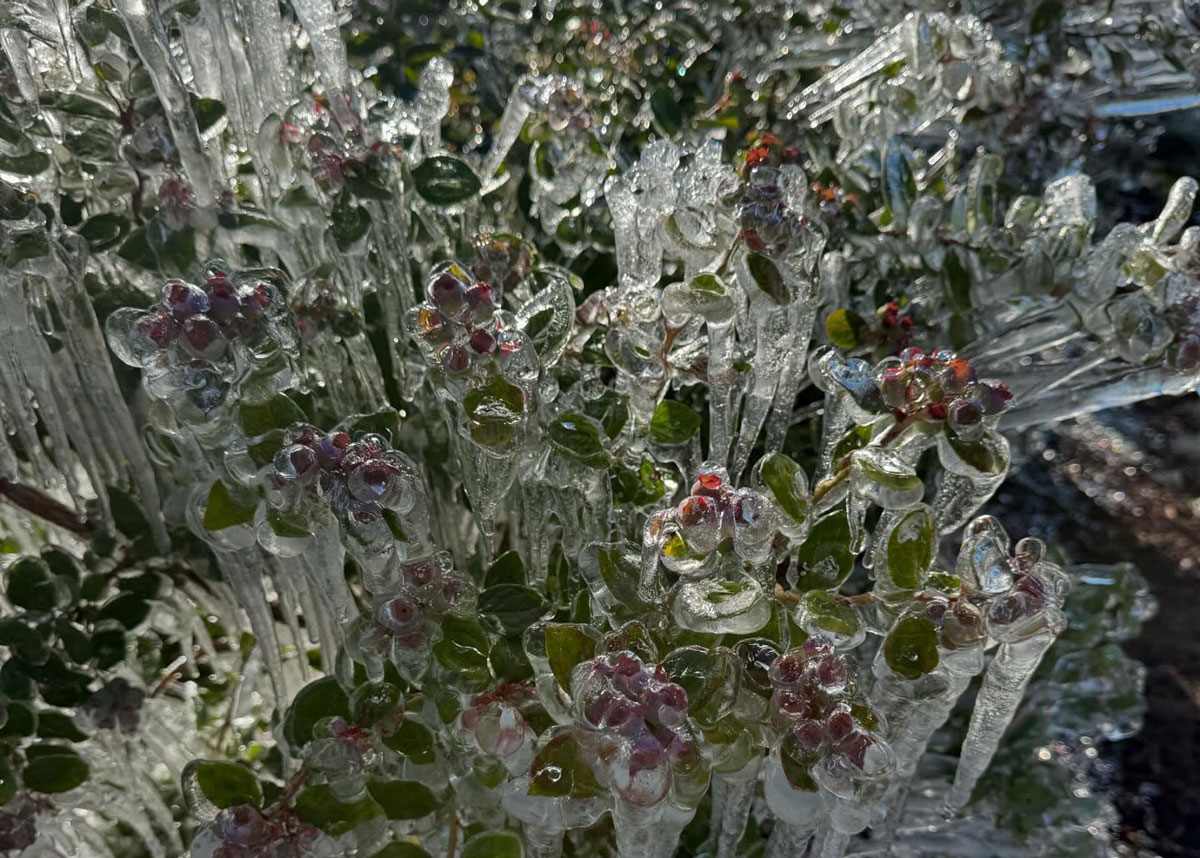
A freeze event in late January and early February has left a lasting impact on Florida’s blueberries, says Philip Harmon, professor of plant pathology and extension specialist with the University of Florida’s Institute of Food and Agricultural Sciences, who offered the assessment during an industrywide update presented by the Florida Blueberry Growers Association.
Harmon says extreme cold and low wind chills killed floral buds, led to dropped fruit and caused plants and limbs to break under the weight of cold protection.
“That has not just cost us this year’s fruit, but also fruit in years to come; replanting is going to be necessary in those cases,” he says. “Even though we may still have some fruit on the bushes out there, it’s very likely that our assessments of loss are going to increase rather than decrease as time goes on.”
Record-Breaking Temperature Swing
Harmon says the generational storm was unlike the typical freeze events that Florida growers could face in a growing season. Temperatures fell below 30°F throughout the state from Jan. 31 to Feb. 2, which was lower than some records dating back to 1909. Further complicating matters were the cold temperatures arriving right after record-high temperatures, he says, adding that the state experienced a nearly 50-degree temperature swing in 48 hours.
“Our plants were not hardened off,” he says. “They had broken buds, bloomed, set fruit in many cases … and those floral structures, once activated, once blooming and opening, become sensitive to these freeze conditions much more so than when they’re dormant.”
Harmon says wind chills also impacted plants. For example, the temperature might have been 19°F in Gainesville, Fla., but the wind chill was 6°F.
“We also had some of the coldest air since 2010,” he says. “And in fact, going back further than that, in addition to cold temperatures, wind chill factors were very low because of an extreme wind associated with this cold temperature, as well as a polar vortex, and it brought us winds in excess of 20 miles an hour during the period when we had temperatures in the teens and 20s.”
Limits of Freeze Protection
Low wind chills also made it very difficult for growers to use irrigation for freeze protection. Harmon says the cold conditions, coupled with the bitter wind chills, reduced the freeze protection’s effectiveness.
Early estimates indicate a 30% to 50% loss in north-central Florida, more than 80% loss in Central Florida and around a 40% to 50% loss in South Florida, he says.
Location and varieties are likely the cause for such extreme fluctuations in initial damage reports. While some blueberry plantings still might have been in the tight bud growth stage, other varieties might have progressed further to early and late pink bud. Blueberry plants that had progressed to late pink bud were the most heavily damaged by the cold snap and will abort.
“Some of our berries in Central and South Florida were very near harvest,” Harmon says. “These become quite sensitive to freeze damage.”
For those berries that do survive, the fruit is much more susceptible to disease, he says.
While cold protection may have been an option for some growers, in some parts of the state temperatures dipped below where cold protection is effective, Harmon says. Ice that forms on bushes keeps the temperature at 32°F, a temperature that blueberries can withstand, but the ice stops forming once temperatures dip below freezing.
“This year a lot of the growers did this exactly right,” he says. “They woke up the next morning with a lot of ice formed. However, not enough latent heat of fusion produced in those cases, in extreme cases, to save the crop.”
Risk of Pathogens
Along with the damage to plants from the cold temperatures, the ice buildup caused cane breakage.
Some plants broke at the bed level, and others suffered cracks and fractures in the structure of the plant. These cracks and fractures can open the blueberry plant to the colonization of stem blight disease, which enters through the wounds, goes to the crown and kills the plant.
“This is not the end of the story as far as the losses that we’re going to see,” Harmon says. “We’re going to see additional losses from stem blight over the next year or two years become even more severe moving forward.”
Harmon says growers need to be mindful of another pathogen, botrytis, as well as blossom blight, which he calls an immediate concern.
“If you haven’t already put out a fungicide for botrytis, consider making an additional fungicide in addition to the program that growers use to protect their crops, where our berries are still on the bush, where we still have some potential for production of a crop this year,” he says.
Anthracnose will be a postharvest concern, Harmon says, especially as growers make the first few passes in fields that have internally damaged fruit on the bushes. Damaged fruit will ripen earlier, and anthracnose can sporulate within a short period of time.
“Anthracnose is one that can cause disease on the canker and the stems, also on the berries … and on the leaves as well,” he says.
Resistance management is going to play a major factor with the applications growers make to control these pathogens, Harmon says. Botrytis and anthracnose have shown fungicide resistance, he says. “We can’t just use one silver bullet product.”
Harmon says the additional stress of winter injury to blueberry plantings allows for pathogens such as Colletotrichum ripe rot to become an even bigger problem for growers in the months ahead. Even with a good fungicide program, growers will need to consider additional sprays to keep ripe rot at bay, he adds.
Harmon says growers who are facing tough losses have a difficult choice of whether or not to make those preventative sprays.
“We’re going to have extremely high disease pressure this year,” he says. “A lot of growers are going through the process of deciding if and when to hedge their crops, their plants, where they’ve lost their crop.”