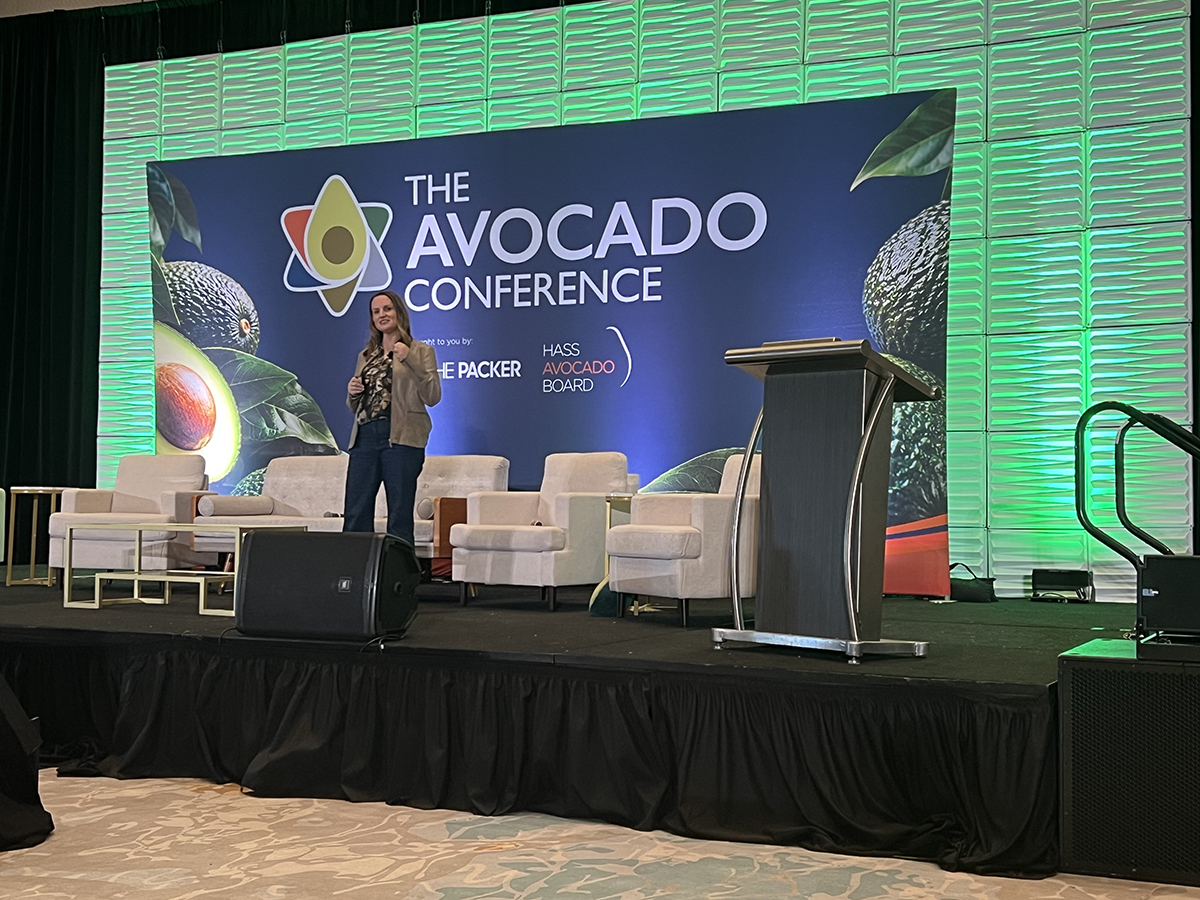
SAN DIEGO — While economic uncertainty and an elevated cost of living are causing today’s grocery shoppers to hesitate in the aisles, tailwinds in certain areas of the fresh produce department are giving the avocado category a distinct advantage over other retail sectors, according to Jonna Parker, vice president of fresh for Circana.
Speaking at The Avocado Conference during a session titled, The Retail Reality Check: How Shoppers, Channels, Merchandising and Fresh Trends are Reshaping Avocado Growth, Parker outlined the macroeconomic pressures shaping modern consumer behavior.
Amid labor market softening and declining consumer sentiment, shoppers are responding with more intentional purchasing decisions, prioritizing value, convenience and versatility while maintaining a focus on everyday health and wellness, she says.
“The reality is that this year... consumers are taking pause at what the future economic impact will be, and those little pauses are causing price sensitivity in the moment,” Parker says. “What it means is that consumers — even if the price of the product hasn’t changed — are wondering, ‘Is it worth it?’”
While that hesitation spans the entire food and beverage retail space, Parker emphasizes that driving avocado sales requires looking beyond simple markdowns.
“You can’t just give a discount and expect someone to buy a ton more,” she says. “That is also another opportunity that we have in avocados — not to pull the price lever, but to drive our own growth.”
Despite the broader economic headwinds, Parker says the current market environment differs sharply from past downturns, positioning fresh foods to outperform other store categories.
“Because truly, the avocado industry... is looking at a lot of positivity,” Parker says. “What’s so interesting about this moment versus the 2008-2009 recession is the tailwinds are in some respects — especially in fresh foods — much stronger of a driver of getting folks to spend than honestly many other items are.”
Redefining Value in the Age of Wellness and GLP-1s
For today’s shoppers, value isn’t defined solely by price, but by relevance and product attributes as they weigh whether an item deserves their dollars, says Parker, who adds that avocados check those boxes, particularly as younger consumers gravitate toward wellness-focused lifestyles and experience-led spending.
“When it comes to avocados, oh, they definitely deserve it,” she says. “Did you know that the average 20-something today is far more interested in how their food is produced and what it’s going to do to their bodies than any 20-something-year-olds in history? That is such an amazing thing for us. Not just because ‘hey, young kids are cool.’ It’s actually going to set us up for a lot of growth.”
Shifting post-pandemic daily routines and the widespread adoption of GLP-1 weight loss medications are also reshaping food demand. Citing Circana’s in-depth research, Parker notes that 38% of U.S. households now have at least one member taking GLP-1 drugs, with another 37% having used them previously or expressing interest — bringing the share of households actively on or considering the medications to 69%.
“Almost every American is doing and living their life differently than they did a decade ago. We have to embrace that change because when we do, it will turn into demand,” Parker says, adding that the category is uniquely suited for the trend.
“Avocados are extremely well positioned for GLP-1 lifestyles, with healthy fat, easy [to consume], and portion size.”
Gas Prices Curb Cross-Town Shopping Trips
Rising fuel costs are also reshaping how frequently and where consumers buy groceries, cutting into the post-pandemic habit of making multiple trips across several stores each week, says Parker.
According to Circana survey data, 85% of consumers reported concern over gas prices in October — a 9-percentage-point jump from August — while 63% said higher fuel costs have directly affected their purchasing behavior, up 6 points over the same period.
“Produce is extremely relevant, but because [of] gas prices, we’re not necessarily seeing every single retailer win. The ones that are positioned right are still making the gas prices worth it,” Parker says. “But we have to make sure we recognize this adjustment in value, and people driving [all] over town to get what they need is kind of at an end with [today’s] gas prices.”
Channel Shifts and Smaller Meals Reshape Produce Buying
Today’s consumers are proving highly adaptable, adjusting not just how frequently they buy produce — including in the wake of the summer’s July cyclospora outbreak — but also which brands they choose and where they shop. Rather than viewing those behavioral shifts as setbacks, Parker urges the industry to treat them as opportunities.
“Every single time a consumer makes a pivot, it’s a growth opportunity,” she says. “But the other big things that are driving this intentionality is that we eat differently as a society today. We are eating smaller meals. We’re changing between foodservice and retail, really trying to solve what we need [for] that meal.”
That adaptability extends to e-commerce, where fresh avocados and other produce items are increasingly being purchased online. Citing Circana data, Parker notes that 10% of every produce dollar sold in America — one in $10 — now comes through e-commerce, making avocados a natural fit for shoppers who aren’t always confident picking ripe fruit themselves. However, she cautioned that digital shoppers still expect compelling presentation rather than simply taking whatever is offered.
“They are just as interested in merchandising digitally as they are in the produce shop,” Parker says, noting that retailers and marketers must also account for five distinct generations of shoppers in the marketplace.
“Embracing what makes today’s consumers different is a superpower,” she says.
Where today’s shoppers spend those dollars is shifting rapidly as well.
Presentation data shared by Parker showed that traditional food stores have lost more than 4 share points in avocados from 2023 to year-to-date, while club stores — followed by value stores — are capturing the largest gains.
“Just since 2022, we have seen the grocery supermarket channel lose five market share points in produce,” Parker says, pointing to major conventional chains such as Kroger, Albertsons, Publix and Wegmans.
“However, with all of the other types of channels, whether it be mass, supercenter, club, value grocery, health and wellness grocery — death by a thousand cuts is what’s causing supermarkets to lose their full share,” she says.
According to Circana’s 52-week figures through October, traditional grocery accounts for roughly 36.7% to 38.6% of fresh avocado dollar sales.
Meanwhile, 20% of all fresh avocado dollars are now flowing through club channels like Sam’s Club, BJ’s Wholesale Club and Costco, while mass retailers account for about 17%. Value chains — such as Aldi, Lidl and Grocery Outlet, which leverage everyday low pricing on bulk and packaged avocados — capture nearly 13%.
Shrinking Baskets and Food Safety Ripple Effects
Across the broader store, food and fresh baskets are shrinking, even though produce remains the most frequently visited department with strong unit depth, says Parker.
Prior to mid-July, produce was ranking as one of the fastest volume-growth departments in the store, according to Parker. However, the summer cyclospora outbreak triggered a sharp demand disruption that reversed that momentum.
“For the first time — definitely in this decade — we are seeing less pounds of produce in this country sold year over year,” Parker says.
That volume decline is happening despite minimal price inflation in the department — average price per volume in produce is up just 0.9% this year, leaving items relatively well-priced compared to other store categories. Still, Parker urges produce leaders to look beyond the perimeter and leverage the department’s prime real estate.
“We just think the world stops at the end of the produce aisle, and yet our positioning in the store is really important,” she says.
While avocados themselves have performed strongly despite the outbreak, the category still feels the ripple effects when food safety concerns pull weekly staple shoppers out of the store. With fewer grocery trips and smaller overall baskets, avocados have fewer chances to piggyback on routine shopping carts.
“Cyclospora and food safety concerns have truly changed not just produce — it’s actually changed a lot of the way we shop,” Parker says.
Despite those changes, opportunity remains to capitalize on produce’s natural foot traffic.
Parker points to shopper behavior data showing that the average family spends about $782 on produce annually across 83 store trips — making it the most frequently purchased category in the supermarket. Because produce already brings shoppers through the doors, she notes that the real challenge for retailers isn’t driving trips but converting basket depth across the department’s 64 categories as consumers buy less per visit.
“Our value is one of [our] greatest superpowers,” Parker says, emphasizing that avocados are stepping up to deliver that basket-building power. “Avocados are delivering when it comes to retail. Retailers need avocados.”
Presentation figures from Circana Integrated Fresh data for the 52 weeks ending Oct. 25, 2026, underscore the category’s scale, showing total avocado sales reaching $3.6 billion and 1.6 billion pounds:
· Fresh avocados: Accounted for $3.4 billion in sales (up 4.2% compared to four years ago) and 1.58 billion pounds in volume sales (up 33.1% over the same period).
· Prepared avocado dips: Generated $200 million in sales (up 36.5% versus four years ago) and 34 million pounds in volume sales (up 46.8%).
“Look at that volume growth of avocados, up 33% since four years ago,” Parker says. “When I talk to retail customers, I remind them of this growth.”
Value Pricing and Regional Gains Fuel Sustained Growth
Avocados continue to deliver consistent retail momentum, buoyed by strong demographic appeal, booming prepared dip sales and a compelling price advantage over the broader grocery store.
“Avocados are in and demand is up in the retail sector,” Parker says. “We see steady growth in dollars and steady growth in pounds.”
That sustained performance stands out against the wider food and beverage landscape. While average prices per item across food and beverage have climbed 26% compared to four years ago, avocados are actually 6% less expensive over that same span, says Parker.
However, she cautions that convenience alone won’t automatically command a premium — shoppers still need to see clear value to justify the purchase.
Geographically, fresh avocado volume is expanding across every U.S. region.
According to Circana Integrated Fresh point-of-sale data for the 52 weeks ending Oct. 4, 2026, growth is strongest in the East — led by the Southeast, where volume sales jumped 15.4% — while California continues to hold the largest share of overall dollar sales.
Avocados Defy Produce Slump With Rising Household Penetration
While Parker notes the summer cyclospora outbreak triggered a widespread pullback across the produce department — resulting in 280.4 million in lost volume sales led by melons, berries, cherries, lettuce, salad kits and more — avocados stood out as one of the few categories to gain ground. Alongside sweetpotatoes and yams (up 12.9 million), corn (up 10.4 million), apples (up 6.2 million) and potatoes (up 4.4 million), avocados added 6.6 million in volume sales during the disruption.
“We saw consumers were walking away from produce and just buying less often,” Parker says. “Not avocados. We are growing faster even in this post-[cyclospora] world.”
According to Circana data, household penetration for avocados climbed to 71.6% — an increase of 1.6 percentage points compared to the prior year — while repeat purchasing expanded by 2 points to reach 59.7% of households. Even as shoppers tighten their overall produce buying windows, consumers continue to purchase avocados every two to four days, though Parker notes that room remains to convert non-buyers.
“This [is] not a unique category. This is an everyone category,” Parker says. “Furthermore, we see repeat purchasing. So, about 60% — 59.7% — of people who bought avocados came back more than once to buy them again. That doesn’t always happen. We see a lot of trends go up and down in produce and other fresh categories. This, not just wide reach, but lasting frequency is really, really important.
“To put that in context, 94 million more households in 2026 bought avocados than in 2025,” Parker continues. “The demand is there.”
Looking ahead, Parker says the category’s long-term runway is already taking shape, driven by everyday habit, rising household penetration, repeat buying, trips and units per buyer, alongside strong engagement from younger generations.
“Avocados are an affordable luxury, a very affordable luxury that premiumizes most meals,” she says, emphasizing the need to focus on the right audiences and consumer education tools.
With broad awareness already secured, Parker’s closing takeaway puts the next phase squarely on building lasting routines.
“The opportunity ahead is to turn consumer relevance into lifelong avocado behaviors,” she says. “Avocados have already won awareness. The next chapter is expanding occasions, deepening frequency, and becoming indispensable across every life stage.”