While two federal judges ordered the Trump administration to pay Supplemental Nutrition Assistance Program (SNAP) funds last week, the ongoing government shutdown has impeded payment of those funds that should have gone out Nov. 1. It's a situation that's left the 42 million people who receive SNAP benefits uncertain about where their next meal is coming from.
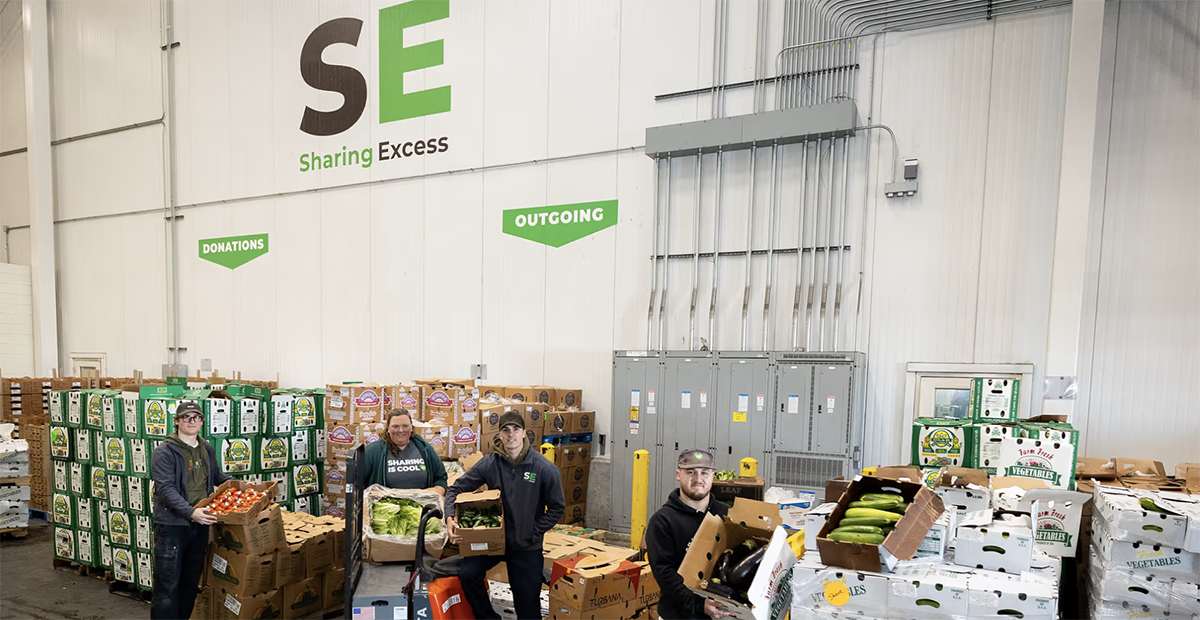
Food rescue nonprofit Sharing Excess, which rescues and distributes more than 2 million pounds of food a week in partnership with grocers, wholesalers and farmers, is working to help ease the uncertainty by increasing access to food through its network of distribution centers.
Evan Ehlers, founder and executive director of Sharing Excess, says the country is facing one of the most pivotal moments in food access in recent history. The Packer spoke with Ehlers on Friday to learn why this is a critical time and what the nonprofit is doing to get food to those in need.
“The reality is, come Nov. 1, people who are reliant on SNAP will no longer see balances in their SNAP accounts if they have used it already, and this is going to be a huge wake-up call,” he says. “Not only will people not be able to use those funds, but they'll be in a moment of panic to try to get as much food as possible into their pantries — into their refrigerators — and it will be a frenzy scenario similar to what we saw during COVID, only during COVID there were SNAP benefits. There was actually an increase in SNAP benefits, so this is going to be even more dire.”
Ehlers says the lack of SNAP benefits is going to put a tremendous amount of pressure on the charitable food network of local food banks, pantries and free food distribution sites.
“And it's almost guaranteed that those sites will be running out of food before the lines of people waiting for food are finished,” he says.
When it comes to the impact at retail, Ehlers says there could be billions in losses if SNAP benefits don't resume quickly.
“There's 250,000 major retailers out there accepting SNAP,” he says. “That's over $8 billion in revenue that will dry up.”
Ehlers says the impact of those lost dollars will not only threaten the food security of everyone using SNAP dollars but local economies as well.
“It will have a chain reaction of effects that are not only going to impact people who are hungry, but also the very businesses that support the food supply for everyone that isn't using SNAP dollars,” he says.
Mapping Out Food Distribution
To help get food to those in need, Sharing Excess has created a landing page on its website that features a map of the U.S. with the locations of food distribution centers and the times they're feeding people. He says the nonprofit is careful to only send people to places that can handle the volume.
“Sharing Excess works with hundreds of community partners with food distribution sites that regularly feed people, and what we're doing is bolstering them with more supplies and getting their approval to send people their way,” he says.
Ehlers, who along with his team were racing to get the map up on Friday, says it's a work in progress that they will continue to enhance.
“Our immediate response is that we're directing people to our closest partners that we're bolstering with supplies,” Ehlers says. “We will also be setting up our own distribution centers that are similar to farmers markets.
“But I want to be clear: We're not going to be able to provide everything that a family needs — every single staple of the food supply from meat to dairy. We have incredible partnerships with produce suppliers that are really becoming our champions during this time and are supporting even more than they have been,” continues Ehlers, pointing to a pear supplier who decided to donate his pears rather than try to sell them.
Sharing Excess works with an extensive network of organizations across Philadelphia, where the nonprofit was founded, as well as in New York, where it works with over 170 organizations across all five boroughs. Ehlers says while Sharing Excess is national, it isn't able to deliver to each site every day.
“It really depends on where we have consistent supply,” he says. “We have consistent supply wherever we have produce terminal partners or retail partners. So, in the Maryland/Virginia area or D.C. and Baltimore area, we're working with about 20 Trader Joe's stores where we're able to provide access at these different sites. And then we are working with wholesalers — mainly in Philly, New York, Detroit and Chicago — at the produce markets there.”
The website also invites visitors to sponsor a truckload of food to any of the sites. Ehlers says it costs about $1,290 for a truckload, which is over 30,000 pounds of food.
“Each truckload is enough to feed 80 families for a month,” he says. “We're seeing some companies sponsor five truckloads, six truckloads, 10 truckloads, and that is what will really keep us going during this time. There are so many generous food businesses that not only are donating their excess that is a part of their normal day to day business, but they're also reaching into their pockets and reaching into their hearts to donate outside of their typical excess or surplus.”

Produce Steps Up
Sharing Excess, which has space at produce terminal markets including the Philadelphia Wholesale Produce Market and Hunts Point Produce Market in the Bronx, N.Y., regularly works with produce suppliers to rescue fresh fruits and vegetables.
“The produce industry, even before this crisis, has been such a steadfast partner of food access, one of those silent supporters that has been the backbone of food security for so many Americans for decades,” Ehlers sats. “I think they have quietly always been supporting this work with fresh food donations, and now they're stepping up more than ever by prioritizing these food distribution sites for free distribution, knowing they won't make a profit for the sake of helping people during this critical time.”
Ehlers says the produce industry is like no other in its response to crisis.
“When times like this happen, although business is also suffering for them, the produce industry still wants to support their local communities, especially when the SNAP dollars that are being impacted and what's going to be available through a lot of food banks is going to be nonperishable food,” he says. “Produce wholesalers are coming in to provide the nutritious food that's really important for families and kids.”
Food Insecurity Persists
With Thanksgiving around the corner, November is a particularly difficult month to await SNAP benefits.
“There is at least the added benefit that people's minds are on giving back around Thanksgiving, so you'll see a lot more volunteers, you'll see more companies wanting to get involved,” says Ehlers. “But there are also increased costs of family gatherings. This is such a critical time for families to have a food budget to be able to provide. And I think we shouldn't understate the emotional well-being of people and families who aren't able to support their children during this time.
“There's not only the physical anguish of hunger, but also the emotional piece and the anxiety that it creates to not have food security for your family going into the winter,” he adds.
Ehlers also wants to remind people that even when government reopens and SNAP benefits are issued, the problem of food insecurity doesn't go away.
“There are already tightening restrictions on SNAP, and everyone has been feeling the pressure of that,” he says. “We saw a 40% increase of people in need showing up at all our partner distribution centers before this shutdown was impending. So, even if this does get resolved, we still need to think about how we are going to come together as a society to support if communities can no longer rely on SNAP.
“SNAP supplies nine times more food than all food banks combined,” he continues. “I don't think when people hear about some of these SNAP changes that they really understand that. We should be advocating for doing everything we can to protect SNAP because we're never going to be able to fill the gap as a charitable food network.”
Your next read:
- Stop to SNAP Payments Could Have Multibillion-Dollar Ripple Effect on Entire Food Supply Chain
- ‘Unprecedented Hunger Crisis' Looms as Illinois and Arizona Brace for SNAP Shutdown
- Food Banks Brace for ‘Tsunami' of Need Without SNAP Disbursement
- SNAP Cuts Could Leave Millions Hungry, States Scramble to Fill the Gap