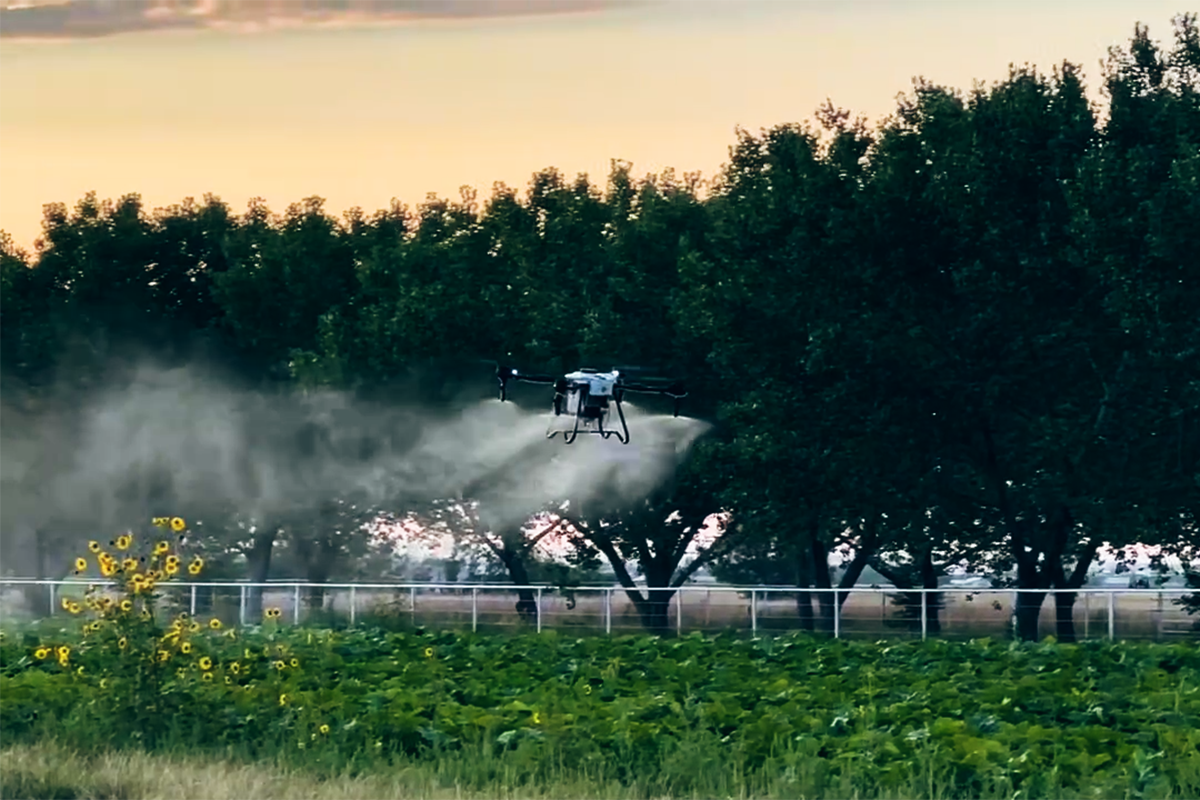
For specialty crop growers, 2025 marked a turning point. Faced with tighter margins, labor shortages and heightened sensitivity to off-target applications, growers leaned harder than ever into precision agriculture, according to Arthur Erickson, CEO and co-founder of Hylio. While adoption once lagged due to concerns around payload, accuracy and drift, those barriers are quickly disappearing, Erickson says.
Specialty crop operations, from citrus and berries to nursery and tree fruit, made notable strides in adopting spray drones and autonomous tools in 2025. Erickson estimates Hylio alone saw roughly a 30% increase in specialty crop adoption year-over-year, driven by advances in drone payload capacity and GPS accuracy.
“Specialty crops are really sensitive,” Erickson says. “You can't have drift from one field to a neighbor who might have a nursery or another sensitive crop.”
Improved RTK (real-time kinematic) precision and larger-capacity drones addressed earlier concerns, making targeted applications feasible even in smaller, high-value fields, Erickson says.
While both row and specialty crop growers faced a learning curve, Erickson says the shift was often more pronounced for specialty operations. Higher dollars per acre and greater crop sensitivity demanded a more disciplined approach to application.

“They're having to implement high-resolution scanning with drones or satellites, use AI tools to analyze that data and then apply only to problem areas,” Erickson says. “They can't just throw stuff at the wall anymore.”
This precision-first mindset allows growers to protect crop quality while reducing unnecessary chemical use — a key concern in specialty markets.
Erickson says in specialty crops, drones often serve as force multipliers rather than substitutes to the labor force. Many operations simply lack enough skilled workers to execute the number of applications required for optimal crop health, he says.
“You might have two or three people you really trust, but they only have so much bandwidth,” Erickson says. “With drones, one person can do the work of five.”
That capability allows specialty growers to increase application frequency, sometimes from what they could manage to the 12 to 20 passes a crop might actually need, without adding staff.
The Year Ahead: Precision as a Survival Strategy
Looking forward, Erickson sees flexibility and responsiveness as critical for specialty crop success. With market volatility and input cost swings likely to continue, the ability to adapt quickly will separate profitable operations from those struggling to keep up.
“Precision tools are less capital-intensive and much easier to pivot with,” Erickson says. “They let growers respond to whatever the season throws at them.”
While some economic analyses from the row crop world suggest autonomy isn't broadly cost-competitive with average labor rates, only becoming advantageous when labor costs exceed about $44 per hour, Erickson believes that framework doesn't fully capture how specialty crop growers are using the technology.
“Specialty crops are less about swapping out one hour of labor for one hour of autonomous machine time,” he says. “Growers are using these tools to get better timing, reduce drift risk, improve crop quality and expand what one crew can do in a day — those benefits aren't always reflected in a simple labor cost equation.”
This positions autonomy as a tool for value creation, and not just a labor cost substitute, in high-value specialty systems.