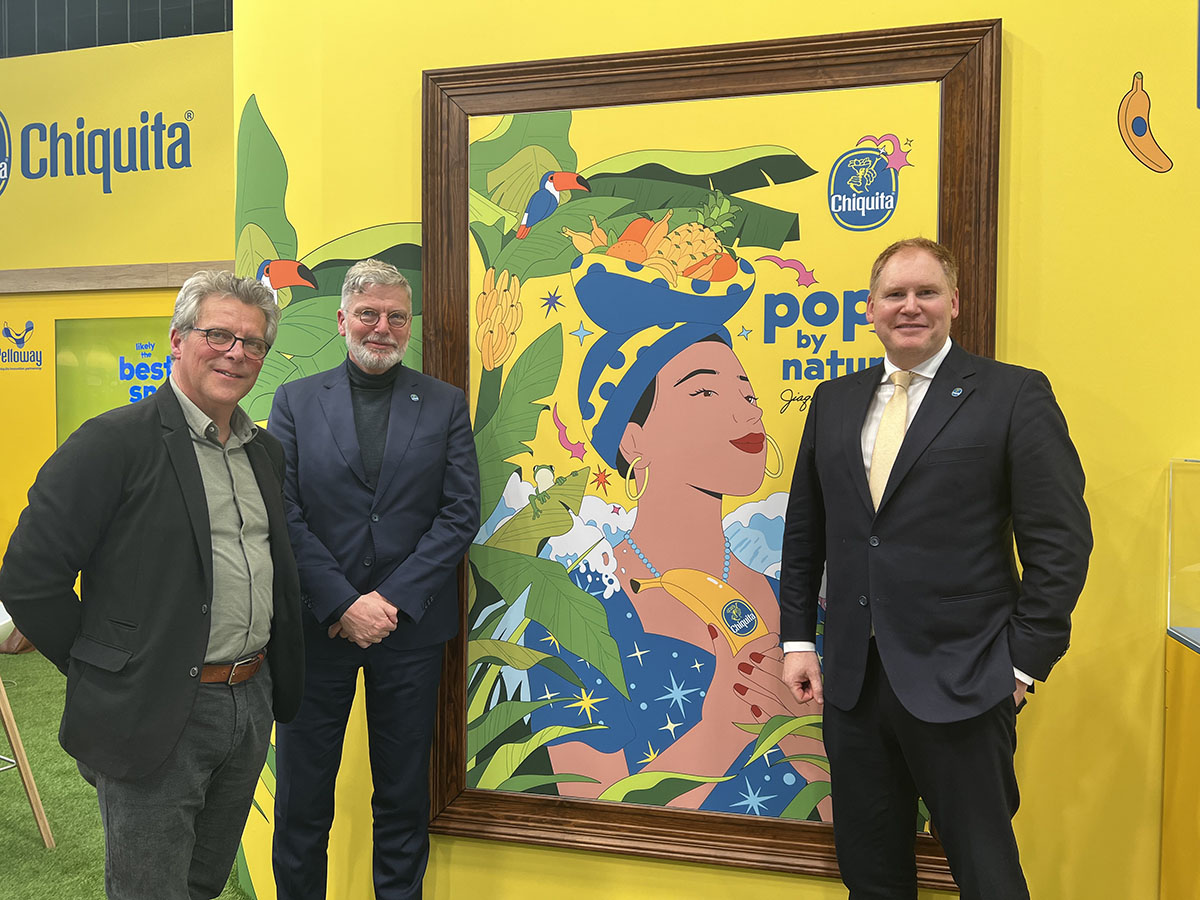
BERLIN — Yelloway, Chiquita's innovation partnership with KeyGene, has announced what it says is a major breakthrough in future-proofing the banana industry: the completion of a banana pan-genome that accelerates breeding of disease‑resistant, climate‑resilient banana varieties.
With Fusarium wilt Tropical Race 4 (TR4) continuing to spread worldwide and Black Sigatoka costing the banana industry more than $100 million annually in protective measures, the need for faster, more precise breeding has never been more urgent.
What's a pan-genome and how can it help the banana industry respond to global disease threats?
A pan-genome is like a “treasure map,” Peter Steadman, director of sustainability for Chiquita, told The Packer at Fruit Logistica 2026. It's a detailed map of a species' genetic diversity that reveals the full range of variation found in bananas, enabling faster, more precise research and supporting the preservation of biodiversity.
Cavendish in Crisis
This understanding of genetic diversity is critical in an industry dominated by a single variety, as more than 95% of the banana export market is comprised of cavendish bananas.
“From a sustainability perspective, that's a situation you don't want to end up with,” says Gert Kema, board member of Yelloway and emeritus professor of phytopathology at Wageningen University. “There are increasing disease problems, and they revolve around two diseases: The first one is Fusarium wilt, and the second one is Black Sigatoka.
“Yelloway was founded as an innovation partnership between Chiquita and KeyGene with the final goal to deliver diversity to the retail store and to consumers,” Kema says.
With a market dominated by cavendish varieties, essentially one clone, the threat of disease potentially taking down an entire industry is real.
“We are spending around $100 million U.S. dollars a year spraying to stop Black Sigatoka disease,” Steadman says.
Black Sigatoka stops the plant from photosynthesizing, resulting in low yields of weak, small bananas.
“That's a huge cost for any agricultural business to spend $100 million on something that doesn't actually stop the disease,” he says. “We're not growing more bananas; we're just stopping it from getting worse, and that cycle is increasing all the time, especially in hot spots like Costa Rica.”
Adding to the challenge is the threat of TR4.
“We've spent millions on biosecurity to try and stop the movement of people in and out of our farms, because TR4 is a soilborne pathogen that can move just as easily in river water as it can on the boot of somebody's shoe, and we want to try and minimize the risk of that,” Steadman says.
Being soilborne has accelerated the spread of TR4 exponentially.
“More and more countries are seeing it,” Steadman says. “It's now been confirmed in Ecuador, which is a huge powerhouse of production, both for the conventional and the organic market.”
What's more, Steadman says, TR4 can also be dormant in the soil for up to two years. “So, wherever we know it is now, it's already two years ahead of us.”
Adding to the uncertainty, there's no way to know exactly how much of banana production has been impacted by TR4.
“There isn't an incentive mechanism for growers to come forward to acknowledge that they have TR4,” Steadman says. “There is no mechanism that exists out there to say, ‘OK, well, you have TR4, you can be compensated and assisted to move into something else.'”
But this is not the banana industry's first disease epidemic.
The Fusarian fungus, also a soilborne fungus, caused the first major plant disease epidemic in bananas in Central America in the 1950s and wiped out supplies to the U.S., Kema says.
Enter the cavendish variety — a wild clone discovered in Southeast Asia that eventually made it to the U.K., where the Duke of Cavendish lent his name to the fruit growing in his botanical garden in Derbyshire, Kema explains.
“Why did cavendish emerge? Because it was super resistant and still is resistant to the strains that caused that first Fusarian wilt epidemic,” Kema says. “Then in the late '60s, a new strain emerged in Southeast Asia, which we call now Tropical Race 4, and that is extremely pathogenic on cavendish.
“You have kind of repetition of history now, since the last 10 years, that strain has disseminated to 17 new countries in all major production areas, including Latin America,” he says. “Now cavendish is really under threat, and we have a global monoculture that is super susceptible to this fungus.”
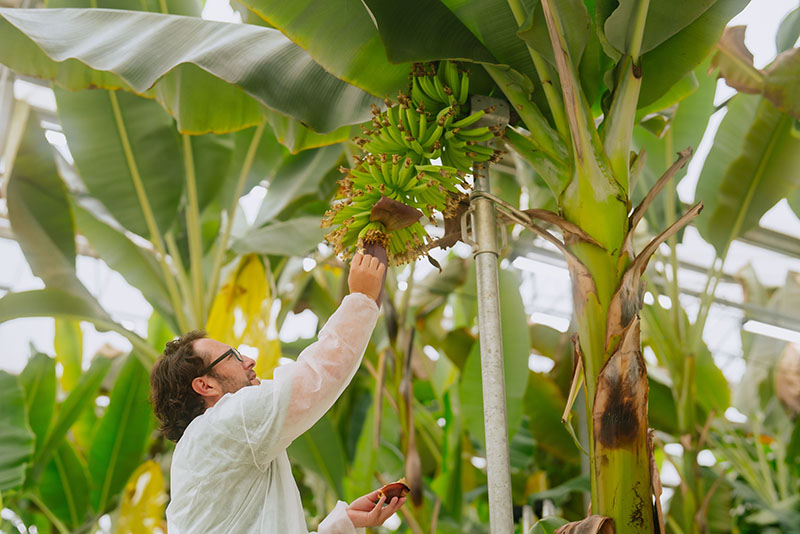
Critical Tool for Accelerating Disease-Resistant Bananas
Developed by KeyGene scientists using Oxford Nanopore sequencing technology in a collaboration across the banana value chain with Innocent Drinks, which provided match funding for the project through its Farmer Innovation Fund, the banana pan-genome is a milestone and major step forward in Yelloway's innovation roadmap.
As part of its commitment to shared progress, Yelloway says it will share this knowledge and provide access to the pan-genome for academic researchers through a dedicated web portal to foster collaboration in banana breeding and research.
What does the pan-genome breakthrough mean for the future of the banana industry?
“Our solution to the issues in the banana sector is novel varieties … more diversity of varieties in the fields,” says Anker Sorensen, vice president of new business at KeyGene in the Netherlands and a founder and board member of the Yelloway partnership. “Diversity is a result of diversity in the DNA of the plants, … so a pan-genome is a very powerful tool because it's a precise description of the DNA diversity in all of the different banana accessions that we are using in the breeding program.”
The banana pan-genome has sequenced 52 wild banana species.
“We know from beginning to the end what the DNA sequence is, where the genes are. And for some of them, we already know what the genes are doing,” Sorensen says. “So, we can kind of predict what offspring will come out of the process.
“With the resolution of a pan-genome, we can go to the gene level and say, ‘this is the DNA variation in nature we are interested in, and that's what we want to have in our future varieties,'” he adds.
Sorensen estimates Yelloway is five years out from commercially scalable, diversified banana varieties.
“The breeding program is geared toward developing this diversity and novel varieties continuously,” Sorensen says. “The first ones that we will start with are the ones that are resistant to the two main diseases, which we expect to have ready five years from now to be ready for commercial scale-up and production. After that five-year period, there will be new varieties arising continuously.”
While diversity with the goal of disease resistance is the initial goal, the pan-genome will allow for more nuanced cultivation down the road.
“Then we can start looking at other things like more yield, more steadiness — not falling over when there's a lot of wind, more immunity to the things we are facing in terms of climate change, resilience to heat, resilience to frost,” Sorensen says. “These are all traits that are hidden in the DNA and our task is to find out where it's hidden and then to make the smart combinations to have those traits in the new varieties. And this is exactly where the pan-genome comes in as a very, very powerful tool.”
And the pan-genome is a tool that Yelloway expects will continue to deliver.
“Our ultimate goal is to replace cavendish by not only one cultivar, but over time, delivering continuously new, innovative, disease-resistant varieties,” Kema says. “That's what breeders do, and that's the aim of Yelloway.”
Fueling a Favorite Fruit
Once again, The Packer's Fresh Trends 2026 report of more than 1,000 consumers nationwide found that bananas are the No. 1 most-purchased fruit.
“Bananas play such an important role in our lives — in Europe, in North America. It's a function of affordability,” Steadman says. “To be honest, it is one of the world's most loved fruits because it is also the world's most affordable fruit. And that's what Yelloway helps safeguard.”
As the banana industry grapples with increasing production costs and insecurity, Yelloway hopes to bring more stability to supply and more sustainability to the farming system, he says.
“What we're doing is guaranteeing long-term supply, long-term security of supply, long-term affordability of bananas — both for our retail customers and for the consumers, which I think is very important, the ability to put to buy five bananas per child and let's put it in the lunch box every day. That's something really important for nutrition and food security.”
Steadman says Yelloway is also committed to safeguarding the banana industry for the communities that grow them.
“There are also hundreds of millions of people around the world that rely on the banana industry, whether it's for employment or for food security,” he says. “We want to help by making bananas more secure. We know very well how reliant the communities within which we work are upon the banana industry for their income.”
Yelloway also understands that the need for continual innovation is key to a sustainable banana supply, as there will always be new disease and climate pressures on the horizon.
“Yelloway is an innovation partnership. And this is a pipeline that will continue into the future because Black Sigatoka is not going to just be fixed once and go away,” Steadman says. “We're going to have to keep releasing new varieties into the future. We can also look at the market, what the market wants, and that's what this innovation pipeline has created for us is safeguarding the future of the industry.”