BERLIN — As generative artificial intelligence continues to reshape how information is created, distributed and consumed, protecting your personal and business brand reputation has never been more important.
At the International Fresh Produce Association Executive Leadership Summit Europe on Feb. 3, the day prior to the start of Fruit Logistica 2026, Pete Wilson, partner and head of digital reputation for EMEA FleishmanHillard, addressed a room of produce industry leaders on the topic of “Trust, Intelligence and Influence: Protecting Brand Reputation in an AI-Driven World.”
“I’m a reputation management guy,” Wilson said. “And I’ve been asked to talk to you about managing your reputation through marketing and communications.”
Just three years ago, business communications were human to human. Sure, we had spell check and Google finishing our sentences, says Wilson, but it was all driven by humans.
“Three-and-a-half years after ChatGPT came on the market, we’re only at this point now where humans and machines are working together,” he says. “And initially it was just a chatbot, which was quite a lot of fun.”
Next came AI-generated images, which were easily identifiable as fake. Then last year OpenAI Sora came onto the market, and that meant we could create videos that weren’t real.
“The market is moving extraordinarily fast,” Wilson says. “That’s the first thing we have bear in mind ... We don’t know what’s coming, but we can guess already it’ll be machine plus human, as opposed to human plus machine.”
6 Key Things to Know About Communications and AI
Wilson highlighted the following in this new world of marketing and communications.
1. AI Shapes Reputation
While it may seem obvious, Wilson says, the key is it’s not passive any longer.
“AI is actively shaping your reputation,” he says. “This should matter to you, because AI is shaping your reputation, not just you personally, but also your business and your sector. And it’s being done all the time.”
Consider that there are 2.5 billion prompts in ChatGPT every day that come from virtually nothing, he says. Three years ago, Google got 15 billion searches a day.
ChatGPT is catching up to Google, and quickly. While it isn’t the only large language model out there, it is the dominant player, Wilson says. Another fact to consider, he says, is that 20% of all content on YouTube is fake, and creating fake content on Facebook is also easy to do.
2. Trust Is Being Outsourced to AI
Do a Google search and you now get an AI summary overview — a condensed response of everything on the internet.
“When you used to ask a question, you’d say, ‘Provide me with everything about BMW 3 Series,’ and you’d get a series of links. They’re called blue bits,” Wilson says. “Now, if you said to Google, provide me [with everything I need to know] they’re going to know about a BMW 3 Series, it’d say, ‘That’s quite a car, right?’
“Why is it doing that? It’s providing a value judgment,” he says. “It’s algorithmically programmed to summarize and provide a value judgment. Now imagine that’s your business that I’m asking a question of.”
People can ask if they think your business is trustworthy, and you might not like ChatGPT’s answer.
Google and ChatGPT aren’t just going to provide a bunch of links. They’re programmed to keep you interacting, Wilson says.
“All of this means Google wants to keep you in its program,” he says. “That’s not surprising. Facebook does. Meta does. They all want to keep you in their program. They don’t want you walking away. They want you to interact with the results so you stay exactly where you are.
“That’s worrying for e-commerce businesses,” he adds.
3. AI Collapses Time in a Crisis
“What does that mean? In the old days, when you’ve had a crisis, a reputational crisis, you had time on your side,” Wilson says. “I expect you had a media consultant or a crisis consultant who would say to you, sit put, sit tight, do nothing. And you’d wait, and you’d wait.”
Then you’d consult your social and legal playbooks and finally decide how to move forward.
“Nowadays, that time is gone,” he says. “You can’t sit around and have a meeting, because by that time, something else has already happened.”
And misinformation and disinformation can spread like wildfire in the age of AI.
4. AI Lowers the Cost and the Practical Consequences of Disinformation
Wilson shared the story of someone who created a fake company with fake products and a fake website to see if he could trick ChatGPT and other large language models. He then wrote reviews about his products in three well-known blogs. He put reviews up there, saying what great products they were.
He then created an FAQ section on the same fake website that specifically said the company was fake, the reviews not true, etc.
But because ChatGPT is geared up to look for earned answers, it continued to generate answers to questions about the fake company that were based on the initial lies.
“That means ... that these large language models continue to get it wrong,” Wilson says.
Why? Because earned “content” has more weight than what you say about your own business, he says.
“Five to 10 years ago, disinformation could only be done at government level or very, very high level, because it cost a lot of money,” he says. “Nowadays, I could do it at home. You could do it at home. You could take down a business, almost on your own at home, because disinformation is that easy to do.
“Disinformation is a real problem, and it’s not just on a government-, foreign-acting level now,” Wilson continues. “It’s really at an individual level.”
Disinformation isn’t just done casually in a vacuum; it’s done where there’s an emotional appeal attached to it.
5. Disinformation That Pulls at the Heartstrings
When there’s an emotional appeal, Wilson says, that makes the disinformation stick.
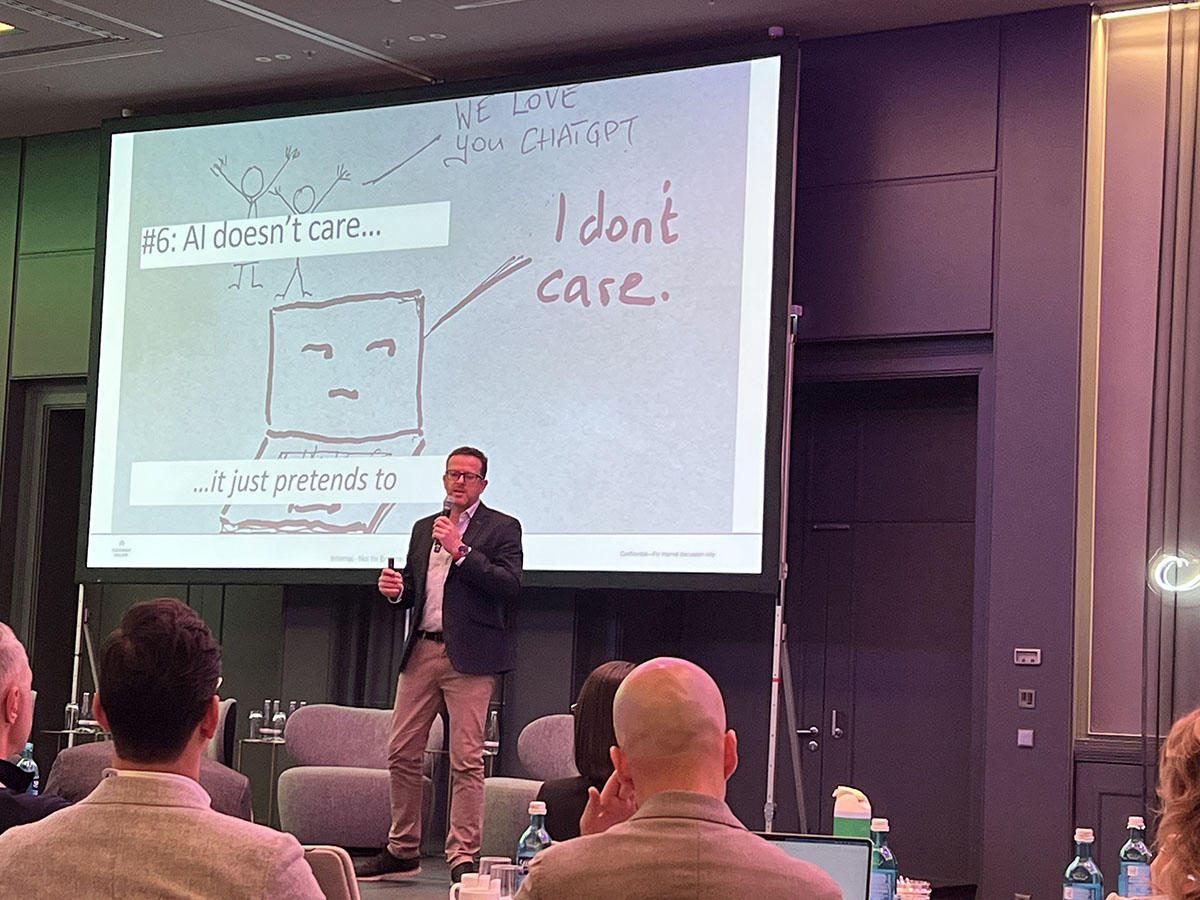
6. AI Doesn’t Care; It Just Pretends to
“AI is an algorithm. It’s a predictive algorithm. It’s a series of words in a known order,” Wilson says. “Actually, it doesn’t care. It just tells you what it thinks you want to hear. Because every time it learns from what you ask it, and it thinks, ‘Oh, that person is easy. They liked it. That means I’m doing the right thing.’ It doesn’t care; it’s just built to succeed.”
5 Things We Can Do About it Now
Wilson recommends taking the following actions today.
1. Stress Test Your Reputation
Find out what large language models think about you. Put your brand or business into any of those large language models, and it will have an opinion of you. Either you as an individual or your business or both.
Find out what large language models say about you, because you may have a problem without realizing it.
2. Decide What You Want to Do About That
You will have a reputation, and now you need to decide how much data you want to put in the system. We want to have a balance of negative and positive in the system. To give these systems a bit of credit, they will always look for balance. They will look for the bad and the good — the contrary views.
3. Put Yourself Out There
Speak in public more often. Stand on a stage and speak in public. Get on your LinkedIn channels. Do videos. Be active. Be proactive.
“You as individuals, and your C-suite, your leadership, are very difficult to impersonate,” Wilson says. “If you don’t speak often, then any one of you can be personated.”
4. Have a Crisis Plan
Use AI to build an automated playbook that you can operate within an instant of the crisis going on, Wilson says. You could use AI to create 50 responses to possible crises. You also can use AI to monitor your brand, the media message of your brand and the social message of your brand or business. You should be doing that already. The more you listen to now, the more prepared you are.
5. Have an AI Governance Policy
Prepare an AI governance policy for every employee in your operation who uses AI.