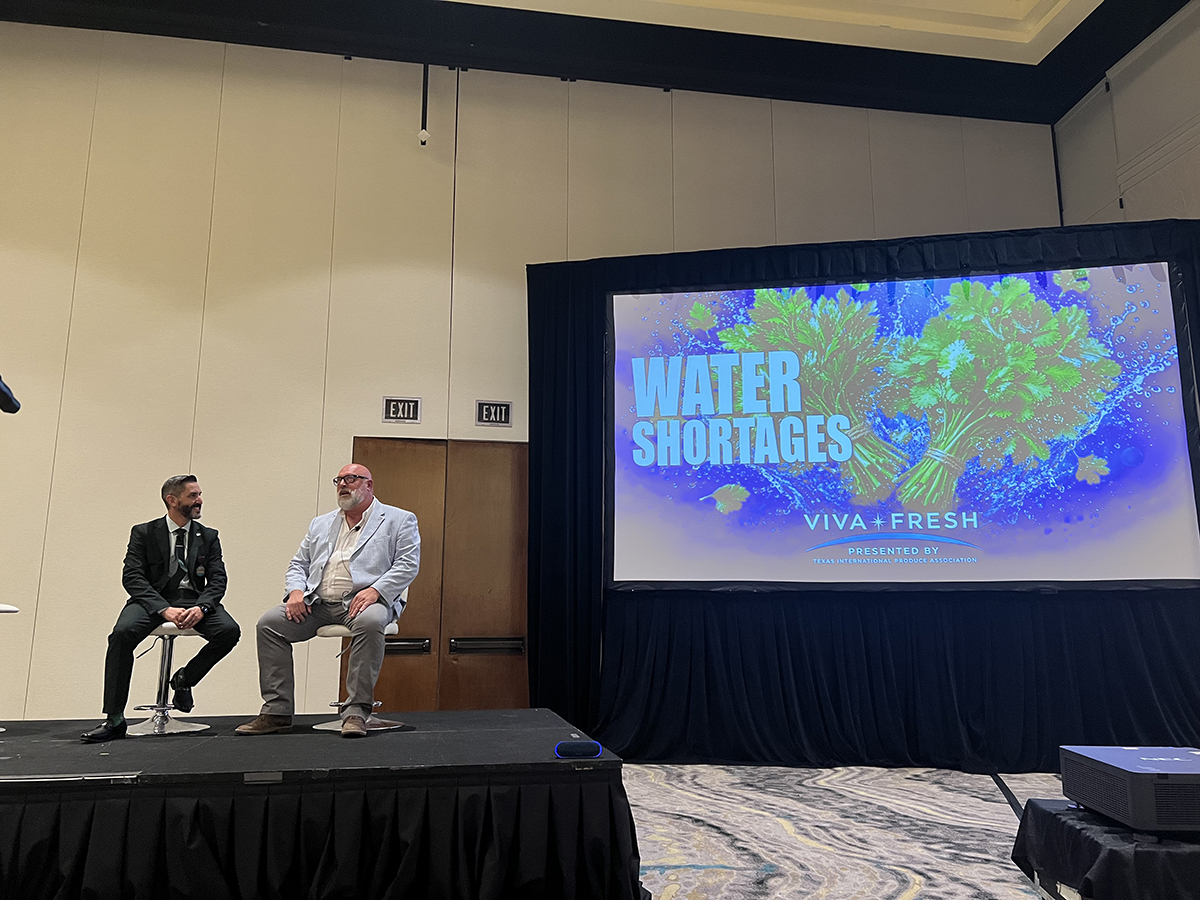
SAN ANTONIO — From labor and water shortages to fraud and cartels, the fast-paced, insight-packed session, “TIPA on the Buzzer Beaters of Produce Policy,” at Viva Fresh Expo 2026 tackled some of the biggest challenges facing produce in the Tex-Mex corridor and beyond.
The April 17 session featured the Texas International Produce Association’s Dante Galeazzi, CEO and president, and Jed Murray, director of government relations, who offered rapid, three-minute responses to a combination of prepared questions and questions from the audience on a range of hot topics.
Call for Water Infrastructure
Persistent water shortages in South Texas, driven by drought and water obligations from Mexico under the 1944 treaty not being met, have forced farmers to cut back on both the acreage and variety planted to fruits and vegetables, says Galeazzi.
Water scarcity, affecting the Rio Grande Valley and surrounding areas, has caused some producers to plant only half their typical acreage while others face reduced yields, smaller produce and significant financial risks.
“Weather and water shortages played a major role,” says Galeazzi, who notes Texas water shortages led to decreased production of between 30% and 40% this season for growers in the state.
“Water infrastructure seems to be the very last thing we focus on,” says Galeazzi, who sees investment in other infrastructure from roads to bridges to internet. “The government needs to look at water infrastructure before it’s too late to do something about it,” he says.
Produce Prices Not Keeping Pace
While the cost of growing, packing and shipping produce has gone up exponentially, produce prices at retail went up just .03% in the last year, says Galeazzi.
“We are not seeing prices adjust quickly enough,” he says. “Just in the last year alone the price of diesel has gone up $2 a gallon. A truck from the Rio Valley in Texas to Hunts Point [Produce Market] costs $800 more in fuel.”
Add to this soaring input and labor costs, tariffs and geopolitical volatility, and the profit margin on produce shrivels further.
Labor Crisis Accelerates
Because of its proximity to Mexico, South Texas was slower to experience labor shortages than other parts of the country.
“Our folks really didn’t start feeling labor shortages until about 15 years ago, but very quickly in the last 10 years, those issues have compounded, and so we have had to move very quickly, not only to adapt to the changing environment — to adapt to H-2A — but also for our folks to understand those programs and find ways to become more efficient,” says Galeazzi.
In the last 10 years, Texas wasn’t even on the radar of the top 10% of H-2A users, says Murray.
“Last year, we were No. 7 and Q1 [first quarter] of 2026 we were No. 4,” says Murray, underscoring how quickly labor has become a key issue in the state.
“Overall, the nation has about 65,000 workers already signed up this year to come in the United States and work, with 91% [of them] being from Mexico, Venezuela, Guatemala, South Africa and some of these other countries that are sending workers this way,” he adds.
“Last year, we did right around 380,000 H-2A workers in the nation. We’re anticipating that number to be close to 430,000 if not more, this coming year,” Murray continues.
Murray then discussed the Adverse Effect Wage Rate, which in Texas went down to $11.61 an hour for a Tier 1 employee, which has helped the state’s growers have a competitive rate.
Cartels
Fielding a question from the audience on whether TIPA has seen an impact of cartel activity in Mexico, Galeazzi said, “I think we have seen impact.”
As mangoes and avocados out of Mexico require inspection, recent changes in cartel leadership in Sinaloa caused the U.S. to suspend all inspections. This also impacted H-2A worker visa applications that were shut down.
“Now takes almost three weeks to get an H-2A worker visa,” he says.
Rise in Produce Fraud
Galeazzi cautioned the audience that there’s been a rise in fraud.
Last summer a TIPA member received a call from someone falsely representing a major company in produce. The fraudster ordered a load of limes, and because the company name was already in the supplier’s system, they filled the order.
“We all do business like that. We’ve all sold to companies where you recognize the name when you pick up the phone,” says Galeazzi.
The buyer calls again and orders a second load, which the supplier fills.
“Now what happens is, between the second and the third load, the market drops about $5 in limes,” says Galeazzi. But when the seller got the green light for a third load, the buyer didn’t ask about the cost. Realizing this was suspicious, the seller called the company that was supposed to be the buyer and the scam was revealed.
“Long story short, those two loads have disappeared,” Galeazzi says. “Thankfully, he was able to move quickly and save the third load.
“What has happened, though, is that you have this ring of fraudsters, and they’re operating throughout the country, primarily out of the East Coast,” he adds. “What they’re doing is these guys are familiar with our industry and how it works. They basically are going into Blue Book, calling suppliers, impersonating large companies, and they are exposing our weaknesses.
“They know, as a produce industry, we extend people credit. They also know we don’t start calling for money until what, day 20? So, these guys are going to put in orders as fast as they can for 20 days and then disappear,” Galeazzi says.
While Galeazzi says TIPA has been challenged to find the right law enforcement to pursue these cases, last month Blue Book helped get a case together in South Florida, and they finally caught the fraudster.
“We need to be vigilant about this,” says Galeazzi. “You need to make sure you’ve got some best practices [in place].”
What Would You Ask Rollins?
Fielding another question from the audience, Galeazzi and Murray were asked what they would ask Agriculture Secretary Brooke Rollins if they met with her.
“We have sent communications to her about a lot of different things,” Galeazzi says. “We would first ask that they do something to improve the FSA process. FSA is a Farm Service Agency. It’s where our farmers report things, how they go in for acreage. It’s how they get crop insurance for NAP [Noninsured Crop Disaster Assistance Program]. It’s how they access the drought programs for relief. Right now, that process is very antiquated. Believe it or not, the farmers have to physically go into the office to report acreage when they put something in the ground and they harvested it, versus an email. Changing that would be huge.”
Murray says they’d also welcome the opportunity to discuss specialty crop crop insurance and grant money for covering risk.
“They have a great, robust program for cotton and grain guys. That’s easy to do because the acres are there,” says Murray. “They’re not so specialized as we are — 2 acres of this and 3 acres of that — so it’s very difficult for them to put together a disaster relief or insurance program.”
Murray cited the disparity between the $12 billion in farm aid relief that went to American farmers of row crops compared to the $1 billion earmarked for specialty crops.
He also wants to see the USDA do more to promote fruits and vegetables as part of a healthy diet through the education system.
Canada to Cease Quality Inspections
Galeazzi also addressed efforts in response to the Canadian Food Inspection Agency’s announcement earlier this year that it plans to discontinue the Destination Inspection Service for fresh fruits and vegetables, citing budgetary reasons.
“We, alongside CPMA [Canadian Produce Marketing Association] and others … worked so hard to get those inspections in place,” he says. “We have worked hard to create equality across the United States and Canada, and so we are working alongside our friends in Canada to ensure they understand the importance of keeping government inspections for fresh produce.”
Galeazzi says another challenge to U.S.-Canada produce trade is Canada’s new packaging rules.
“Canada has a whole slew of packaging rules that are going to come into place. And there are a lot of concerns. One of the concerns is the glue on the PLU sticker is not compostable, so you may not be able to use that PLU sticker, or you might pay a fine for every single piece of produce you go with to Canada that has a PLU,” says Galeazzi.
He says TIPA is working to help the Canadian government understand the complications of such a packaging rule.
He says Canada also wants to limit food to a single package.
“How are grapes shipped? Grapes go in a bag, and then they go in a box, and then they go on a pallet,” says Galeazzi. While he says TIPA understands sustainability concerns, without protective packaging, products from grapes to berries to tomatoes will be damaged in transit, resulting in unsustainable food waste.
“I call it the Amazon effect,” says Murray. “You order something in a box, and you get two more boxes inside that, and then it goes to you. And so, I think that they kind of created this rule as well to look at what’s happening in that packaging, but they didn’t realize that standardization then transfers to fresh fruits and vegetables, which we have to protect them and have more than just one box.”
Tomato Dumping
Tomatoes and the end of the Tomato Suspension Agreement was another hot topic at Viva Fresh.
In July, the U.S. Department of Commerce terminated the 2019 Agreement Suspending the Antidumping Duty Investigation on Fresh Tomatoes from Mexico, and with that termination, the Commerce Department issued an antidumping order that places a 17.09% duty on most imported tomatoes from Mexico.
“The biggest issue too is, at some point very soon, ITC [the U.S. International Trade Commission] is going to determine if, not only is [dumping] still happening or not happening, but is 17% enough? [What] a lot of people don’t know is the 17% duty rate on tomatoes is just a placeholder at a point in a review,” says Galeazzi. “Anytime between now and six years, ITC can make the evaluation after so many years and say, ‘Hey, actually, we noticed that 17% wasn’t enough.
“Dumping was still happening, and it was happening at a rate of what looks like 25%, so everybody that already paid those millions of dollars on 17% has to make up that additional percentage,” he adds.
Galeazzi says TIPA is working to help educate ITC.
TIPA Sues OSHA
TIPA and the Texas Vegetable Association sued OSHA in late 2025 in the Northern District of Texas, challenging OSHA’s constitutional authority to create laws without legal foundation. The suit argues the 1970 Act gives the agency overly broad power. As such, it seeks to block one-size-fits-all safety regulations and their enforcement on produce companies.
Galeazzi says the lawsuit moved to South Texas last week. He gave the example of an OSHA regulation that requires a tractor driver on a farm receive training every year, even if the worker has been with the farm for 16 years.
“Does that make sense? Our concern is these regulations are being created in a vacuum without the stakeholders in the room,” says Galeazzi.