When you think of sustainability in the produce industry, your thoughts might go to regenerative practices and precision irrigation on the grower side. Maybe you think about alternative packaging materials and electric trucks on the packing and shipping side or food waste reduction efforts on the retailer side.
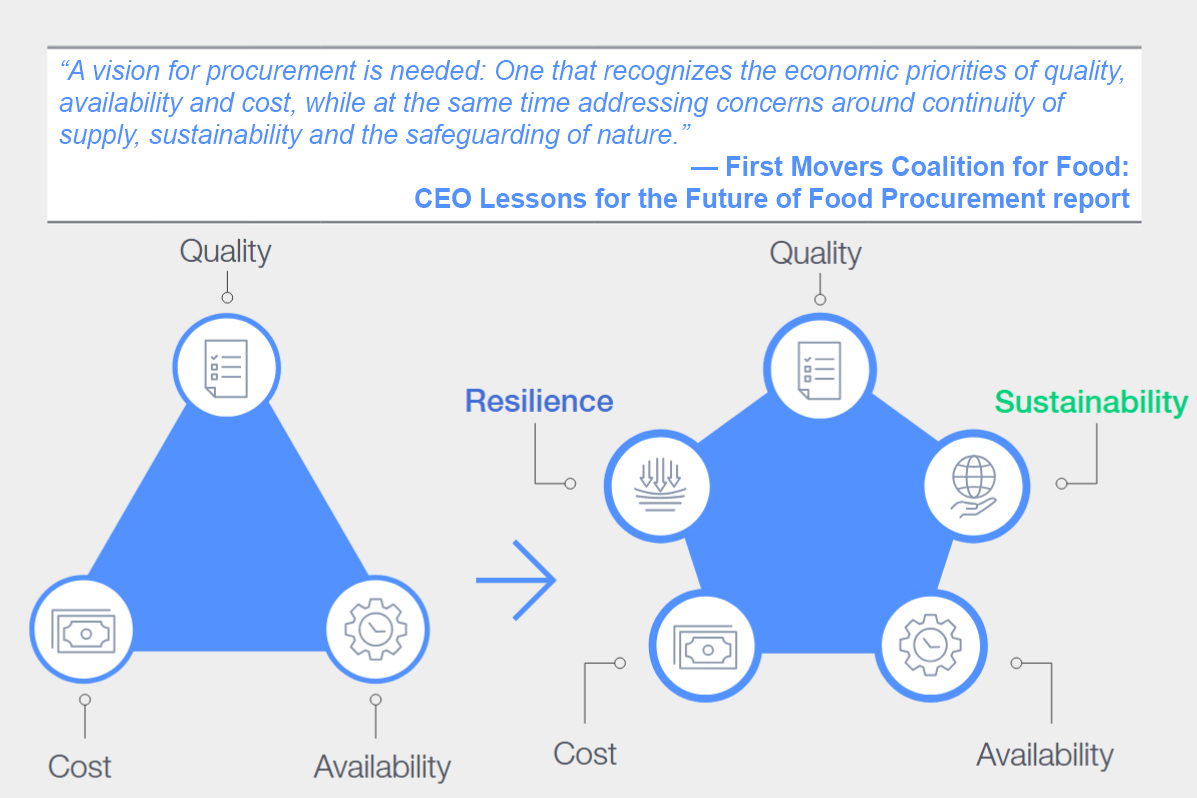
But according to a recent report from the First Movers Coalition for Food, an initiative of the World Economic Forum, procurement also has a role to play in the sustainability of the supply chain. And it’s one that has to change with the times.
“For a century, food supply chains have been feeding a growing global population with unprecedented efficiency. However, they were built to operate in a stable climate, with more predictable costs and consumer demand,” reads the report’s foreward.
But climate is increasingly unstable, and this is causing more frequent food supply chain shocks.
Euan Murray, partner at Bain & Company, which collaborated on the report, points to several examples of this in action in fresh produce. These included the 2021 drought in the southeast U.S. that spiked vegetable prices, the projection that Fusarium wilt tropical race 4 (TR4) could kill off the commercially dominant cavendish banana in the near future and research in Spain showing that water stress in oranges can significantly decrease yields.
“These are issues that are impacting the produce industry today and will be out into the future,” Murray says.
“This is a business opportunity to manage risk, to manage costs, to maintain security of supply and to be able to continue to serve customers,” he adds. “And that’s why we think this should be a priority for produce and the food system as a whole.”
What Produce Procurement Can Do for Sustainability
The report offers two main strategies to build resiliency and sustainability into procurement, efforts that have worked in case studies and according to interviews with chief procurement officers at several global food companies. The report calls these strategies spec-anchored sourcing and decoupled sourcing.
The spec-anchored sourcing strategy involves procurement companies including sustainability requirements in specifications for commodities. The strategy is most applicable in commodities with high dependency on specific growers or low flexibility in production. The report gave the example of hazelnuts, where 70% of global production occurs in Turkey.
“We do see spec-anchored sourcing really all the time in fresh produce,” says Murray, offering the examples of fair trade bananas or Rainforest Alliance-certified mangoes. “The reason they make it to us as shoppers is because those corporates have embedded that requirement in the spec, and that’s what then drives standards back through the supply chain.”
He adds that this strategy works best when procurement companies work directly with growers, commodity groups, sustainability nonprofits and others to help the growers implement the right practices and access financing for it. This makes the individual growers more sustainable and resilient themselves, in turn leading to greater resiliency for the companies that buy from them.
The decoupled sourcing strategy works on a broader, more landscape-level scale, functioning through investment in specific sustainability or resiliency elements within regions where many growers of a commodity can be found. The report gave the examples of soy, rice and wheat, which are grown by many producers across wide swaths of the world.
Murray noted that decoupled sourcing models are newer in produce and seen more often in fruit than in vegetables, though they are growing.
“By investing at that landscape level, [produce procurement companies] know that they’re securing the supply overall and ultimately raising the sustainability profile into the bargain,” he says.
Climbing the Sourcing Maturity Ladder
Though the report gives examples from large, globe-spanning companies, Murray says that the report’s findings can apply broadly to any size of procurement operation.
“The need to operate sustainably and the benefits from building resilience apply to food companies of any size,” he says. “Of course, smaller companies might not have the same level of resources to dedicate to this, and they may not have the same negotiating clout with upstream suppliers and downstream customers, but the flip side to that is that smaller companies often find it easier to innovate and to act nimbly.”
The report also offers a “maturity ladder” with recommended strategies and goals for companies to step up their approaches to increased procurement sustainability and resiliency according to their ability.
The three levels of the ladder are:
- Get the basics right (the pilot stage) — This involves building up baseline data and starting the effort. Examples include updating key metrics and starting collaboration with a current partner.
- Step up performance — This involves moving toward structured initiatives and could involve creating cost-sharing models with supply partners or drawing on external funding opportunities.
- Lead at scale — The report estimates this could be 30% to 50% or more of procurement, is underpinned by partnerships and includes clear demand signals and comprehensive grower support services.
Murray says the report’s findings can bring produce procurement companies three main things: more options in sourcing, improved protections from supply shocks and a better ability to bounce back quickly when supply shocks do hit.
“That’s why we think this should be a priority for produce and the food system as a whole,” he says.