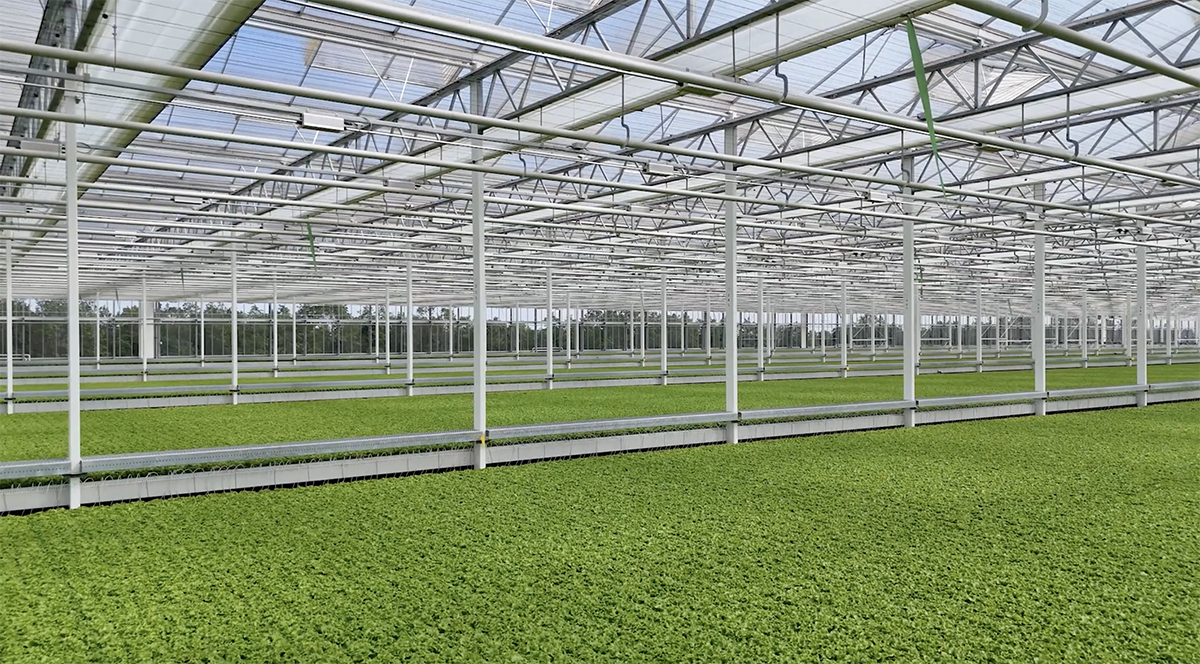
When headlines tying a major cyclospora outbreak to severe illness caused shoppers to retreat from the leafy greens category, Little Leaf Farms CEO and founder Paul Sellew saw an opportunity not just to reassure consumers but also to educate them on a fundamentally different way to grow lettuce.
By taking to social media to detail its indoor farming operations and water safety protocols, Little Leaf doubled its digital following and drove millions of views from Gen Z and millennial shoppers seeking safer alternatives.
The strategy paid off: During a four-week period ending Aug. 8, when the broader packaged salad category contracted 31%, Nielsen data showed Little Leaf's sales grew 6% year over year — offering a striking proof point for controlled environment agriculture's resilience in an era of heightened food safety scrutiny.
Sellew says that while the sensational nature of the outbreak coverage initially drove consumers away from fresh produce altogether, as fear turned to curiosity, Little Leaf Farms seized the moment to highlight what makes its growing practices different.
“When you're equating cyclospora with explosive diarrhea, that does not conjure up great feelings about wanting to eat fresh fruit and vegetables,” Sellew says of this summer's national media coverage. “I think it also sparked a tremendous curiosity among many consumers about wanting to understand the food system better, wanting to understand whether there are alternatives available to them that are safer — that are, in effect, better for them.”
While previous outbreaks like E. coli caused temporary disruption to the produce aisle, Sellew says the cyclospora scare took on a life of its own on social media, creating an urgent need for clear, authentic consumer education. Rather than relying on traditional PR channels, Little Leaf Farms met shoppers directly on platforms like Instagram and TikTok, putting the founder front and center in the greenhouse to tell its story.
“We made the decision for me to get out in the greenhouse and just talk about how we do things,” Sellew says. “I think people react to authenticity today, and that was kind of what we tried to do — just reassure the public that how we grow is so fundamentally different.”
That direct, transparent approach transformed initial consumer anxiety into brand trial, with curiosity bringing first-time buyers to the product and taste keeping them there.
“A lot of people were new to our brand over this sort of curiosity driven by the cyclospora scare,” Sellew says. “It allowed us to have new customers, and if they have a great eating experience, then they'll buy it again. That's the nature of building a great food product — in our case fresh, crunchy, long-lasting leafy greens.”
Consumer response was so strong that over the four weeks ending Aug. 8, the brand reached a record 6.1% share of the national packaged salad category, up from 4% a year ago, according to Nielsen.
Reaching Record Market Share
Little Leaf Farms' record-setting market share wasn't built overnight as a social media viral sensation; rather it's the calculated payoff of 11 years spent strategically expanding its controlled-environment infrastructure to scale capacity.
While much of the traditional leafy greens supply chain relies on shipping product cross-country from the West Coast, Little Leaf's growth model targets high-yield greenhouses strategically situated near major population centers. From its origins in Devens, Mass., with a 10-acre facility; to its 40-acre campus in McAdoo, Pa.; and its newest 20-acre operation in Manchester, Tenn., with the capacity to expand to 80 acres; the company has built regional production hubs designed to dramatically cut distribution times.
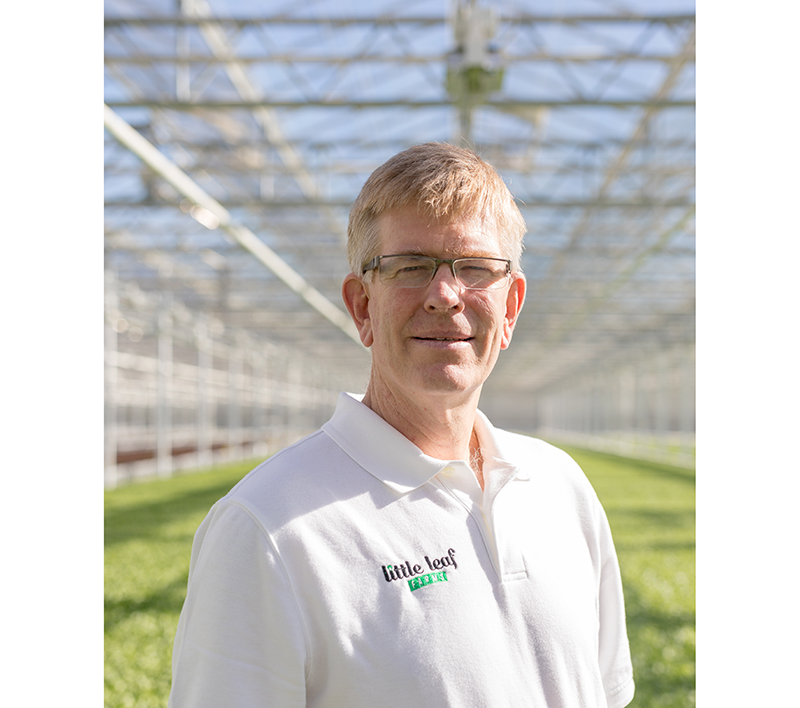
“These are the highest-performing, highest-yielding greenhouses of their type in the world,” Sellew says. “Instead of consumers in the eastern part of the country waiting several days for West Coast product to arrive, just simply by the nature of where we're located geographically, we're able to harvest seven days a week.”
That geographic proximity translates directly into shelf life and freshness, allowing Little Leaf to move product from harvest to distribution channels in just 24 to 36 hours.
“We're able to deliver a fundamentally fresher product, and thereby a better eating experience for the consumer,” he says. “And to my earlier point, they'll buy more.”
With the newly operational Manchester facility already completing its first harvest — marking the largest single build in the company's history — Little Leaf is positioned to capture additional volume just as nationwide demand accelerates.
“We've been investing over the last 11 years in greater capacity, and that's why we're the fastest growing packaged salad brand now in the country,” Sellew says. “So, while we were initially impacted by the cyclospora outbreak, it was by much less than the broader category, and from there the word got out about us, and we've been racing to keep up with demand ever since.”
That expansion translates into an extensive reach across the eastern half of the country, where Little Leaf currently services approximately 8,000 grocery stores alongside a robust foodservice business. With its production network in Massachusetts, Pennsylvania and now Tennessee operational, the brand has created a formidable logistical foundation to fuel its next phase of growth into new territories.
“Now with our Tennessee facility open, we're much better positioned to service the Southeast, and then Tennessee is a short jump to the Midwest market as well,” Sellew says.
Calling All Lettuce Lovers
To capitalize on the surge of online engagement and turn new shoppers into lifelong brand advocates, Little Leaf Farms launched its “Most Loved Lettuce” campaign — a sweepstakes inviting passionate followers to share why they love the brand for a chance to win free lettuce for a year.
Beginning Aug. 26, consumers were invited to visit the “Most Loved Lettuce” sweepstakes webpage and submit a letter, sharing what they love most about Little Leaf Farms. The campaign gives up to 200 fans the chance to win free lettuce for a year. Fifty winners per week will be selected through Sept. 30.
For Sellew, consumer-facing marketing and B2B messaging to retail buyers are two sides of the same coin, anchored by an unassailable supply chain and full operational control.
“Food traceability seems to be a hotter topic now,” Sellew says. “We don't bring anything into our facilities; we're a grower, packer and marketer, and we only then harvest and sell the products we grow in our greenhouses. So, from a traceability standpoint, we're basically beyond reproach.”
That operational confidence provides the foundation for marketing campaigns that engage shoppers on an emotional level while subtly reinforcing the brand's food safety advantages.
“Our marketing team is full of creative ideas, and the latest is this ‘Most Loved Lettuce' campaign,” Sellew says. “We have a lot of passionate brand followers, and so this gives them the opportunity to write us a love letter. ... It's just a clever way to engage and then also to highlight how we grow, which is fundamentally different than the majority of the lettuce you can buy in the marketplace.”
What's Next for Little Leaf
Looking ahead, Sellew sees the category crisis and intense media coverage around cyclospora as a tailwind for CEA. As heightened consumer curiosity drives interest in how produce is grown, Little Leaf Farms is leaning on its strict food safety protocols and aggressive geographic expansion to lead the shift.
“The public has gotten a little bit more curious about lettuce and how it's grown,” Sellew says. “From that standpoint, we're quite confident in our practices. We only use the cleanest and purest rainwater, and everything that comes into our greenhouse is UV disinfected so there's no potential for unwanted biology coming in. It's a highly automated process — no humans come in contact with our product — and harvest is in distribution within 24 to 36 hours.”
To capitalize on that surging demand, Little Leaf is scaling operations, including launching its third site in Tennessee. However, Sellew emphasizes that expanding footprint requires relentless operational discipline.
“I can never emphasize enough the importance of the day-to-day execution of running these high-tech greenhouses,” Sellew says. “Having everyone aligned to ensure the very best product is harvested every day of the year gives our customers consistent quality and freshness. That's my main focus as we scale: hiring and training new teams to guarantee consistent quality. We can never lose that.”
Your next read: Cyclospora Outbreak Fallout: What Produce Brands Need to Know About Retail Recovery





.png)