It's Climate Week in New York City, and for Sara Roversi, founder and president of the Future Food Institute (FFI), an organization and global ecosystem devoted to sustainable food futures, there's no substitute for the strides made when stakeholders meet in person.
“All the activists, scientists, changemakers, innovators, philanthropists, investors in social innovation and so on, come together for Climate Week, and I strongly believe that meeting in person can accelerate [climate action],” says Roversi. “What is also fundamental is that these meeting points help us to build trust, because you cannot build trust through digital meetings.
“You build trust if you start to shake hands, hug people, see people in the eyes, and make commitments,” she continues. “And this is happening here this week in New York. So, it's very important to be here.”
Climate Week NYC, Sept. 21-28, is the world's largest climate gathering outside of the Conference of the Parties (COP), and organizers say this year's theme, “Power On,” is a call to continue to drive progress.
“What I've found here at Climate Week, is that people want to be part of the change. They want to be part of the solution,” says Roversi.
With offices, living labs, innovation hubs and ambassadors around the world, the Bologna, Italy-based non-profit Future Food Institute seeks to be part of the solution through its three main pillars: education, community development and innovation.
Founded in 2014, FFI has long participated in Climate Week, but Roversi says this year the organization's involvement is amplified.
“Future Food Institute started many years ago with the ambition of nudging food system transformation — seeing food really at the epicenter, the nexus between humans and nature,” she says. “It's what represents our identity, history and culture. At this year's Climate Week, we are connecting all of those dots.”
Connecting the dots includes presenting Future Food Institute's efforts that align in education with its academy; work it's doing within communities from marginal and rural areas to urban centers; and “also showcasing how much public-private collaborations can really spark innovative solutions,” she says.
The Power of Food
Gastronomy is central to the non-profit's efforts, as Roversi sees food as a lever for climate action and “a super powerful, positive weapon that we all have in our hands.”
She also says the power of food is often underestimated.
“Food is a global language and a driver for global economic prosperity,” she says. “Food is also a catalyst for change. So how do we face the urgent issues of creating a more sustainable future of food while understanding technology's role in closing the gaps in our food system? The key is knowledge and education, the cornerstones of innovation.”
At Climate Week NYC, Future Food Institute has been presenting several of its projects, including one that looks at the connection between where food and water comes from and human health.
“We're looking at everything — creating the correlation with the soil to where the food comes from, as well as how much fresh food you're eating, how much food in season you're eating, and trying to understand what are those parameters that are at the end of the game impacting on our health,” she says.
The goal, says Roversi, is to create a kind of “algorithm of longevity,” a platform that can support policy and decision makers to understand the health costs of its future citizens.
“If we see that eating fresh food is going to impact positively on human health, and we know it, we know it clearly, then we have to start to invest in the infrastructure to target human health. So, [the fresh produce] sector is absolutely fundamental.”
Roversi also says it's more important than ever to be at Climate Week because we're in a unique time in history.
“It's a unique time given the complexity at the global level, in terms of the geopolitical situation, the human, social, spiritual crisis, the environmental crisis and the political crisis,” she says. “It's a time in history where we see lots of different conflicts that are reshaping the equilibrium of the planet.
“If you're thinking about food, food security, procurement — and we know the complexity of the food system — it's very important to be here and talk about food.”
And she sees fruits and vegetables as critical to the global food system.
“[Produce] plays a critical root and role in the future of food because fruits and vegetables are nutritious and feed the world. I strongly believe that your sector is going to play the most important role in the future.”
Technology and the Future of Food
While Roversi says she's “a strong supporter of AI and technology” in agriculture, she eyes it with caution.
“With AI and any kind of tech solution, I'm very afraid that we're going to grow a dumb society, if we're not able to work with and invest in the infrastructure around AI in a way that makes humans more creative, more conscious, more empathetic and uses AI in the proper way,” she says. “I think that in food, this is absolutely fundamental, because when we're talking about food, we're talking about human health and we're talking environmental health. So, it's important to empower people to make much more thoughtful decisions when they're thinking about food.”
A Global Initiative
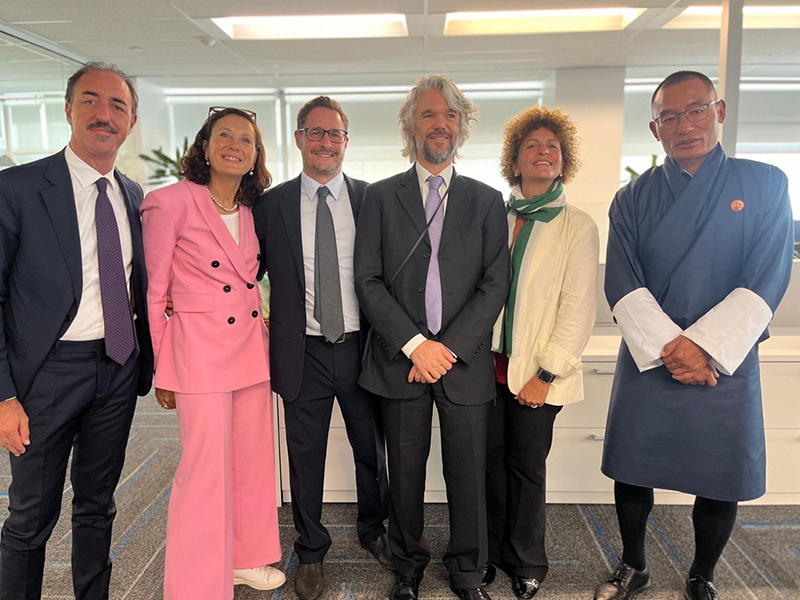
Beyond Climate Week NYC, Future Food Institute participates in climate-related events around the globe including Venice Climate Week.
“Venice is a place that itself represents fragility and beauty and resilience, because we know that sea level rising in a city like Venice is something that you can touch every single day,” she says.
The institute is also actively involved in promoting the Mediterranean diet, which Roversi says is much more than supporting a planet-friendly diet — it means embracing a balanced and holistic way of life.
“We see the power of gastronomy as a very important pillar of our set of cultural heritages,” she says. “So, we are also managing the permanent secretariat of UNESCO for the Mediterranean diet, and we were here also presenting our summit that is going to take place in Italy in November, and we are celebrating the 15th anniversary of the Mediterranean diet as a UNESCO Intangible Cultural Heritage of Humanity.”
At Climate Week, FFI is also meeting with its project partner Tokyo Tatemono. Together the organizations are building a sustainable food ecosystem in the Kyobashi area of Tokyo known as Tokyo Living Lab.
“They are strong believers in a regenerative economy,” she says. “Basically they don't have agriculture there because they are in one of the most crowded places in the world…We are working with them on designing a strategic initiative advocating for regenerative models in cities that can really create an alliance with the agricultural area around major cities.”
What does Climate Week NYC's theme mean to Roversi and Future Food Institute?
“I think that empowering human development is the starting point and when we think about powering on, it's about rethinking the models, rethinking the KPIs, rethinking the system, rethinking the way we are building partnerships,” she says. “For Future Food Institute our identity is [based on] pioneering. We have always put ourselves out there as a pilot, as a trial. We are a kind of a fab lab of systems. We are hackers. We are always acting in this way, and powering on.
“And we always put ourselves in the system saying, ‘come on board, and let's change the world together,'” she says.