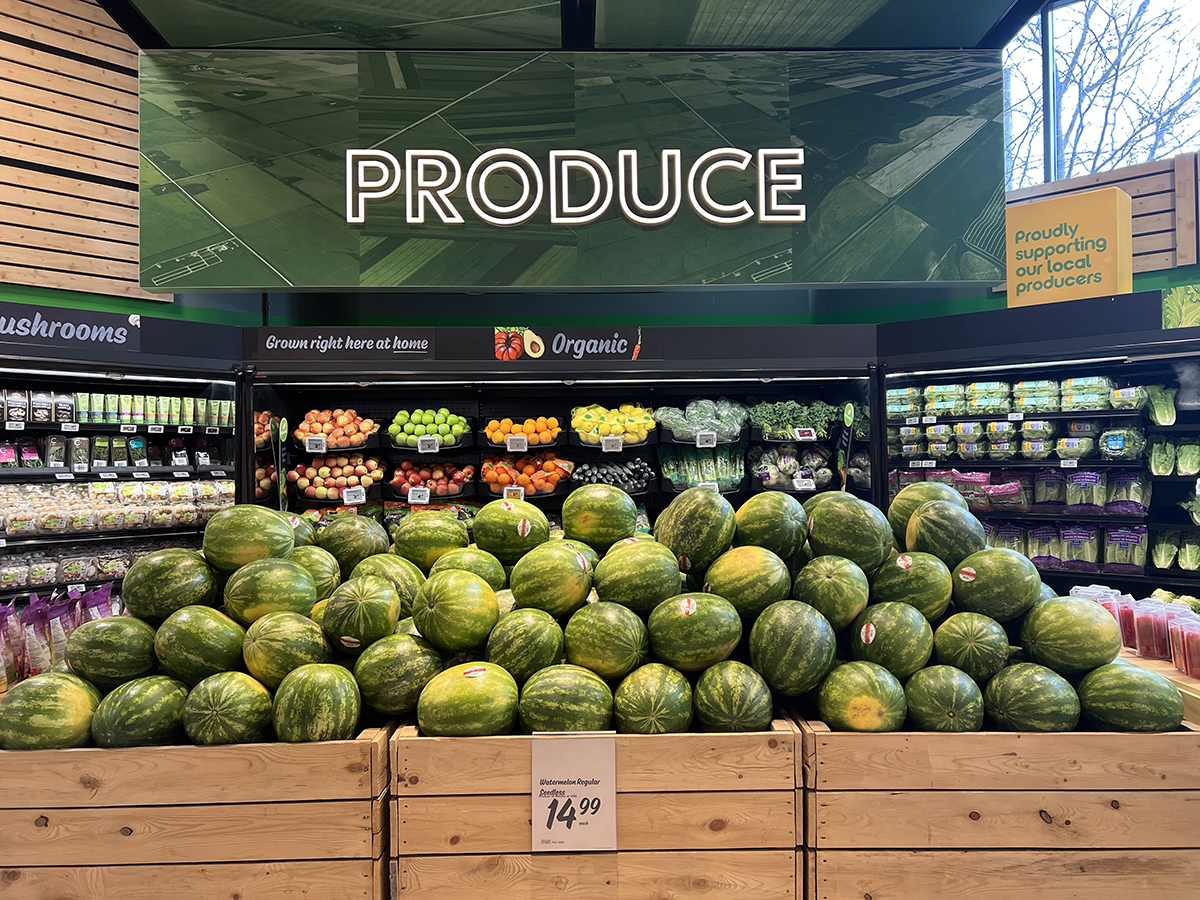
TORONTO — As part of the 2026 Canadian Produce Marketing Association Conference and Trade Show, attendees had the opportunity to tour some of Ontario's leading grocery retailers April 28, where anti-American sentiment continues to linger across the produce aisle and store.
Spurred by the Trump administration's 2025 implementation of sweeping tariffs and ongoing threats of making Canada the 51st state, many Canadians have pivoted toward a “buy domestic” movement, replacing American goods with Canadian alternatives as both a personal form of economic retaliation and a statement of national sovereignty.
The CPMA city retail tour first took attendees to a Longo's grocery store at the Leaside Village shopping complex. Formerly a locomotive maintenance shop for Toronto's railway system, the site is now a stunning grocery store with soaring ceilings, some of the highest sales among the company's network of 43 stores and a destination produce department that sells 6,000 to 7,000 fresh-squeezed orange juices from the produce department each week alone.
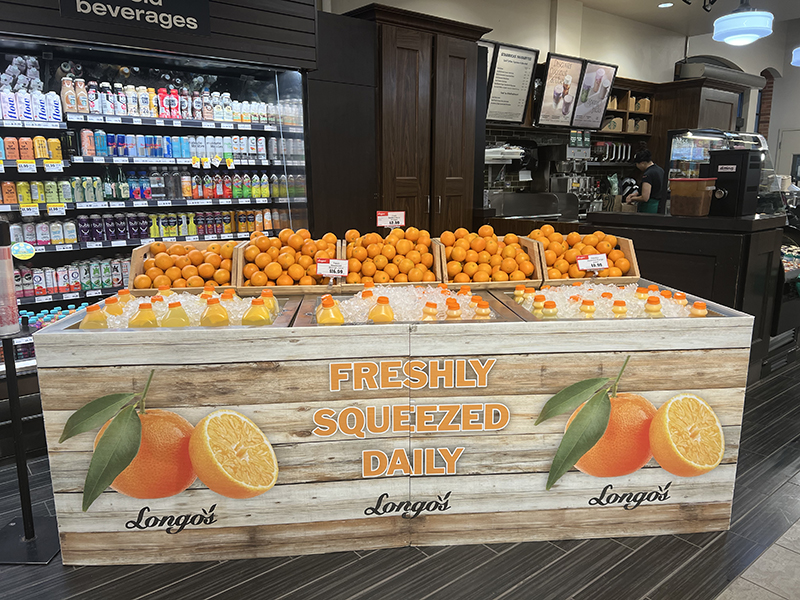
“I like to think we're the best produce department in Toronto,” says Edward Vandergriend, assistant department manager.
On the day of the CPMA tour, Longo's featured a prominent Foodland Ontario's “Good Things Grow in Ontario” display of greenhouse-grown produce. The campaign, launched in 1977, is a long-standing initiative by the Ontario Ministry of Agriculture to promote local food consumption. Retail stores with the best display of local goods can win a prize.
Vandergriend says while shopper sentiment has softened slightly on U.S.-grown produce, his customers' first choice is Canadian-grown.
“We have a big push on greenhouse-grown produce and a huge push on Canadian-grown and local produce,” says Vandergriend.
But the realities are that Longo's also needs to supplement its shelves with U.S.-grown produce that's more competitively priced than domestically grown.
“My motivation is to sell more product,” says Vandergriend. “The customer shift to ‘Do you have anything other than American' is ongoing, and we still have customers asking for Canadian product, but we want to offer savings as well. The U.S. is a huge producer. We want to offer good pricing to our customers, and sometimes that means American partnerships.”
The U.S. also grows certain produce items, like citrus, that don't grow in Canada.
“We need to balance local product with savings and supply that come from U.S. produce,” explains Vandergriend, who says he's hearing about some U.S. businesses — not just in produce, but across food and beverage — now struggling because they no longer sell to Canada.
Vandergriend breaks down how this plays out in the salad category, for example. He says Longo's Leaside Village location used to sell Canada's GoodLeaf Farms vertically grown lettuce in a 4-foot space. As demand has intensified for Canadian-grown greens, the retailer has bumped up the display to 8 feet. However, price and availability can be compelling selling points, and Longo's store brand of lettuce is a U.S.-grown product.
During the CPMA retail tour, the Longo's greens were on sale, which “still moves the product,” says Vandergriend.
“Arugula from the U.S. is selling well because there's only an American option,” he adds. “Shoppers will buy American if there's no other choice.”
It's a similar story at Loblaws' Maple Leaf Gardens 85,000-square-foot flagship store, which uses Canadian maple leaves on store signage to draw attention to domestic produce.
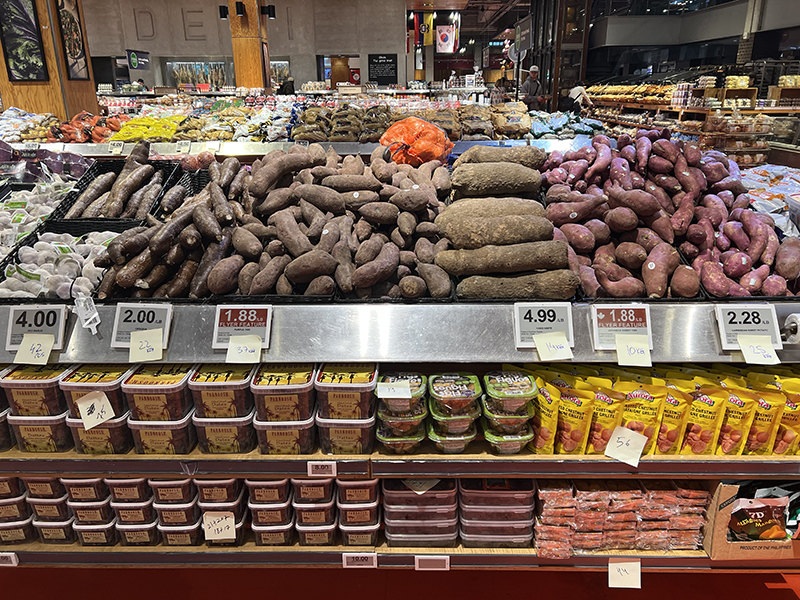
“Our shoppers still don't like to see American products, and while price point and affordability come into play, our customers are not shy about telling us what they want and what they don't,” says Deneth Kahadawala, store manager. “The anti-American sentiment is still going strong.”
And at Sobeys' Queensway Flagship store, Dionne McCready, manager of retail operations for Ontario, says there's a big focus on local.
“In Ontario, and the GTA [Greater Toronto area] especially, shoppers are very vocal about wanting local with the things going on in the world,” she says.
As a result, Sobeys emphasizes locally grown and Ontario greenhouse-grown in POS throughout the produce aisle.
The theme continued on the show floor, where a Produce Trends business session April 29 featured intelligence from Francis Parisien, senior vice president for NielsenIQ Canada, who says 54% of Canadians report trying to eat more domestic products and visit local businesses. Additionally, NIQ finds that 42% of Canadians, while aiming to avoid U.S. products, will buy American-grown if there's no Canadian alternative.
Can a USMCA Renewal Repair North American Produce Trade, Consumer Sentiment?
Another education session at the 2026 CPMA show explored the Canada-United States-Mexico Agreement (CUSMA), or United States-Mexico-Canada Agreement (USMCA), as it approaches its high-stakes, six-year review on July 1.
The panel, moderated by Jim DiMenna of Red Sun Farms, presented compelling perspectives on the subject. Featured speakers included Richard Lee of Ontario Greenhouse Vegetable Growers; Dave Puglia of Western Growers Association; Richard Schouten of The Netherlands' Fresh Produce Centre; and Fernando Cruz of Grupo Comercial Terroir del Valle.
During the discussion, Puglia, WGA president and CEO and a co-chair of the Specialty Crop Farm Bill Alliance, said Canadian consumer backlash on U.S. produce items has impacted U.S. specialty crop growers' bottom line.
In a follow-up interview with The Packer after the session, Puglia said the extent to which U.S. produce companies are impacted by anti-American sentiment in Canada depends on which commodities you grow.

“Canada has well-developed production of certain things that are also produced in California. For Canadian retailers with consumer sentiment running in the direction it is, there is at least an opening to buy more Canadian produce over California-grown produce,” says Puglia. “If it's the same item and the quality is roughly the same, but there may be a price premium, because California operates at a high level of efficiency. It all depends on which category we're talking about.”
But Puglia is also quick to point out that a number of fruits, vegetables and tree nuts are not produced commercially at scale in Canada as they are in California and Arizona.
“As Canadian retailers look to source and feel the pressure from their customers to not have American produce on the shelves, it still might be hard to find alternatives — just given the sheer volume that comes out of the Western U.S. at a very high level of consistency and quality.”
Puglia says growers in the West are feeling the pushback on American products.
“I think it's dangerous to paint with too broad a brush, but certainly we've heard the [anti-American] sentiment reflected back to our members from Canadian retailers,” he says. “So, it's there. I haven't any doubt about that.
“The commercial tethers between the two countries, all depending on what crop we're talking about, are stronger in some cases, and in other cases, not as strong. And maybe there are tethers that can be created somewhere else,” he continues. “Some of the OVGA members have an opportunity to jump into an opening. But as Richard [Lee] said, they also export a very large amount [85%] of what they grow in Ontario to the U.S. So, this is really complicated stuff.”
Puglia says USMCA has created commercial networks that have evolved over decades “for all the right reasons.”
“We have a situation that is uncomfortable and unfortunate and unwanted in terms of tone and rhetoric, but that alone doesn't dismantle a decadeslong constructed commercial network,” he says. “It can break some of the linkages, but they may be re-linked in a different way. I think the salve to this wound is perpetuation of USMCA as it relates to the fresh produce industry, and again, possibly with some changes.”
Puglia advocates for the continuation of the USMCA as the primary framework for the produce industry, though he suggests specific enhancements to strengthen the agreement. His primary concern lies in the disparity between food safety inspection rates for domestic products versus Mexican imports. To protect the industry from categorywide market collapses following illness outbreaks, he proposes that the USMCA mandate greater diligence from the FDA and stricter adherence to the Foreign Supplier Verification Program.
In addition to safety standards, Puglia calls for “more cement” around labor provisions, specifically demanding that Mexico improve its diligence in enforcing agreed-upon labor standards. By tightening these rules, WGA aims to ensure a more level playing field for American growers who operate under different regulatory costs.
Finally, Puglia distinguishes his position from more protectionist groups, such as the Florida Fruit and Vegetable Association, which has called for tariff-rate quotas. While acknowledging the Trump administration's protectionist leanings, he remains optimistic that the core merits of the USMCA's produce provisions are strong enough to stand on their own without resorting to extreme trade barriers.
“I don't know where all of this is going to land, but I do think at the end of the day — and this could be silly optimism — but I really do think at the end of the day, the success of the fresh produce aspects of USMCA stand on their own,” says Puglia. “I think that is an entirely defensible construct that will be renewed — possibly with some changes — but a tariff-free movement of fresh produce between the three countries fundamentally renewed.”